
Finding the right age-appropriate activities for 2-year-olds in daycare is not just about keeping children busy. Every activity either builds a skill or misses the opportunity to do so.
Here is what this guide covers:
A 2-year-old’s attention span runs between 4 and 6 minutes per activity. Their fine motor skills are still forming, emotional regulation is limited, and curiosity is at its peak.
Research from First Things First confirms that children form over 1 million new neural connections per second in the early years.
Every sensory moment, every guided interaction, and every peer experience feeds that growth directly.
The practical challenge for many daycare providers is knowing what “just right” actually looks like.
| Activity Type | Too Advanced Signs | Too Simple Signs | Just Right Indicators |
| Sensory play | Child gets frustrated or shuts down | Child disengages within 30 seconds | Child explores, repeats, and stays curious |
| Sorting and matching | Too many categories, child gives up | Only 2 objects, no challenge at all | 3 to 4 options, child stays engaged |
| Group activity | Child cannot follow along at all | Child finishes instantly and searches for something else | Child participates and responds to peers |
| Physical activity | Requires coordination beyond current ability | No physical challenge present | Child tries, sometimes fails, and keeps going |
Set up a tray with two or three cups of different sizes and a small amount of water. Children pour, fill, and empty at their own pace.
This builds cause-and-effect thinking, fine motor control, and early understanding of volume, all while keeping toddlers deeply focused for longer than most activities at this age.
Fill a shallow bin with kinetic or regular sand and add spoons, small cups, and a toy or two. Children scoop, pour, and bury objects freely.
The tactile input supports sensory processing and emotional regulation, and because there is no right or wrong way to do it, even the most hesitant child usually engages within a few minutes.
Collect small swatches of different fabrics (smooth, rough, fluffy, bumpy) and place them in a basket. Ask children to touch each one and group them however they like.
This builds tactile awareness, early sorting logic, and language as children start reaching for words to describe what they feel.
Place colored cups or bowls on a table and give children a mix of objects (blocks, pom-poms, or buttons that are not a choking risk) to sort by color.
It trains early classification thinking, hand control, and focus. Start with two colors and increase only when the child is ready.
Simple as it looks, stacking and nesting activities develop spatial reasoning, grip strength, and persistence. Children this age will stack, knock it down, and start again, and that cycle is exactly where the learning lives.
Tear strips of colored paper and press them onto a piece of contact paper or a glue sheet. No scissors, no instructions. Children develop pincer grip, hand strength, and creative confidence while producing something they are genuinely proud of.
Set up a short path in the room or outdoors and call out different animals: “Bear crawl to the blue mat, then frog hop to the wall.”
This builds coordination, body awareness, and listening skills all at once. It also burns energy in a structured way that helps children regulate better for the activities that follow.
Give children a balloon each and challenge them to keep it off the ground. It looks like a game but it is building tracking, hand-eye coordination, spatial awareness, and reaction time.
Safe for indoor use, no equipment needed, and almost universally loved at this age.
A fabric play tunnel gives children a chance to practice crawling, spatial navigation, and proprioception (their sense of where their body is in space).
Add a soft toy at the end as motivation. Short, repeatable, and easy to set up in almost any daycare room.
Give each child a simple picture card (an animal, fruit, or household object) and take turns naming what is on it. Encourage children to repeat the word back and describe what they see. Builds vocabulary, turn-taking, and early conversational structure.
Songs like “If You’re Happy and You Know It” or simple clapping rhymes build phonological awareness, listening skills, and body coordination at the same time. Repetition is a feature, not a flaw. Hearing the same song multiple times helps children internalize language patterns faster.
Read a simple picture book and stop regularly to ask: “What is that?” or “Where did the dog go?” This turns passive listening into active language practice. Children at this age are capable of pointing, naming, and predicting when given the right prompts at the right pace.
Children sit in a circle and pass a beanbag around, one at a time. Simple, structured, and surprisingly effective for building turn-taking, patience, and group awareness. You can add variations like passing it under the leg or above the head when the group is ready.
Set up a small home corner with safe props (plastic cups, soft toys, a toy phone) and let children play freely within it. Role play at age 2 is where language, empathy, and social awareness all come together.
The educator’s role here is to observe and gently extend the narrative with a question or a suggestion, not to direct it.
Play music and when it stops, everyone freezes. This builds gross motor skills, body control, listening, and self-regulation in one activity.
It also transitions energy levels effectively when you need to move a group from high to calm without conflict.
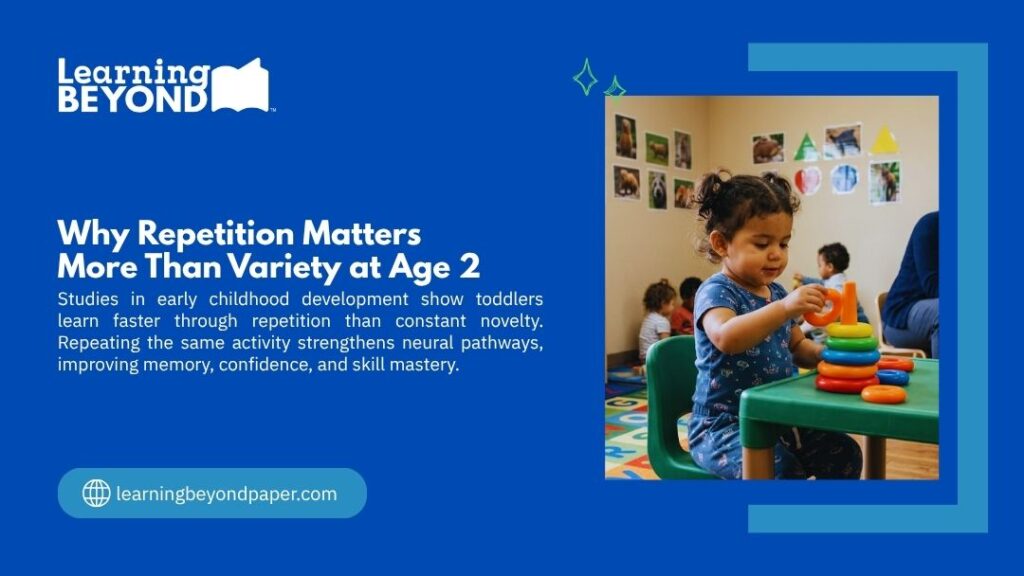
At this age, every activity should build something, even if it looks like simple play.
A strong developmentally appropriate curriculum for toddlers does not rush academic milestones. It creates conditions where the right skills develop at the right time, across four core areas.
| Skill Area | What It Looks Like at Age 2 | Example Activity |
| Fine Motor | Grasping, stacking, scribbling | Block play, simple peg puzzles |
| Gross Motor | Running, climbing, balancing | Obstacle paths, ball rolling |
| Language | Naming objects, 2-word phrases | Singing, picture card games |
| Social and Emotional | Beginning to share, expressing feelings | Group play, simple role play |
Fine motor development at this stage focuses on strengthening the small muscles of the hands and fingers. Stacking blocks, completing simple puzzles, and pressing soft clay are all building the hand-eye coordination children will eventually need for writing.
Good fine motor activities for daycare:
Running, jumping, and climbing might look like chaos. For 2-year-olds, it is development happening in real time.
A meta-analysis published in Frontiers in Public Health found that structured gross motor activities produced large, measurable improvements in locomotor skills and physical coordination in young children.
Activities worth including regularly:
By age 2, most children can say at least 60 words and begin forming two-word phrases. By age 3, that number rises to over 200 words.
Toddlers who receive consistent verbal interaction know around 300 more words by age 2 than those who do not.
Songs, naming games, and picture card activities are not time-fillers. They are the primary engine for language acquisition at this stage.
Two-year-olds are just beginning to play interactively with their peers. They are developing self-awareness and learning that other people have feelings too.
Circle time for preschoolers provides a low-pressure group setting where children practice taking turns, listening, and responding at the same time.
When building a lesson plan for toddlers in daycare, the goal is a consistent rhythm that moves between active and quiet, guided and free, individual and group.
| Activity Type | Purpose | Duration | Group Size |
| Sensory exploration | Tactile and cognitive development | 10 to 15 min | 1 to 4 children |
| Gross motor play | Physical development, energy regulation | 15 to 20 min | Full group |
| Fine motor task | Coordination, focused attention | 8 to 12 min | 2 to 5 children |
| Group language activity | Communication, social learning | 10 to 15 min | Full group |
| Free play | Independence, creativity | 15 to 20 min | Full group |
A full day of high-energy play leads to meltdowns. Alternating between active sessions like dancing and outdoor play, and quieter tasks like puzzles and drawing, keeps children regulated and ready to engage the next time.
Signs a group needs an energy shift:
The ideal activity window for 2-year-olds sits between 5 and 15 minutes. Pushing past that means the activity is running for the educator, not the child.
Signs it is time to switch:
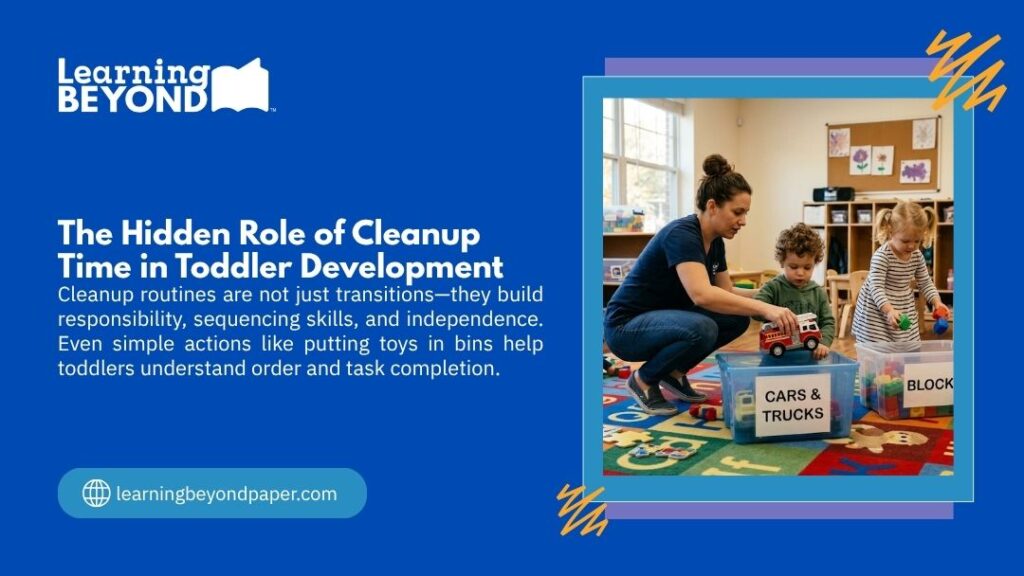
Both types of play belong in the daily plan. Guided play means the educator introduces a clear purpose: “Let us sort these blocks by color.” Free play means stepping back and letting children explore on their own terms.
A workable balance is roughly 60% guided and 40% free. This keeps learning intentional without removing the child’s natural drive to discover things.
| Time | Activity | Purpose | Energy Level |
| 8:00 to 8:30 | Arrival and free play | Transition, self-settling | Low |
| 8:30 to 9:00 | Circle time (songs, greeting) | Language, routine building | Low to medium |
| 9:00 to 9:30 | Sensory or fine motor station | Skill development | Low to medium |
| 9:30 to 10:00 | Outdoor or gross motor play | Physical development | High |
| 10:00 to 10:20 | Snack and group conversation | Language, social skills | Low |
| 10:20 to 10:50 | Guided group activity | Cognitive and social development | Medium |
| 10:50 to 11:15 | Free play | Creativity, independence | Medium |
| 11:15 to 11:30 | Story time and wind-down | Language, emotional regulation | Low |
A calm start lowers the transition stress that many 2-year-olds bring from home. Free play on arrival gives children space to settle in on their own terms.
Following it with a structured circle gives the day a clear, predictable opening that most children at this age find genuinely reassuring.
This is your window for the most intentional activities. Children are alert, regulated, and more receptive than at any other point in the day. Sensory stations, fine motor tasks, and guided group play all sit well here.
Keep it quiet and predictable. Story time, soft music, or gentle free play help children transition toward rest or pickup without an energy spike that is hard to bring back down.
| Mistake | Why It Happens | Better Approach |
| Overcomplicating activities | Educators feel pressure to be creative or impressive | Start with the simplest version; add steps only when children are clearly ready for more |
| Expecting too much too soon | Milestones are misunderstood or compared across children | Base expectations on the individual child, not the group average for that age |
| Ignoring individual differences | Group planning makes one-size-fits-all easier to manage | Offer two versions of the same activity at slightly different difficulty levels |
| Prioritizing busy work over learning | Pressure to fill time or appear productive | Ask what specific skill the activity builds before adding it to the rotation |
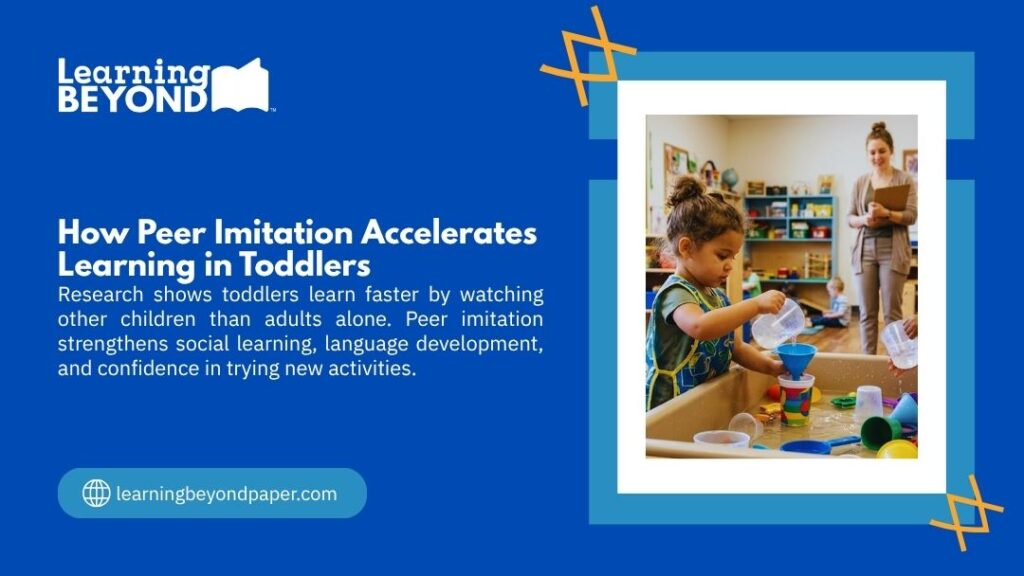
Age-appropriate activities for 2-year-olds in daycare are those matched to their developmental stage across motor, language, social, and cognitive areas. Activities that consistently work at this age include:
Between 5 and 15 minutes is the recommended window. If a child is still engaged after 15 minutes, there is no need to interrupt. The key is not letting an activity run past the point where engagement drops for most of the group.
Both are necessary. Free play builds creativity, independence, and self-regulation. Structured activities develop specific skills that free play alone does not consistently cover. A balanced daycare day includes both in rotation, not one at the expense of the other.
At this age, children should be building fine and gross motor skills, early vocabulary and communication, basic social abilities like sharing and taking turns, emotional recognition, and sensory processing.
If a child repeatedly gives up, shows frustration within the first minute, or cannot engage with the activity at all, it is likely too advanced. Activities that are right for the age allow children to try, sometimes fail, and keep going with minimal support from the educator.
Learning Beyond Paper has already supported over 160,000 children across more than 3,000 schools, with a curriculum built specifically for early childhood educators who want every activity to count.
Each resource connects directly to developmental goals across motor, language, social, and cognitive domains. Whether you are refining your current activity rotation or building a structured program from the start, the tools are ready when you are.Book a free demo today and see how Learning Beyond Paper supports real learning in real classrooms.