
Having solid weekly lesson plan ideas for infants in childcare is one of the most impactful decisions you make for the children in your room, and for your own planning confidence each week.
This guide covers the five developmental domains every infant plan should address, activity ideas grouped by age, a step-by-step planning structure, and an honest look at what strong infant planning looks like compared to weak planning in real classrooms.
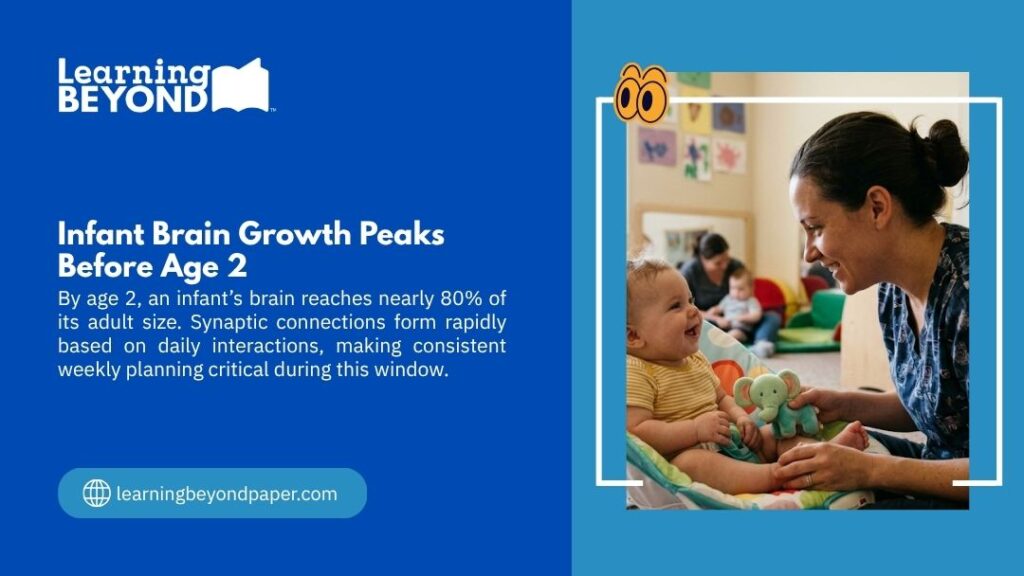
Research published in Nature Neuroscience found that brain growth is fastest in the first 1,000 postnatal days, making early experiences more formative than at any other point in life.
Infants are not waiting to start learning. They begin processing the world from the first day you meet them.
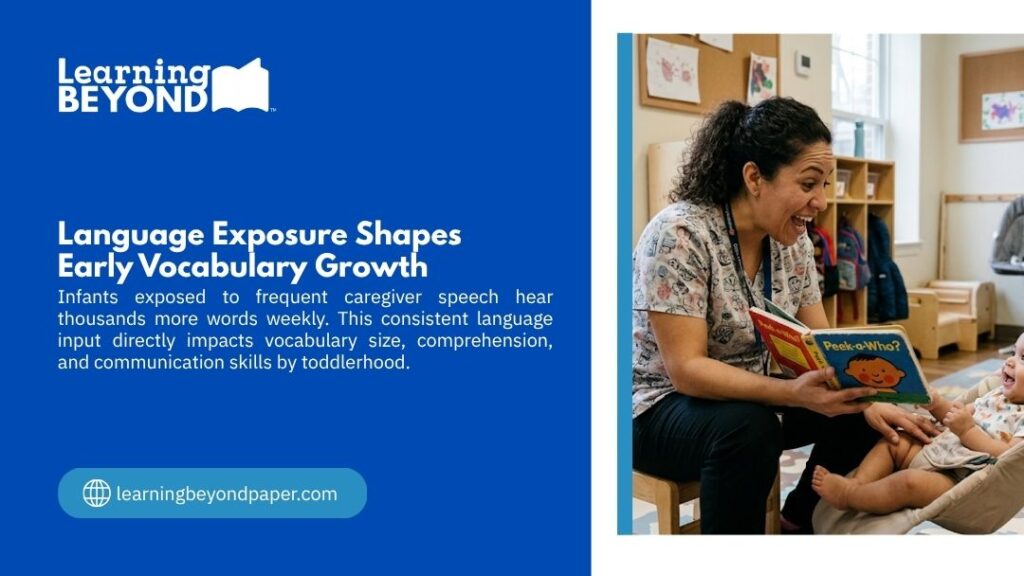
Talking to babies frequently, for example, results in children knowing around 300 more words by age 2 compared to those spoken to less often, according to Zero to Three.
That difference does not happen by chance. It comes from intentional, language-rich interactions built into the daily routine.
| Common Reason Planning Gets Skipped | The Real Impact on Infants |
| “They’re too young to benefit” | Critical sensory and language windows go unsupported |
| “I don’t know what’s age-appropriate” | Activities that miss the developmental stage entirely |
| “It takes too much prep time” | Licensing gaps and inconsistent experiences across the week |
| “Responsive care is enough” | No developmental framework guiding daily interactions |
A 2025 Procare Solutions industry report found that 34% of early childhood teachers spend between 3 and 5 hours per week on lesson planning. That time is already being invested. The goal is to make sure it produces something useful.
If you are newer to infant curriculum design, how to create a lesson plan for toddlers in daycare offers a strong foundation for understanding planning logic before applying it to the infant stage.
Strong weekly lesson plan ideas for infants in childcare are built around developmental intent, not just activity variety. Every activity in your plan should connect to at least one of five core areas.
| Domain | What It Develops | Simple Example Activity |
| Cognitive | Object permanence, cause and effect, problem-solving | Peek-a-boo, hiding toys under a cloth |
| Language | Listening, early comprehension, babbling | Reading aloud, narrating daily care routines |
| Gross Motor | Strength, rolling, sitting, crawling | Tummy time, supported reaching exercises |
| Fine Motor | Grasping, reaching, hand-eye coordination | Soft rattles, textured objects to handle |
| Social-Emotional | Attachment, trust, early emotional regulation | Consistent caregiver responses, sustained eye contact |
One well-chosen activity often covers two or three domains at once. Tummy time on a textured blanket while a caregiver sings a familiar song addresses gross motor development, sensory input, and language all in the same five minutes.
For a clear picture of how these same five domains progress into the toddler stage, what is a developmentally appropriate curriculum for toddlers covers the developmental arc in a way that makes infant planning feel more connected to the bigger picture.
Not every infant in your room is at the same developmental stage, and one plan rarely serves all of them equally.
Grouping your weekly lesson plan ideas for infants in childcare by stage makes each activity more purposeful and your weekly observations far easier to act on.
Infants at this stage are absorbing the world through their senses. Every routine interaction is a learning moment, whether it is recognized as one or not.
Activities that work well this week and the next:
| Activity | Domain Focus | Suggested Duration |
| High-contrast card tracking | Cognitive, Visual | 2 to 3 min |
| Tummy time on texture mat | Gross Motor, Sensory | 3 to 5 min |
| Caregiver narration | Language | Throughout the day |
| Repeated lullabies | Language, Social-Emotional | 3 to 5 min |
| Textured object exploration | Fine Motor, Cognitive | 3 to 5 min |
Infants in this range begin initiating interactions rather than just responding. Mobility is increasing rapidly, and curiosity follows closely behind.
Rotate these across the week:
| Activity | Domain Focus | Suggested Duration |
| Supported sitting with reaching | Gross Motor, Fine Motor | 5 to 7 min |
| Object permanence games | Cognitive | 5 min |
| Mirror play | Social-Emotional, Cognitive | 3 to 5 min |
| Action songs | Language, Gross Motor | 3 to 5 min |
| Sensory bin exploration | Fine Motor, Cognitive | 5 to 10 min |
For activity ideas that bridge this stage forward naturally, structured activities for young toddlers 12-18 months picks up exactly where this age group ends.
Most infants at this stage are pulling to stand or beginning to walk. Language is expanding quickly. Your weekly lesson plan ideas for infants in childcare at this stage should reflect that growing independence and the need for more interactive, choice-based activities.
Strong options to include:
For more detailed activity breakdowns at this stage, age appropriate activities for 2 year olds in daycare offers a practical continuation of the same developmental framework.
Having the right activities is only half the work. Organizing them into a structure that holds across a real week is what makes infant planning sustainable.
| Planning Step | Purpose | Realistic Time Needed |
| Choose 2 to 3 weekly activities | Depth over constant variety | 10 to 15 min |
| Assign developmental domains | Ensure balanced weekly coverage | 5 min |
| Map to daily schedule | Fit activities into real classroom routines | 5 to 10 min |
| Document child responses | Inform and improve next week’s plan | 5 min per child |
For educators thinking about how infant planning fits into the broader curriculum structure, what a preschool should curriculum include shows how early infant planning connects to the full arc of early learning.
Knowing what quality planning actually looks like makes it easier to assess your own approach with honesty.
| Strong Weekly Infant Lesson Plan | Weak Weekly Infant Lesson Plan |
| Activities tied to a specific developmental domain | Activities chosen without a clear learning goal |
| Age-grouped for the different infants in the room | Same plan applied to all ages regardless of stage |
| Balanced coverage across all five domains each week | Heavy on sensory, light on language or social-emotional |
| Adjusted weekly based on individual child responses | Unchanged from week to week without review |
| Shared with families to reinforce learning at home | Kept internal with no parent communication |
A 2025 meta-analysis reviewing 17,913 children found that process quality in early childhood care is a significant predictor of social and emotional development all the way to age 18.
Weekly lesson plan ideas for infants in childcare are not administrative boxes to tick. They are the mechanism through which process quality is actually delivered.
Research from Brookings also found that high-quality early care narrows the school achievement gap by half, with lasting effects on graduation rates and long-term outcomes only visible in children who received two or more years of quality care.
Planning is what makes that quality consistent.
Thinking about moving away from paper-based planning entirely? Our guide on how to transition from paper curriculum to digital in childcare walks through what that shift looks like in real infant and toddler classrooms.
Responsive caregiving and intentional planning work together, not against each other. A plan gives you a structure for offering developmentally appropriate experiences throughout the week. How those experiences are delivered in the moment is exactly where responsiveness comes in.
Weekly updates work well for most infant rooms. Small adjustments based on what each child responded to during the previous week keep plans relevant without adding significant prep time to your schedule.
Some of the strongest sensory activities require almost no materials. Crinkle paper, textured fabric swatches, a shallow water bin, and basic sound-making objects all deliver meaningful sensory input with minimal setup. The activity is less important than the caregiver engagement around it.
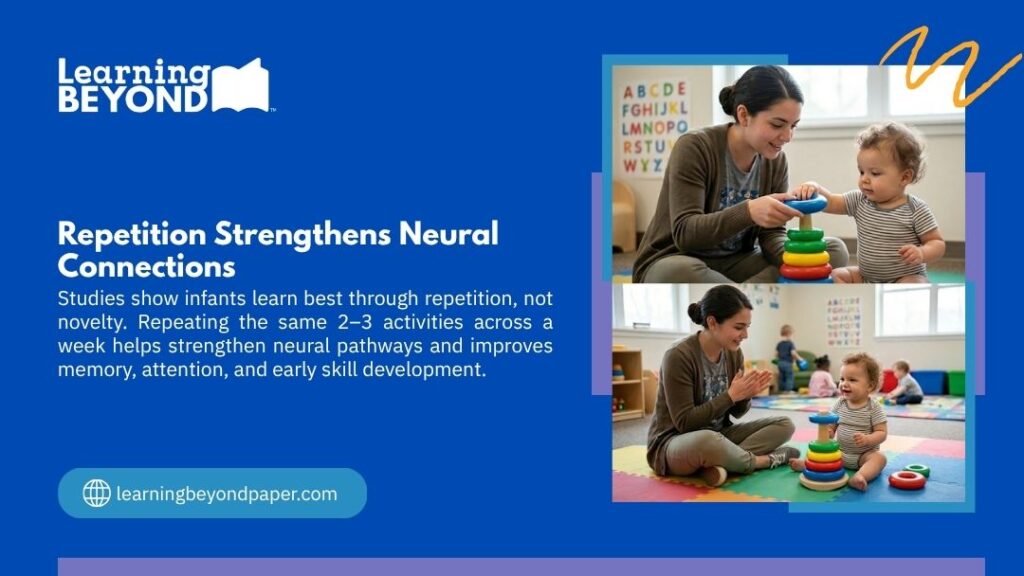
Repetition is how infants learn. Using 2 to 3 activities across the full week with slight daily variations supports deeper engagement than introducing something new each day. Familiarity builds the cognitive foundation that novelty later builds on.
Start with the five developmental domains and assign one activity per domain per week. Keep the plan simple, observe how each child responds, and adjust from there. The structure becomes more specific and confident naturally as your observation skills grow.
The best weekly lesson plan ideas for infants in childcare are the ones that actually get used because they fit the real rhythms of your room and the real needs of your children week after week.
Learning Beyond Paper has already supported over 160,000 children across more than 3,000 schools with curriculum resources built specifically for early childhood educators who want every session to count.
Book a free demo today and see how Learning Beyond Paper makes weekly infant planning faster, more focused, and easier to maintain across every teacher in your center.