
Learning how to create a lesson plan for toddlers in daycare is one of the most underexplained responsibilities in early childhood education, and most available resources were written for preschoolers or older children, not for 1 to 3-year-olds.
This guide is built specifically for the toddler classroom. You will find a breakdown of the five components every strong plan needs, a step-by-step weekly process you can complete in under 30 minutes, and real strategies for when a plan stops working mid-session.
Before diving into planning, it helps to understand what a strong preschool curriculum should include as a broader context for where toddler planning sits within early childhood education.
A 3-year-old’s brain is twice as active as an adult brain, and a 2-year-old’s brain has 50% more synapses. In the first few years of life, more than 1 million new neural connections are formed every second.
That level of development means toddler learning happens constantly through movement, touch, repetition, and interaction rather than sitting and listening.
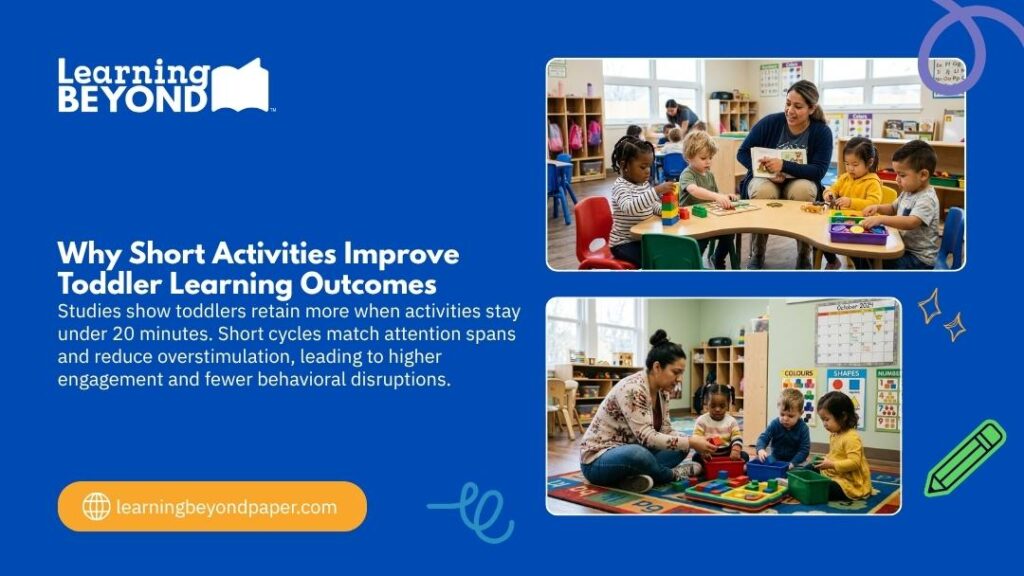
Childhood development experts suggest a child’s attention span is approximately two to three minutes per year of age. For a 2-year-old, that means a realistic focused attention window of about four to six minutes.
Building a lesson plan around that reality separates effective toddler planning from everything that frustrates educators and leads to last-minute scrambling.
Three things make planning for this age group fundamentally different:
| Feature | Toddler Plan (Ages 1 to 3) | Preschool Plan (Ages 3 to 5) |
| Circle time duration | 5 to 10 minutes max | Up to 20 minutes |
| Learning method | Play, sensory, movement | Structured, theme-led |
| New activities per week | 2 to 3 | 4 to 5 |
| Educator role | Facilitate and observe | Guide and instruct |
Creating a lesson plan for toddlers in daycare does not require a complex template. It requires five specific components, each grounded in how toddlers actually develop and learn.
For a deeper look at aligned planning foundations, see developmentally appropriate curriculum for toddlers.
Every activity should have one clear developmental goal. Not two or three. One. Trying to address fine motor skills, language development, and creativity within a single activity overloads both the plan and the child.
A strong objective sounds like: “Children will strengthen their pincer grip through clay play,” not “children will develop fine motor skills, language, and creativity.”
Write a two to three sentence description of the activity and list every material needed. Prepare materials the day before. Scrambling for supplies while managing an active toddler room is one of the fastest ways for a session to lose its shape.
| Activity | Description | Materials Needed |
| Sensory bin exploration | Children scoop, pour, and sort objects in a bin filled with dry pasta | Large bin, dry pasta, small cups, scoops, toy animals |
| Clay pincer play | Children press, poke, and pull small pieces of clay to build grip strength | Air-dry clay, rolling pins, plastic mats |
Tag each activity to one primary developmental domain: cognitive, social-emotional, physical (fine or gross motor), or language. This helps you check at a glance whether the week has balance without overloading any single area.
Assign every activity a time block and include a short transition note. This detail is what most planning templates skip, and it is one of the most important elements for keeping a toddler room running predictably.
Research from Head Start confirms that toddlers do best in stable environments, and familiar transition routines build confidence while reducing challenging behavior.
A note can be as simple as “signal end of activity with the clean-up song” or “dim lights two minutes before nap.”
Our guide on how to plan engaging circle time for preschoolers covers transition timing in more detail if you want to go deeper on that piece.
Mark each activity as either anchor (always happens) or optional (drops if the group needs more time or the room energy has shifted). This one step gives educators explicit permission to adapt without feeling like the plan has failed.
| Component | What It Includes | Example |
| Learning objective | One developmental goal | Strengthen pincer grip through clay |
| Activity and materials | 2 to 3 sentences plus materials list | Clay play with rolling pins and mats |
| Developmental domain | One primary tag | Physical: fine motor |
| Time block and transition | Assigned slot plus cue | 9:15 to 9:30 / clean-up song |
| Flexibility flag | Anchor or optional | Optional |
Creating a lesson plan for toddlers in daycare becomes a manageable, repeatable habit when you follow the same five steps each week. Most educators who stick with this process find they can complete a full weekly plan in 20 to 30 minutes.
Before opening any template, spend five minutes at the end of each week writing down three things:
Observation is not a formal assessment. It is a short habit that makes your next plan smarter without adding extra work.
Pick one primary developmental area to anchor the week’s new activities around. Language this week. Gross motor next week. This reduces decision fatigue and gives the week a clear thread running through it.
You are still covering other domains. You are simply giving the week a backbone.
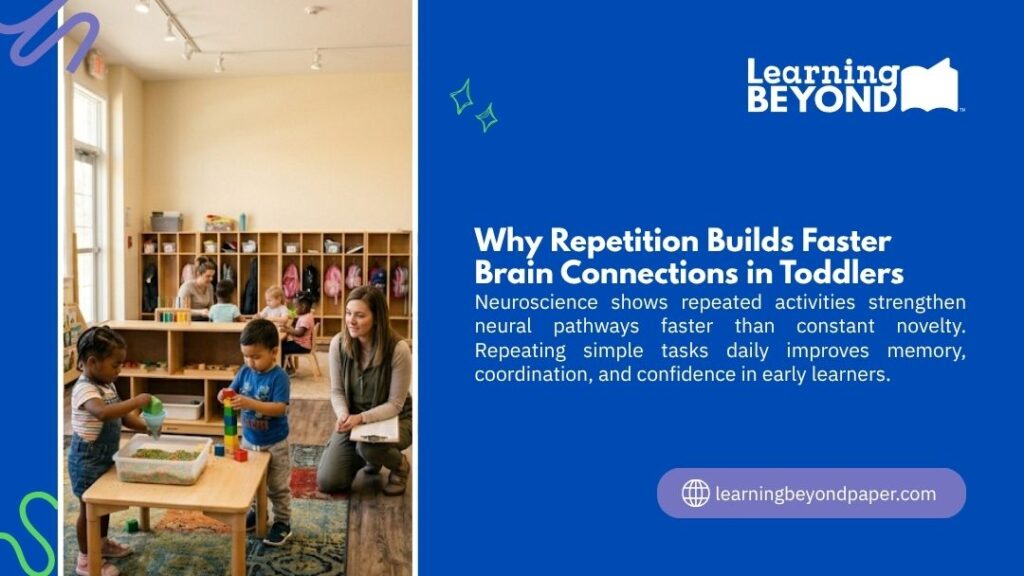
Toddlers learn through repetition. Two to three new activities per week, repeated with small variations each day, is both developmentally appropriate and far more sustainable than planning completely fresh content daily.
For hands-on inspiration, age-appropriate activities for 2-year-olds in daycare is a useful starting point.
A sensory bin on Monday does not need to become an entirely different activity on Wednesday. Change the material inside or swap the tools, and the experience feels new enough to re-engage the group.
Place each activity into a time block and account for transitions, snack, outdoor play, and nap time. Here is a skeleton daily schedule for a toddler room:
| Time | Activity |
| 8:00 to 8:30 | Arrival and welcome activity |
| 8:30 to 9:00 | Free play and learning centers |
| 9:00 to 9:10 | Circle time (10 minutes maximum) |
| 9:10 to 9:30 | Planned morning activity |
| 9:30 to 9:45 | Snack |
| 9:45 to 10:30 | Outdoor play |
| 10:30 to 11:15 | Second activity or sensory play |
| 11:15 to 12:00 | Lunch |
| 12:00 to 14:00 | Nap or quiet rest |
| 14:00 to 14:30 | Afternoon activity |
| 14:30 to 15:00 | Departure preparation |
Every experienced daycare teacher has had a day where three children were upset before 9 AM, a planned activity was rejected in under two minutes, and the session was already off course by 8:50. This section is for those days.
Creating a lesson plan for toddlers in daycare does not mean predicting the future. It means being prepared to pivot without panic, and knowing what to reach for when the original plan stops working.
Signs the group is not ready to receive a planned activity include scattered energy, difficulty settling, and noise that does not respond to normal cues.
The immediate pivot is to drop to a lower-stimulation anchor activity: books, playdough, or independent free play at learning centers.
This is not abandoning the plan. It is responding to what the children actually need at that moment.
Toddlers will sometimes refuse an activity entirely, and that is developmentally normal. Do not force engagement. Observe what the child moves toward instead, and write it down. That preference is data for next week’s planning, which connects directly back to Step 1.
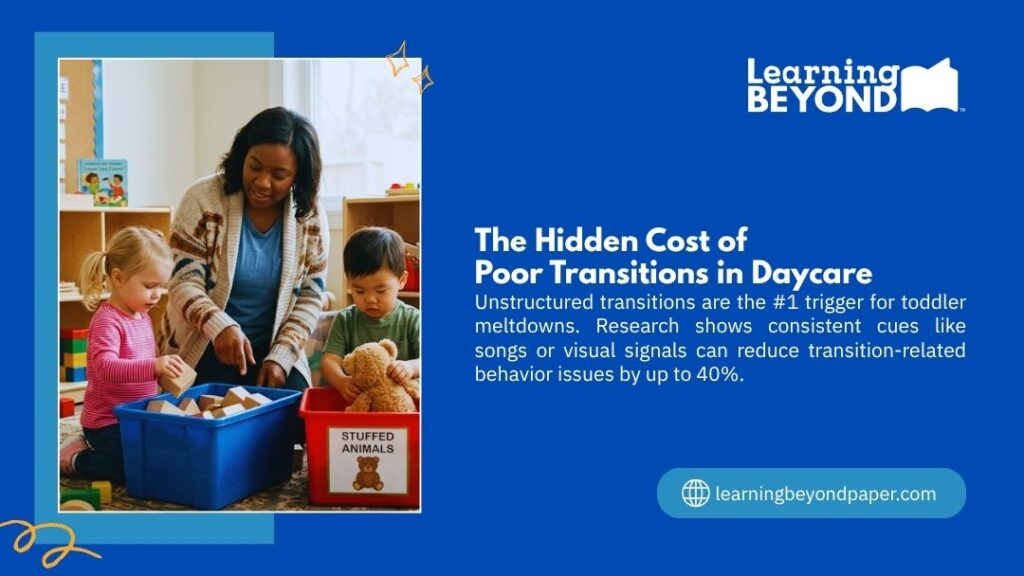
Transitions are the highest-risk moments in a toddler day. A few tools that can be embedded into every plan as standard procedure:
Build these into the transition note for each activity and they become part of the daily routine rather than a reactive response.
Many daycare rooms are not neatly divided by age. If your toddler classroom includes children ranging from 14 months to 36 months, you do not need to build three separate plans.
You need one well-designed activity with tiered variations. For specific ideas to start with, structured activities for toddlers aged 12 to 18 months is a good reference point.
This approach is called an open-ended anchor activity. The same central experience is set up so children at different developmental stages can each engage meaningfully.
Here is how one activity looks across three levels:
| Age Range | Activity Variation | Developmental Goal |
| 12 to 18 months | Scoop and pour dry pasta in a sensory bin | Gross motor, sensory exploration |
| 18 to 24 months | Sort soft toy animals by color into cups | Early cognitive sorting, fine motor |
| 24 to 36 months | Build a simple pattern with colored cups and describe it | Language, early sequencing |
The bin, the materials, and the space are the same. The invitation to engage is layered across developmental levels.
Parents do not need a formal curriculum document. They need to know what their child did that day and why it mattered.
When creating a lesson plan for toddlers in daycare, build in one brief communication touchpoint per day. Share the week’s main activity at the start of the week so families know what to expect.
At pickup, offer one specific observation: “She spent most of the morning at the sensory table and stayed focused for nearly fifteen minutes.” That kind of detail tells parents more than a general update ever could.
The combination of a weekly overview and a daily moment keeps parents genuinely informed and reinforces the professional value of your planning.
Weekly lesson plan ideas for infants in childcare settings offers a useful parallel for centers that serve a wider age range alongside toddlers.
Use whatever communication channel your center already uses, whether that is a childcare app, a printed sheet posted at the door, or a verbal note at pickup.
A strong plan includes five components: a single learning objective, a brief activity description with a materials list, a developmental domain tag, a time block with a transition note, and a flexibility flag marking the activity as anchor or optional.
Circle time should stay within five to ten minutes. Other planned activities work best when kept to fifteen to twenty minutes. Open-ended play at learning centers can run longer, as children self-direct how they engage.
Two to three new activities per week is the recommended approach. Toddlers learn through repetition, so returning to the same activity with slight daily variations is more effective than introducing completely new content every day.
Themes are optional. They can add coherence to a week’s activities, but toddler development does not depend on thematic framing the way preschool programming often does. If a theme helps you plan, use it. If it adds pressure without adding value, skip it.
Yes, ChatGPT can generate a basic lesson plan structure, but it does not know the children in your room, their developmental stages, or what happened during Tuesday’s sensory bin.
It works best as a starting point for ideas, not as a replacement for the observation-based, child-responsive planning that toddler classrooms actually need.
Lesson planning gets easier with practice and the right support behind it. Creating a lesson plan for toddlers in daycare is a skill, and like any skill, it develops faster when you have guidance built for the reality of your classroom rather than a generic framework.
Learning Beyond Paper was built to support educators at every stage of that journey. The program’s activities integrate early learning standards across physical development, social-emotional growth, language and literacy, and early mathematics.
Every daily activity is designed with a clear developmental purpose, and ELBY, the platform’s virtual instructional coach, can tailor lesson content to the individual needs of the children in your room.
For educators new to creating a lesson plan for toddlers in daycare, the platform walks through the process from the ground up. Experienced teachers will find room to expand their practice and explore more intentional approaches to each session.
Continuous improvement is central to how Learning Beyond Paper operates, and that commitment is reflected in every layer of the program, from the activities themselves to the support it provides for teachers and families.
If you are ready to plan with purpose rather than under pressure, Learning Beyond Paper is the place to start.