
You are staring at the Head Start Early Learning Outcomes Framework on one screen and your curriculum binder on the other, unsure where they actually overlap. Learning how to align daycare curriculum with Head Start ELOF is the part no one hands you a template for, yet it drives compliance, funding, and real school-readiness. This guide covers what “aligned” truly means, a repeatable five-step process, and how to keep it sustainable when your week is already full.
What Does It Mean to Align a Curriculum With the ELOF?
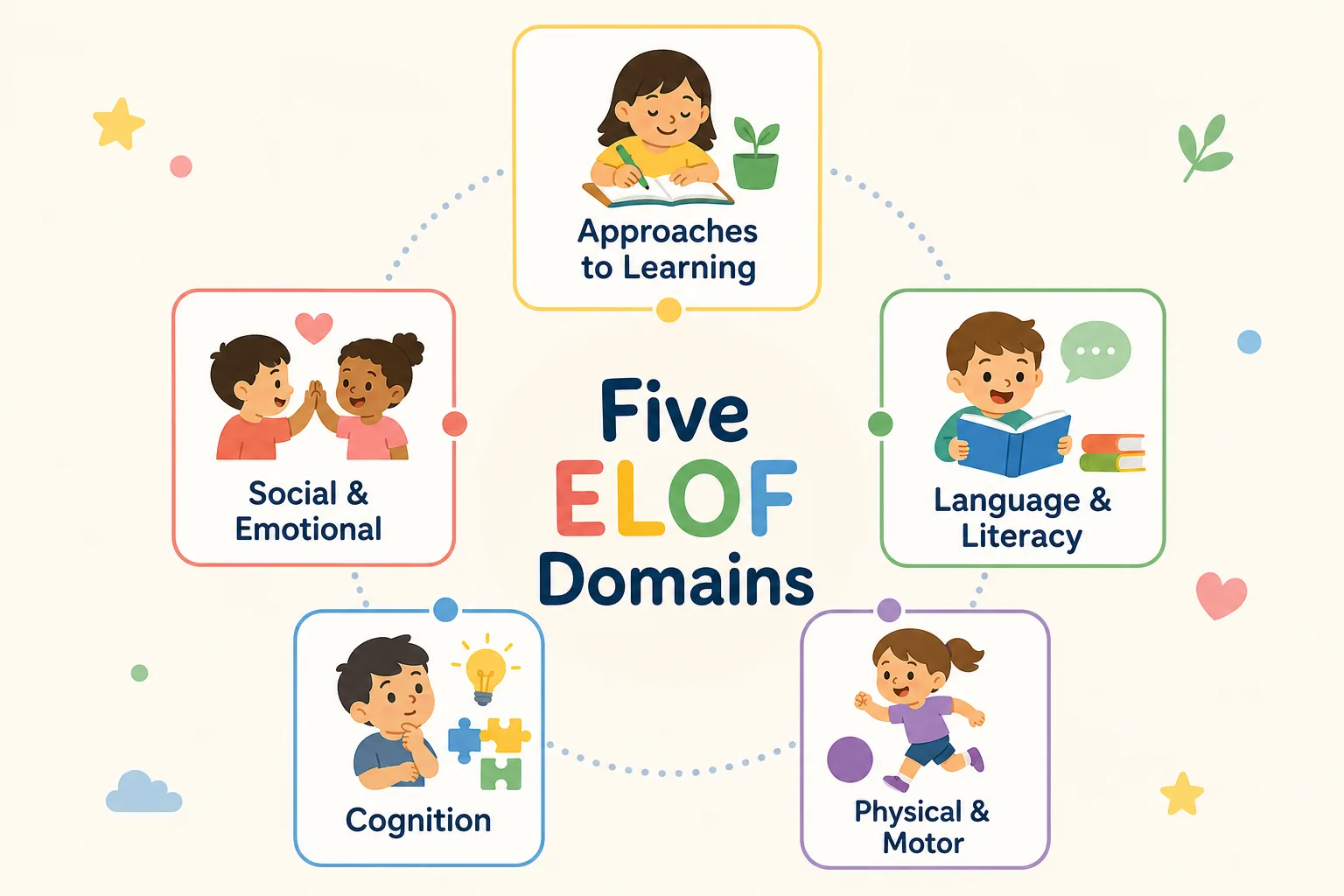
Alignment means showing which ELOF domains and sub-domains your daily activities already address, and where the gaps are. It is a mapping exercise, not a rewrite. You are not replacing your curriculum; you are building a crosswalk between what children do each day and the outcomes the Framework expects.
- Approaches to Learning
- Social and Emotional Development
- Language and Literacy
- Cognition (including early math and scientific reasoning)
- Perceptual, Motor, and Physical Development
Alignment proves your program touches all five with intention.
Why Aligning Your Daycare Curriculum With Head Start ELOF Matters

Compliance is the first reason. The Head Start Program Performance Standards require teaching practices that are aligned with the ELOF, so grantees and partners must document how their curriculum maps to the Framework.
Beyond the audit, alignment gives you consistent school-readiness outcomes, easier child assessment, stronger grant applications, and smoother monitoring reviews. And yes, Head Start does follow a curriculum: a research-based, ELOF-aligned one is expected, not optional. If you serve infants and toddlers too, a curriculum built to support Early Head Start and Head Start programs keeps that mapping consistent across every age you enroll.
How to Align Daycare Curriculum With Head Start ELOF in 5 Steps
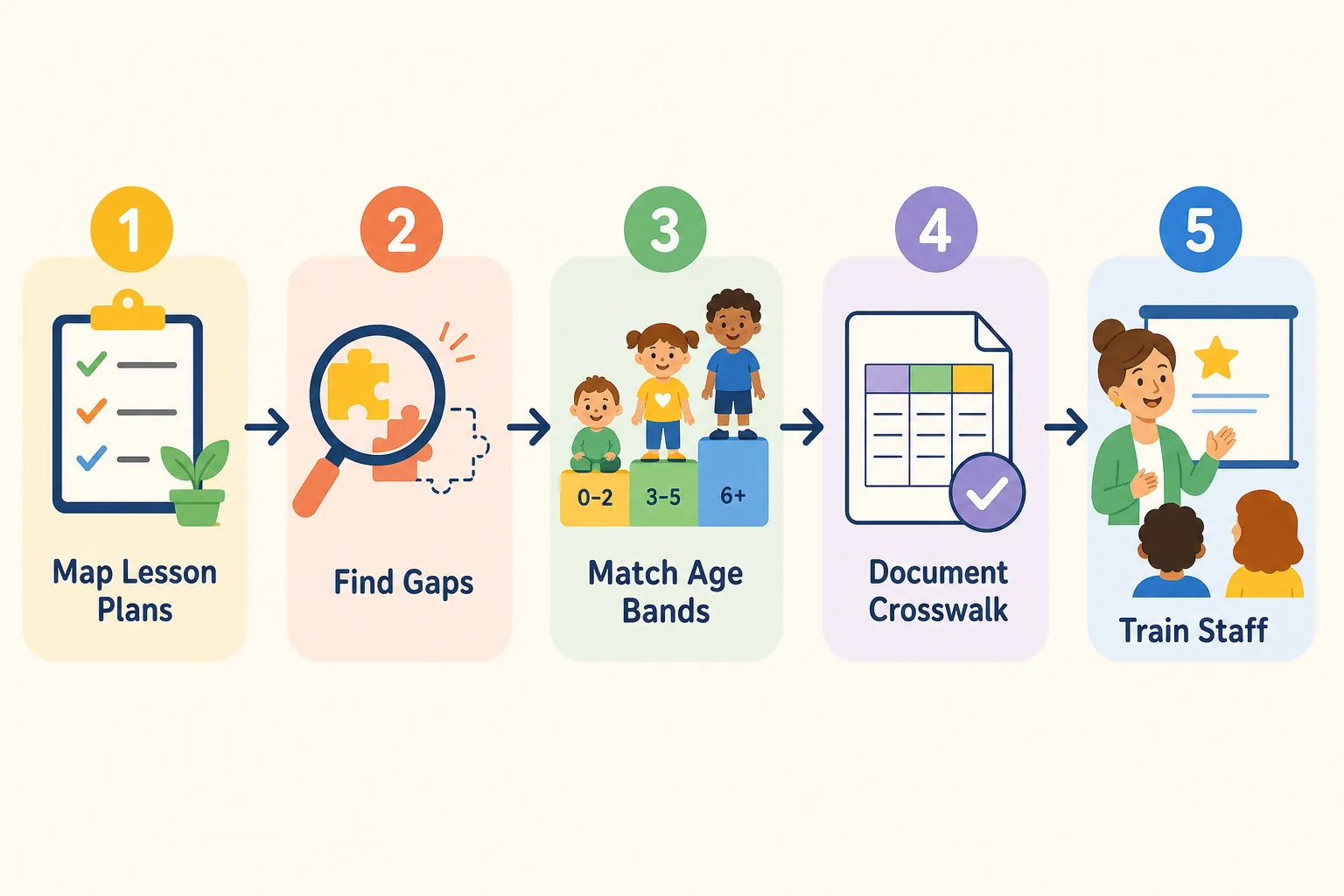
Step 1, Map Your Current Lesson Plans to the Five ELOF Domains
Start with a simple crosswalk. List a real activity, then mark the domain and sub-domain it serves.
| Daily Activity | ELOF Domain | Sub-Domain Touched |
|---|---|---|
| Morning greeting and feelings check-in | Social & Emotional Development | Relationships with adults |
| Read-aloud with open questions | Language & Literacy | Vocabulary, comprehension |
| Block ramp and rolling test | Cognition | Scientific reasoning, early math |
| Choosing and finishing a center | Approaches to Learning | Persistence, initiative |
| Obstacle course | Perceptual, Motor & Physical | Gross motor movement |
Step 2, Identify Coverage Gaps and Overlaps
Now look for thin spots. Cognition is the usual weak column, many programs are rich in literacy but light on early math and inquiry. Cognition is the usual weak column, and Youth Policy Lab early literacy and math research shows many programs are rich in literacy but light on early math and inquiry. This is where STEM activities for 3–5 year olds earn their place: sink-or-float trays, counting collections, and simple pre-k STEM building challenges fill Cognition gaps fast. What matters is that the activities are research-based; a study comparing preschool curricula and children’s outcomes found that how well a curriculum is implemented matters more than which brand name is on the box.
How well a curriculum is implemented matters more than which brand name is on the box.
Step 3, Match Activities to Age Bands (Infant Through Pre-K)
The ELOF spans birth to five, so alignment has to reflect developmental stages. What you expect from daycare for 2-year-olds differs from what a child should learn in preschool at four. Map each age band separately so a toddler’s sensory play and a Pre-K child’s pattern work each land in the right sub-domain. Programs running mixed ages benefit from an early childhood curriculum from infants through Pre-K 4 that already scales by stage.
Step 4, Document the Alignment (Your Crosswalk)
Record the mapping in a living document, not a one-time binder. A shared spreadsheet with activity, domain, sub-domain, and evidence answers the monitor’s question, how do your instructional practices align with these standards, in seconds. Update it whenever a lesson changes so it never goes stale.
Step 5, Train Staff and Review Regularly
Alignment fails without teacher buy-in. Embedded professional development and in-the-moment coaching close the loop, so teachers know why an activity serves a domain. A virtual instructional coach like ELBY can prompt those connections during planning, and quarterly reviews keep the crosswalk honest. To see how a curriculum maps to state and Head Start standards, start from an existing alignment rather than a blank page.
Aligning ELOF With State Early Learning Standards
Here is what most guides skip: you likely have to satisfy two frameworks at once. A Florida provider must meet both the ELOF and the Florida Early Learning and Developmental Standards, and monitors often reference ELOF alongside CLASS indicators. Build one crosswalk with columns for each framework so a single activity shows its ELOF domain and its state benchmark side by side.
Building vs. Buying an ELOF-Aligned Curriculum
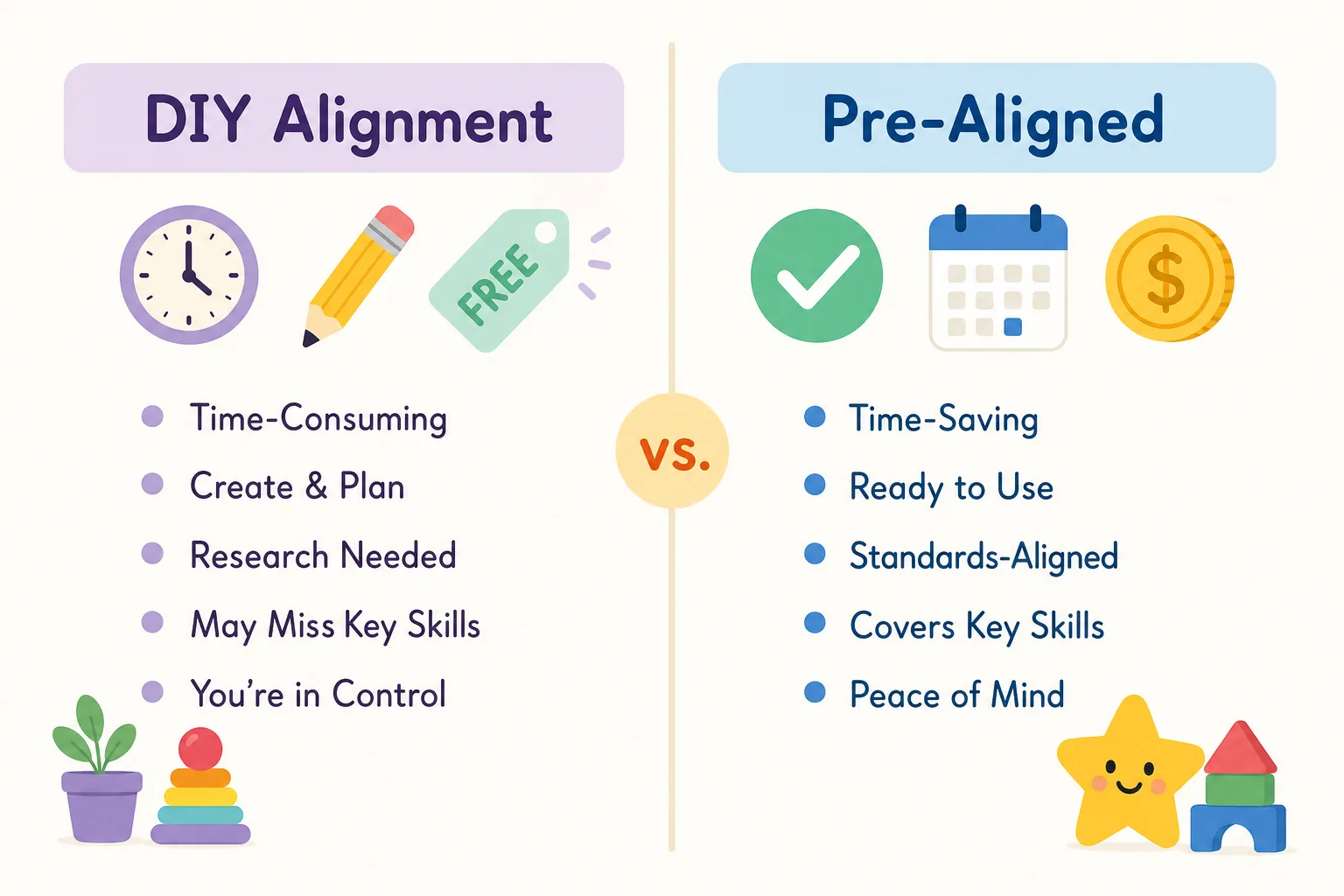
You can align a curriculum yourself for free, it just costs time. Creating a daycare curriculum from scratch means writing lesson plans, mapping every domain, and maintaining it as standards update. Buying one that ships pre-aligned trades money for those hours back.
| Dimension | DIY Alignment | Pre-Aligned Curriculum |
|---|---|---|
| Time investment | High: weeks of mapping | Low: done for you |
| Cost | Free, but staff hours | Flat subscription |
| Staff PD | You source it | Embedded |
| Keeping current | Manual re-mapping | Updated for you |
| Bilingual support | Build it yourself | Included |
Learning Beyond Paper delivers 52 weeks of research-based, ELOF-aligned lesson plans covering Infant through Pre-K 4, in English and Spanish, for one flat monthly price, the alignment already done. With enrollment and budget planning peaking March through September, that is the natural window to adopt.
Frequently asked questions
Does Head Start follow a curriculum?
How do I align a lesson plan with curriculum standards?
How do I create a daycare curriculum from scratch?
Is there a free way to align my daycare curriculum with Head Start ELOF?
How is ELOF different from my state’s early learning standards?
Key Takeaway
Aligning your curriculum to the ELOF is a mapping exercise you can genuinely do in five steps: map, find gaps, match ages, document, and train. Providers who sustain it either maintain a living crosswalk across ELOF, state standards, and CLASS, or start from a curriculum that arrives already aligned, so the hours go back into teaching instead of paperwork.