
The first week of preschool is not about content coverage. It is about a child walking into a new building, meeting new adults, and learning that this place is predictable and safe.
A first week that works looks like this: greet every child by name at the door, teach one routine per day, keep activities to five or ten minutes, read one short book, and leave long stretches for play in a room that is not overstuffed with choices. Same order every day. The sameness is the lesson.
Below: a five-day plan, 20 low-prep activities to pull from, and what to do with everything you notice along the way.
What the First Week of Preschool Is Actually For
Three- to five-year-olds are managing a lot at once in week one. A new bathroom, new adults, a dozen new peers, and a schedule nobody explained to them. Their attention goes toward figuring out whether they are okay, which leaves little room for letter drills.
So week one has three jobs: connection, safety, and routine. Everything you teach over the next forty-plus weeks sits on top of those three things. This is not a throwaway fun week before the real curriculum starts. It is the foundation of the instruction that follows.
If you run a center, there is a second reason to plan it deliberately. When every classroom follows the same first-week shape, new teachers stop improvising, veteran teachers stop reinventing, and a family with a toddler in one room and a Pre-K 4 child in another sees the same welcome in both. That consistency is what parents remember when they decide whether to stay enrolled.
The Week Before: Prep That Makes Day One Easier
Most of what makes Monday calm happens the week before.
Reach out first. Send a postcard, a text, or a thirty-second video from the teacher so children see a face before they walk through the door. Early, positive family contact is the cheapest thing you can do to make separation easier, and it sets the tone for the year. Our guide to building relationships and creating a welcoming environment walks through what that first contact should say.
Ask for two things. A family photo and the child’s preferred name with the pronunciation spelled out. Print name tags, cubby labels, and chair tags before anyone arrives.
Collect a one-page about-my-child form. Comfort item, allergies, sleep habits, home language, and what calms this particular child down. Five questions, not twenty.
Prepare the Spanish version at the same time. Spanish-speaking families should get the same information as everyone else, not a shortened summary of it.
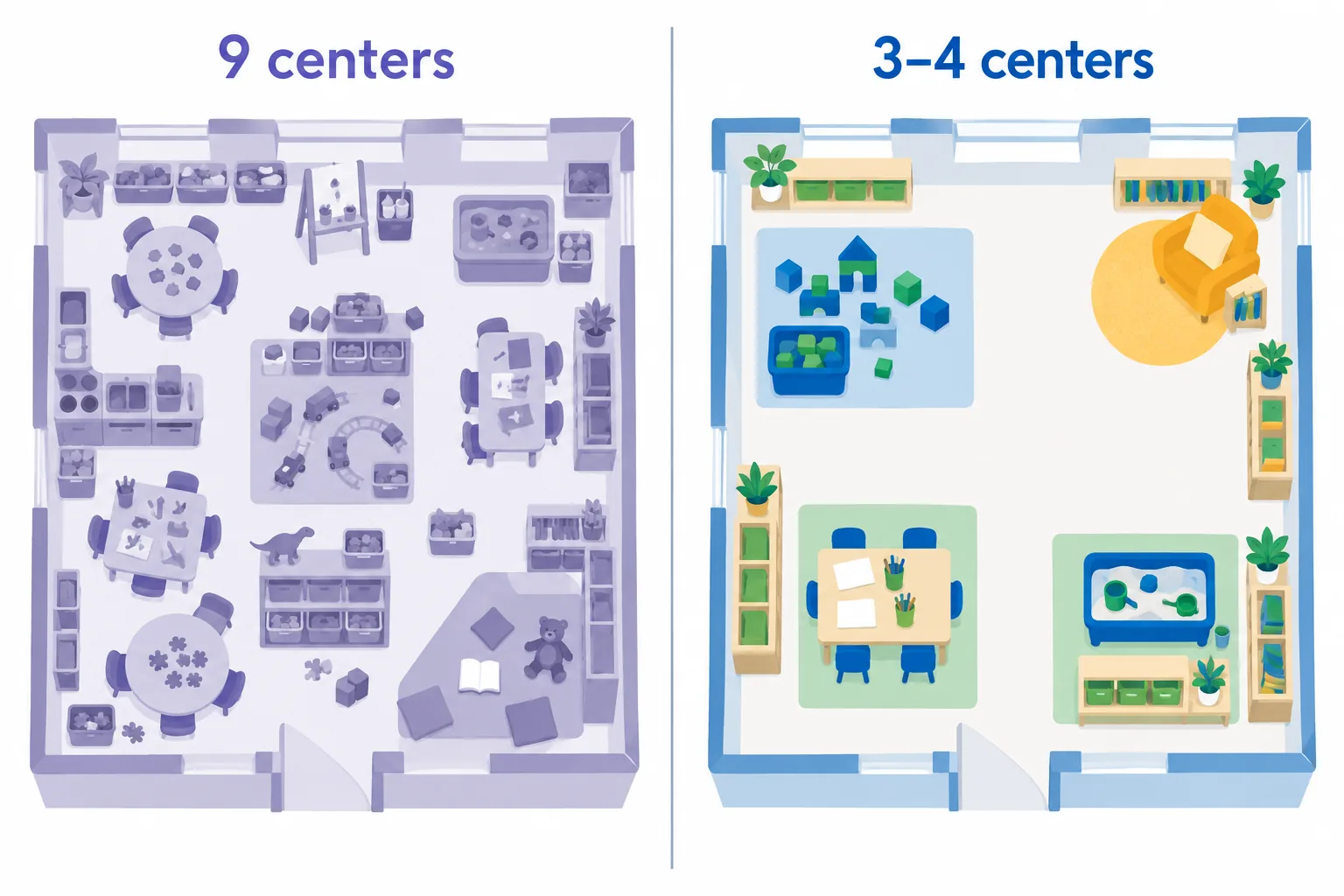
Set the room up with less. Open three or four centers, not nine. Put out fewer materials than you think you need. You can always add. Taking things away after children have found them is much harder.
Stage a first-week bin per classroom. Name tags, markers, chart paper, laminated visual schedule cards, and one read-aloud per day. Nobody should be hunting for scissors at 7:45 on Monday.
A Day-by-Day Plan for the First Week of Preschool
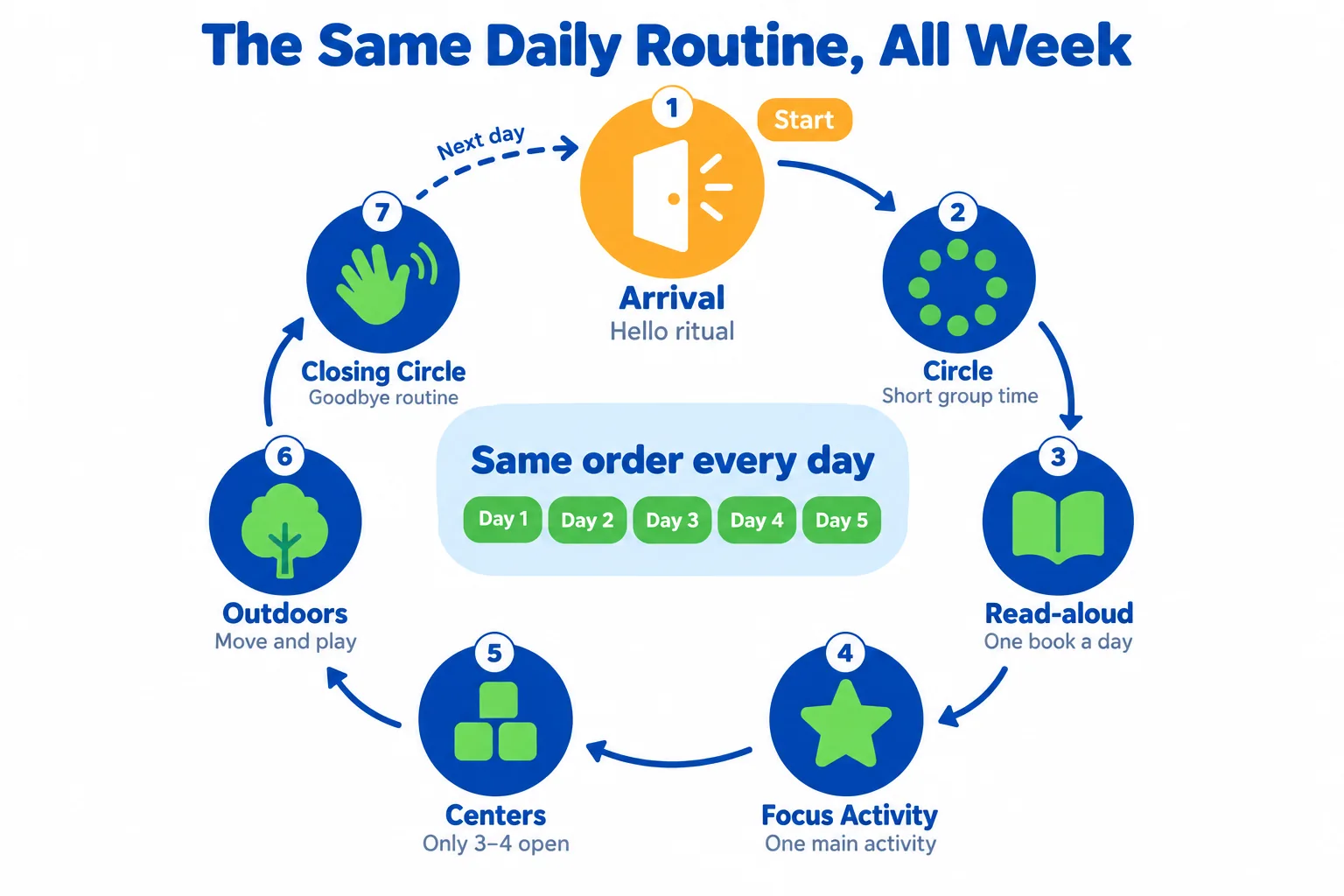
Every day follows the same shape: arrival ritual, short circle, one read-aloud, one focus activity, centers, outdoor time, closing circle. Keep the order fixed all week. Children learn a schedule by living it, not by hearing it explained.
| Day | Main focus | Key activities | Routine to reinforce |
|---|---|---|---|
| Day 1 | Names, faces, and belonging | Name necklaces, name song, family photos | Arrival and goodbye routine |
| Day 2 | Learning the room | Photo scavenger hunt, cubby match, visual schedule | Handwashing and putting materials away |
| Day 3 | Friends and feelings | Friend bingo, feelings faces, voting circle | Asking for a turn and setting boundaries |
| Day 4 | Routines under pressure | Transition games, meal practice, rest-time rehearsal | Cleanup, lining up, listening signal |
| Day 5 | Celebrate and connect with families | Self-portraits, class display, positive notes | Repeat the week’s arrival and closing routines |
Day 1: Names, Faces, and a Safe Landing
Teacher at the door, name tag handed directly to the child, family photo taped to the cubby or clipped onto a photo ring the child can carry. At circle, sing a name song with every child’s name in it so children hear and say each other’s names out loud.
Focus activity: decorate name necklaces. Read a short first-day picture book, pausing often to let children talk. Close with one goodbye routine (a song, a wave at the window, a hand stamp) that you repeat every single day.
Day 2: Learning the Room
Run a classroom scavenger hunt with photo cards: find the sink, the cubbies, the block area, the cozy corner. Play a cubby and chair match game so children can find their own space without an adult.
Build the visual daily schedule together and post it at child eye level. Teach exactly one procedure explicitly, start to finish. Handwashing works well. Open centers with two or three choices and model how materials get put back.
Day 3: Friends and Feelings
Play friend bingo or find-someone-who with picture prompts, since nobody is reading yet. Hold a this-or-that voting circle (apples or bananas, dogs or cats) and chart the results as a class graph, which quietly doubles as early math. Do a feelings faces mirror activity and introduce the calm-down corner as a place to go, never a place you get sent. Teach one conflict script you will reuse all year: “I need a turn.” “Stop, I don’t like that.”
Day 4: Routines Under Real Pressure
Practice transitions as games: cleanup song race, freeze-and-listen signal, line-up train. Run one unhurried meal or snack all the way through, including passing, pouring, and scraping plates. Rehearse rest time even on a short day: cots out, comfort item, quiet music, lights low. Now that expectations exist, add one more center and one new material.
Day 5: Celebrate and Loop in Families
First-week self-portraits go up as an All About Me display or a class book families can flip through at pickup. Take a class photo or make a handprint banner. Send home one specific positive note per child, naming something you actually saw that child do, not a form letter. Preview next week for families so the routine carries into the weekend.
20 Low-Prep Back to School Activities for Preschoolers
Grouped by purpose, so you can pull one from each bucket per day instead of scrolling a flat list. All of these work in a single-age preschool room or a mixed-age daycare group.
| Activity group | Activities | Main purpose |
|---|---|---|
| Name and identity | Name necklaces, name puzzles, sensory-tray name writing, All About Me bag, self-portrait | Belonging, name recognition, early literacy |
| Icebreakers and friendship | Rolling ball name toss, friend bingo, class graph, guess your teacher | Connection, communication, turn-taking |
| Room and routines | Photo scavenger hunt, cubby match, build the schedule, cleanup-song practice | Independence and classroom routines |
| STEM | Sink or float, block name towers, ramps and cars, color mixing | Prediction, observation, problem-solving |
| Comfort and calm | Family photo ring, breathing buddy, feelings faces | Regulation, comfort and emotional security |
Name and Identity Activities
1. Name necklaces. Cardstock, yarn, markers. Children decorate, wear, and read each other’s. 2. Name puzzles. Write the name, cut between letters, have the child rebuild it. 3. Sensory-tray name writing. Salt or sand in a shallow tray, trace with a finger. 4. All About Me bag. Child brings three small items from home to share at circle. 5. Mirror self-portrait. Real mirror, skin-tone crayons, no correcting the results.
Name work is not filler. Early literacy research finds that children’s own names are an excellent starting point for learning the alphabetic principle, which is why week one front-loads names instead of generic letter drills.
Icebreakers and Friendship Games
6. Rolling ball name toss. Roll, say your name, roll to someone new. 7. Friend bingo. Picture prompts only: someone with a pet, someone wearing red. 8. This-or-that class graph. Vote with sticky notes, count the columns together. 9. Guess your teacher. Three statements about you. Children vote on which is false.
Model the language you want to hear during these games. Short teacher prompts (“Ask him what he picked”) do more for turn-taking than a rule chart on the wall.
Room and Routine Builders
10. Photo scavenger hunt of the classroom’s key spots. 11. Cubby and chair match. 12. Build the schedule as a group and hang it low. 13. Quiet signal and cleanup song practice, treated as a game with a beat-the-timer element.
Laminate the visuals once. They carry the whole year, and across every classroom in the building.
STEM Activities for 3-5 Year Olds That Fit Week One
Skip science in week one and you give up one of the easiest ways to keep a new group busy and talking. STEM activities for preschoolers do not need a kit.
14. Sink or float welcome bin. Water table, a basket of classroom objects, one question: what do you think will happen? 15. Block name towers. Build a tower with as many blocks as letters in your name. 16. Ramps and cars. Two ramp heights, race, notice the difference out loud. 17. Color mixing with droppers. Water, food coloring, and pipettes, which also build hand strength for writing later.
Keep the science talk simple: predict, try, tell me what happened. STEAM works best woven into daily activities rather than parked on a separate science day, and every one of these doubles as a center you can leave out through week two.
Comfort and Calm-Down Activities
18. Family photo ring the child can carry all day. 19. Breathing buddy. Stuffed animal on the belly, watch it rise and fall. 20. Feelings faces in the cozy corner, next to familiar books.
Separation Anxiety: What Actually Helps in the First Days
A child crying at drop-off is not a sign that the child is not ready or that the family did something wrong. Pediatric guidance describes separation anxiety as entirely normal behavior and a sign of meaningful attachment. Say that to families out loud, because most of them are quietly worried they broke something.
What helps in practice:
- Coach families on a short, honest goodbye plus a ritual. Two kisses and a wave at the window, every day, same order. Sneaking out ends the crying faster on Monday and makes Tuesday worse.
- Give the child a job on arrival. Feed the fish, move their photo onto the attendance chart, pick the morning song. A task redirects attention better than reassurance does.
- Send a photo within the first hour. It settles the adult, and a settled adult makes a calmer pickup.
- Give every teacher the same script. Consistency across staff matters more than the exact wording anyone uses.
For Spanish-speaking staff and families, share the same guidance in Spanish: cómo apoyar a los niños durante la separación.
What Should a Child Learn in Preschool (and What Week One Skips)
Families ask this constantly, sometimes as a request for your preschool syllabus or a list of preschool subjects, so have a clear answer ready at your open house.
A full program covers five central domains, as organized by the Head Start Early Learning Outcomes Framework: Approaches to Learning; Social and Emotional Development; Language and Literacy; Cognition; and Perceptual, Motor, and Physical Development.
| Preschool domain | What it covers | What week one emphasizes |
|---|---|---|
| Approaches to Learning | Engagement, persistence, curiosity and learning behaviors | Joining activities, exploring centers, following routines |
| Social and Emotional Development | Relationships, emotions, self-regulation and identity | Separating, joining the group, asking for help |
| Language and Literacy | Communication, language, books and early literacy | Names, conversations, listening and expressing needs |
| Cognition | Thinking, reasoning, memory and early concepts | Simple choices, class graphs, predictions and problem-solving |
| Perceptual, Motor, and Physical Development | Movement, coordination and physical skills | Classroom movement, outdoor play and self-help routines |
That framework, along with your state’s early learning standards, organizes the year. It does not organize the first week. Week one covers the social and self-regulation groundwork underneath all five domains: separating, joining a group, following a routine, asking for help, handling a small disappointment.
Formal assessment and academic pacing start once children feel safe enough to show you what they can actually do.
If you are mapping how that groundwork connects to a full-year scope and sequence, our early childhood curriculum overview shows how the domains progress from infants through Pre-K 4.
Use Week One as Your Baseline, Not Your Assessment
The activity list is the easy half. The part that pays off is what you do with everything you watched.
Watch and jot. Who separates easily and who needs a bridge. Who is talking, who is watching, who needs to move every ten minutes. Which two children found each other on day two. What home language you heard at the water table. Three-sentence anecdotal notes on sticky notes beat a formal observation tool in week one, because you are still learning names.
Then use them. Those notes set your groups, your center rotations, and your seating for week two. They also give you concrete material for the first family conversation, which is much better than “she’s doing great.”
For directors: one shared observation format across every room turns coaching from vague to specific. When you sit down with a teacher, you are both looking at the same kind of evidence about interaction quality that a CLASS-style observation looks for later in the year, and the teacher has been practicing it since day one.
Free Printables and the Real Cost of Free
You can absolutely run this week on free resources. What you want on hand: a first-week checklist, a name tag template, visual schedule cards, and a one-page family info form. Print, laminate, reuse.
The honest catch is that free is rarely free. It costs the Sunday afternoon you spend hunting, printing, and stitching together resources from six sources that do not match each other, in the same week you are setting up a classroom and calling twelve families. Multiply that by every teacher in your building.
The other end of the spectrum is not much better. Paper curriculum kits run into the thousands, need replacing every few years, and the binders still do not tell a brand-new teacher what to do on Tuesday.
That gap is what Learning Beyond Paper was built for. Everything a teacher needs sits in one cloud-based place: 52 weeks of research-based lesson plans, 4,000+ activities in a developmental progression, English and Spanish included at no extra cost, and Infant through Pre-K 4 in one subscription rather than a separate purchase per age group.
Plans are aligned to all 50 state standards, Head Start ELOF, and CLASS indicators, so nobody is reverse-engineering compliance documentation in October.
Two things matter specifically in week one. ELBY, the virtual instructional coach built into the platform, answers a teacher’s question in the moment, which is exactly when a first-year teacher needs it and exactly when you are somewhere else.
And LBP University includes 49.5 hours of embedded professional development, useful when a new hire starts the same week the children do. Teachers using the platform report saving about three hours a week on planning. No printing, no binders, no hardware.
First Week of Preschool: Common Questions
Related readingHow to Align Daycare Curriculum With Head Start ELOFRead the guide →Frequently asked questions
What do you do the first week of preschool?
What are some good back-to-school activities for preschoolers?
What should families do the week before preschool starts?
How long should first-week activities be?
See What a Planned First Week Feels Like
If you are building next year’s plan now, you are right on schedule. Enrollment and budget decisions cluster in spring and summer, and the first week goes far better when it is chosen in April instead of assembled in August.
The easiest way to judge whether this fits your program is to look at an actual week of plans. Watch a short demo or start a free trial and run a week in your own classroom, with your own teachers, before you decide anything.
Peter Smith is CEO and President of Learning Beyond Paper, based in Boca Raton, Florida, where his team of former Department of Education leaders and master teachers supports more than 100,000 educators with affordable, research-backed digital curriculum.