Every preschool teacher knows assessment matters, yet the day rarely leaves room for it. Between transitions, snack, and forty small emotions, sitting down to document each child feels impossible. The good news: the strongest class assessment strategies for preschool teachers happen inside the school day, not after it. This guide covers the everyday methods teachers actually use, demystifies the CLASS® framework, shows how to assess play and STEM, and explains how to stay standards-compliant without the paper piling up.
What Classroom Assessment Really Means in Preschool
In early childhood, assessment is the ongoing process of watching what children do, gathering evidence, and using it to guide teaching. It is mostly formative, feedback that shapes the next lesson, rather than summative, and it leans on observation instead of testing.
That distinction matters for young children. A three-year-old cannot fill in a bubble sheet, but she shows you plenty when she sorts blocks or negotiates a turn. A review by the New South Wales Department of Education points to formative, observation-based practices as the developmentally appropriate foundation for the preschool years.
Good assessment also tracks progress across domains. When parents ask what a child should learn in preschool, language, early math, motor skills, social-emotional growth, your assessment records are the honest answer.
Methods of Assessment Preschool Teachers Can Actually Use
There is no single “right” method. Most strong classrooms mix a few, matching the tool to the moment.
Observation and Anecdotal Records
Short, factual notes about what a child said or did are the backbone of early childhood assessment. A sticky note that reads “Mateo counted six cups, one-to-one” is more useful than any worksheet.
Work Sampling and Portfolios
Collecting drawings, photos, and dictated stories over time builds authentic evidence of growth. A portfolio shows change that a single snapshot never could, and it makes family conferences concrete.
Checklists and Developmental Rating Scales
When you need to map skills to standards quickly, a checklist keyed to milestones does the job. These are fast to complete and easy to scan for gaps.
Play-Based and Authentic Assessment
Assessing during centers, blocks, and dramatic play, rather than pulling a child aside, captures real ability. Research published through ERIC supports observation and portfolio methods as accurate ways to document young children’s learning.
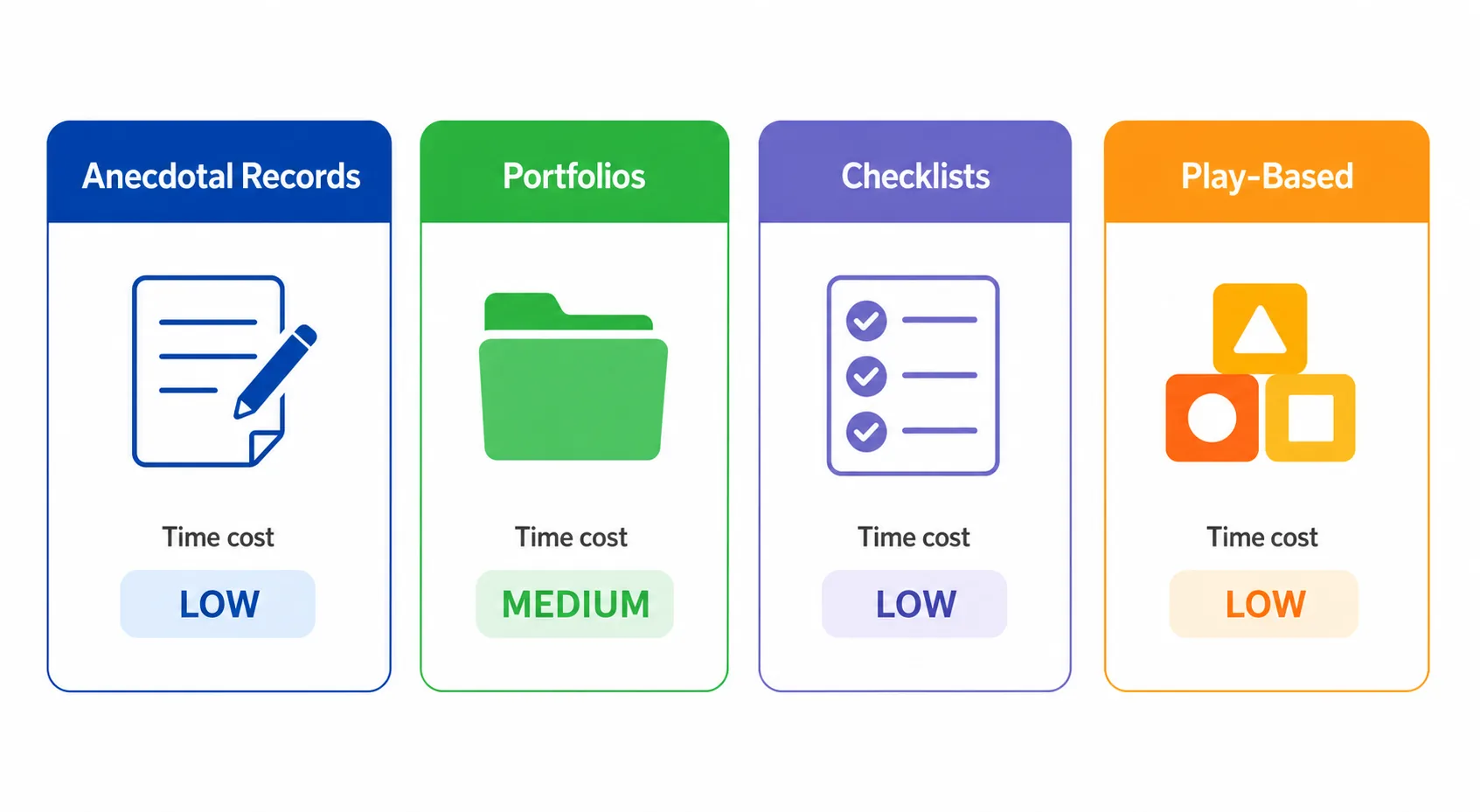
| Method | What it captures | Best for | Time cost |
|---|---|---|---|
| Anecdotal records | Specific behaviors in context | Social-emotional, language | Low |
| Portfolios | Growth over weeks/months | Family conferences | Medium |
| Checklists | Skills mapped to standards | Compliance snapshots | Low |
| Play-based observation | Authentic problem-solving | STEM, collaboration | Low |
If you want these methods woven into a daily plan rather than added on top, it helps to see how CLASS® is integrated into a daily preschool curriculum so observation lives inside the lesson.
Class Assessment Strategies for Preschool Teachers Using the CLASS® Framework
Much of the search traffic around “class assessment” points to CLASS®, the Classroom Assessment Scoring System. It is worth understanding clearly, because it measures something different from a child assessment: it scores the quality of teacher–child interactions, not what any single child knows.
Class Assessment Strategies That Align to CLASS® Domains
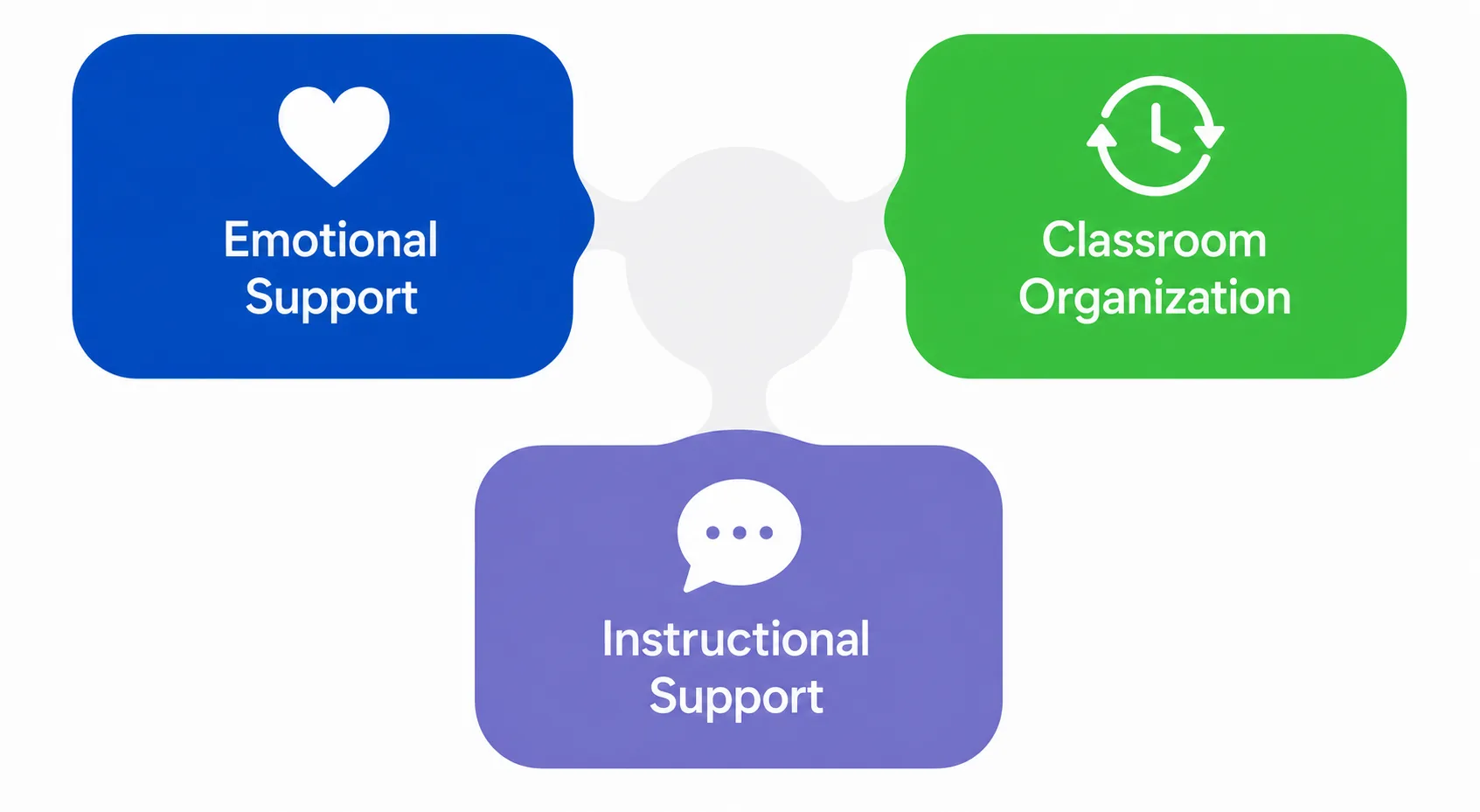
CLASS® looks at three domains: Emotional Support (warmth, sensitivity, respect for children’s perspectives), Classroom Organization (routines, behavior guidance, engaging pacing), and Instructional Support (concept development, quality feedback, language modeling).
Teachers raise these scores through everyday language moves: self- and parallel talk, open-ended questions, and repeating then extending what a child says. Asking “What do you think will happen if we add another block?” does more than fill silence, it lifts instructional quality. Head Start programs use CLASS® as a core measure of classroom quality, and state systems documented by the California Department of Education build training around the same framework.
For a concrete starting point, see practical guidance on aligning classroom interactions to CLASS® indicators within a lesson plan.
CLASS® measures the quality of teacher-child interactions, not what any single child knows.
The 3-2-1 Technique and Other Quick Formative Checks
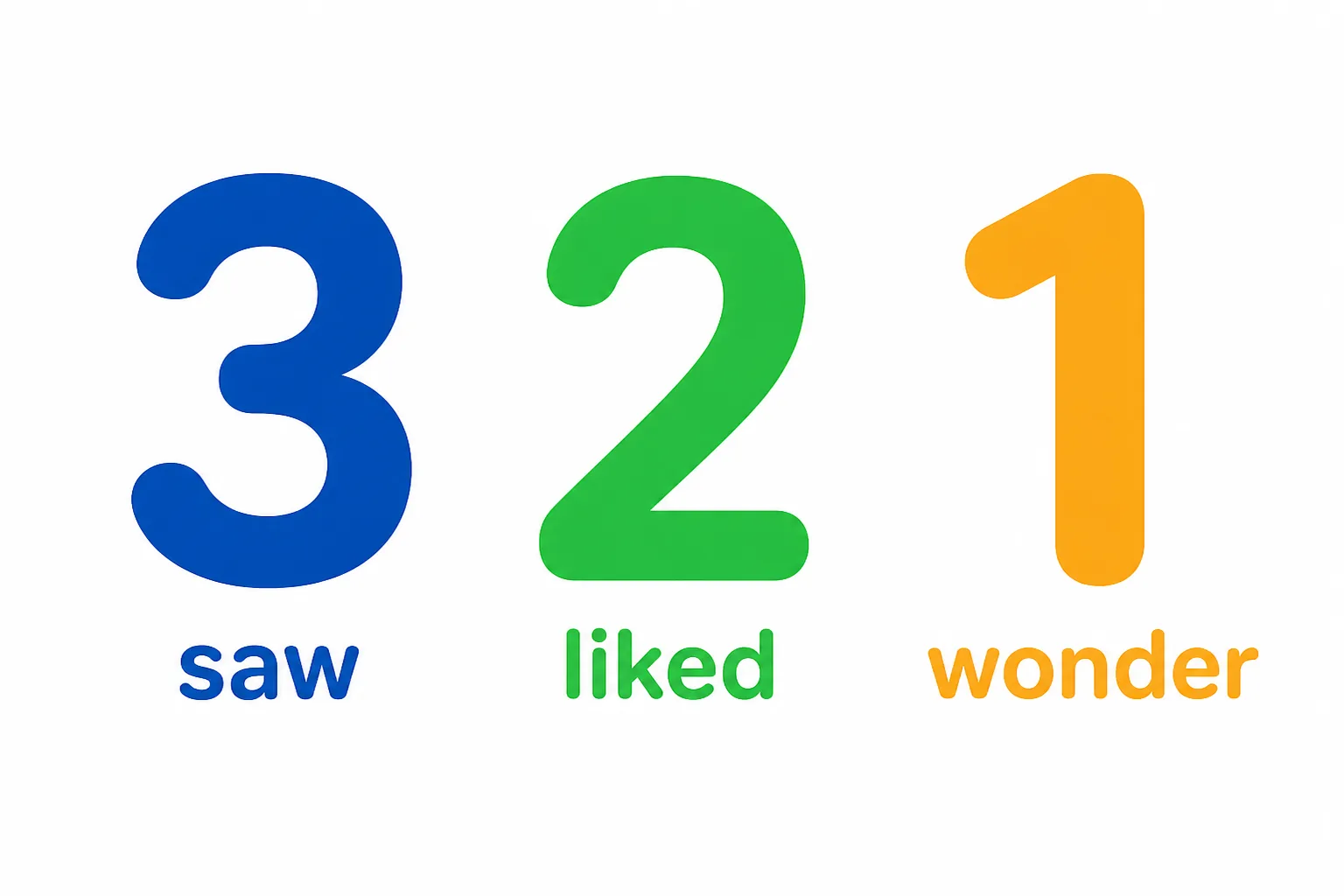
The 3-2-1 classroom assessment technique asks learners to name three things they noticed, two they liked, and one question they still have. For older students it is written; for pre-readers, make it verbal and visual, three things you saw, two you liked, one thing you wonder.
Other fast checks fit a preschool day well:
- Thumbs-up / thumbs-down after a story
- Emotion cards to gauge how a child feels about an activity
- “Show me” prompts at cleanup (“Show me the longest block”)
These take seconds and give real information. Assessment works best embedded in the moment, not bolted on at the end of the week.
Assessing STEM and Hands-On Learning in the 3–5 Age Group

Most assessment guides stop at literacy and behavior, but STEM activities for 3–5 year olds are rich assessment territory. When children build a ramp, predict which ball rolls faster, or replant a seed, you can observe reasoning that never shows on a checklist.
During hands-on learning, watch for prediction (“I think it will fall”), persistence after a tower collapses, and how a child explains a result. Note these the same way you note language: brief, factual, in context. Because ratings can drift, a study in ScienceDirect comparing teacher ratings with direct child assessments is a useful reminder to anchor observations in specific behaviors rather than general impressions. Preschool STEM activities give you those specifics in abundance.
Staying Standards-Compliant Without the Paperwork
Here is where good intentions collide with reality. Programs must align to their state early learning standards, plus Head Start ELOF and, often, CLASS® indicators. Mapping every observation to every standard by hand is where burnout starts. Guidance from the University of Nebraska–Lincoln stresses that assessment should inform teaching, not consume it.
This is the gap Learning Beyond Paper was built to close. It is an all-in-one, 100% cloud-based early childhood curriculum that maps 52 weeks of research-based lesson plans to all 50 state standards, Head Start ELOF, and CLASS®, so the alignment work is already done. Content is bilingual at no extra cost, fully paperless, and includes a virtual instructional coach (ELBY) that offers teachers in-the-moment feedback. For programs running afterschool alongside their preschool rooms, or directors managing multiple sites, the same platform scales without new binders or add-on fees.
See how embedded assessment and professional development work together in the full preschool curriculum overview, or take a quick product demo.
Frequently asked questions
What are the methods of assessment in preschool?
What is the 3-2-1 classroom assessment technique?
What is the difference between CLASS® and a child assessment?
How often should preschool teachers assess children?
Where can I find free class assessment strategies for preschool teachers?
Key Takeaway
The best assessment strategy is the one that fits a real classroom day: observation-driven, play-based, aligned to your standards, and light on paperwork. Understand CLASS® for what it is, lean on quick formative checks, and let your curriculum carry the compliance weight so your attention stays on the children. If the documentation load is what is wearing your team down, that is exactly the burden Learning Beyond Paper was designed to lift.