
Someone tells you to “make sure you’re ELOF-aligned,” and then you’re staring at a document well over a hundred pages long, wondering where to even start. Take a breath.
ELOF is the destination, not the route. It lays out what children should know and be able to do from birth to age five, and leaves the how entirely up to you.
This guide covers what ELOF actually is, how its five domains break down, and how programs use it day to day without drowning in the paperwork.
What the Head Start Early Learning Outcomes Framework (ELOF) actually is
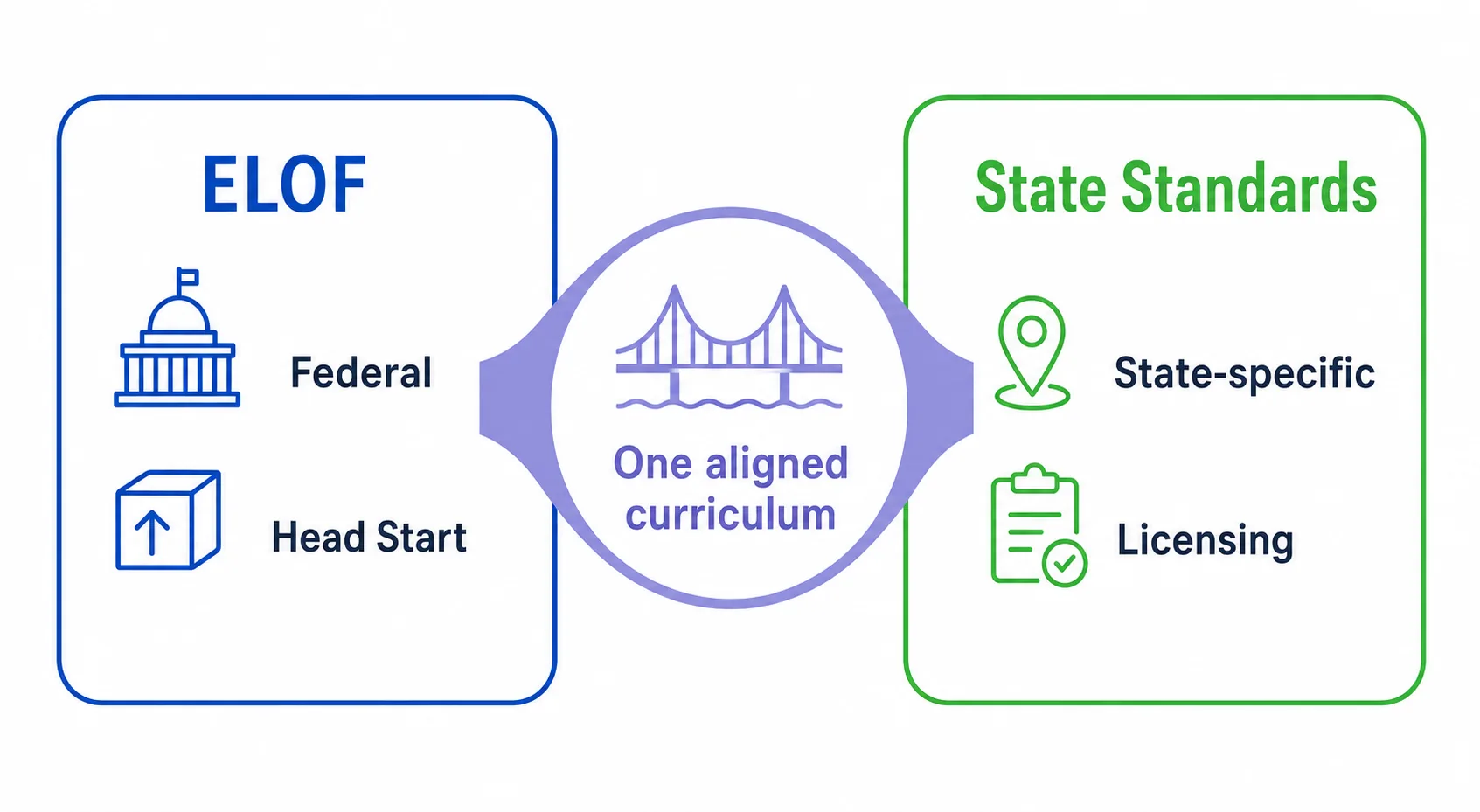
At its core, ELOF is a shared set of expectations. It describes the skills, behaviors, and knowledge that programs are expected to nurture in every child, from the youngest infants through preschoolers heading to kindergarten. The interactive version of the framework puts it plainly: it lays out what children should learn and do across five central developmental domains.
It helps to be clear about what ELOF is not. It is not a curriculum, and it is not an assessment. It won’t tell you which lesson to teach on Tuesday morning or hand you a checklist to score a child. It’s the map of the destination; the curriculum is the route you choose, and assessment is how you check your progress along the way.
Every Head Start and Early Head Start program uses it, and plenty of state-funded and private programs lean on it too, because it reflects broadly accepted ideas about early development.
| ELOF | Curriculum | Assessment | |
|---|---|---|---|
| What it is | A framework of goals and expectations | The lessons and activities you use to teach | How you check a child’s progress |
| Answers | What should children learn? | How do we teach it? | Where is each child on the progression? |
| Set by | Office of Head Start | Your program’s choice | Your program’s chosen tool |
The five central domains of ELOF
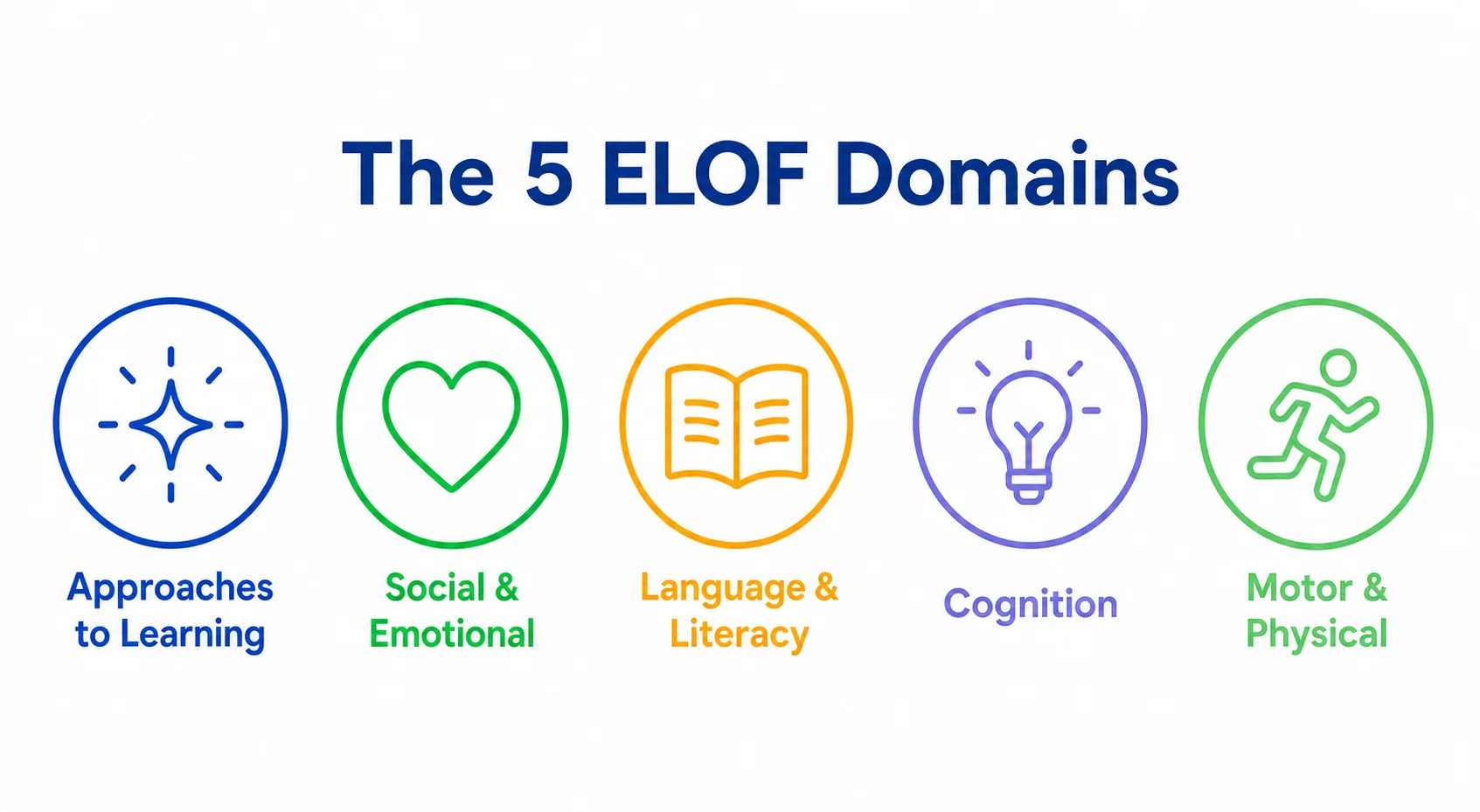
ELOF organizes early learning into five broad domains. Here’s what each one looks like in a real classroom.
Approaches to Learning
This is the “how children learn” domain: curiosity, persistence, attention, and the early self-regulation skills often called executive function. A toddler who keeps trying to fit a shape into a sorter, or a four-year-old who waits for a turn, is building here.
Social and Emotional Development
This domain covers relationships, understanding and expressing feelings, and a growing sense of self. Decades of research summarized in resources like Harvard’s Explore SEL tie these early social-emotional skills to later school success. In practice, it’s the comfort of a trusted teacher and the language to say “I’m frustrated” instead of throwing a block.
Language and Literacy
Communication, vocabulary, and the earliest reading and writing skills live here. This is where a language-rich classroom matters, and where the Science of Reading offers a strong foundation: building phonological awareness, vocabulary, and comprehension through everyday talk, songs, and shared books.
Cognition
This domain holds early math and scientific reasoning, plus problem-solving. Counting snacks, noticing patterns, sorting by color, and testing what floats are all cognition in action. It’s also the natural home for STEM in the early years.
Perceptual, Motor, and Physical Development
Gross motor (running, climbing), fine motor (holding a crayon, using scissors), and health and safety habits round out the five. Movement isn’t a break from learning; it is learning at this age.
Head Start’s Early Learning Outcomes Framework (ELOF) covering language, motor skills, cognitive growth, and emotional development.Read on LinkedIn ↗
How ELOF is organized: domains, sub-domains, goals, and developmental progressions
Once you understand the structure, the size of the document stops feeling intimidating. ELOF nests from broad to specific: the five domains each break into sub-domains, which contain goals, which are supported by developmental progressions and indicators. Those progressions are then shown by age group, roughly infant, toddler, and preschool.
The throughline is continuity. As the background on the framework’s development describes, learning is treated as one connected path from birth to five rather than three disconnected stages. So when you read a goal, you can trace how it looks for a six-month-old, then a two-year-old, then a four-year-old. That’s the whole reason the document is long: it’s showing the same goals growing up alongside the child. Read it that way and it becomes a reference you dip into, not a manual you memorize.
ELOF is the map of the destination; the curriculum is the route you choose, and assessment is how you check your progress along the way.
What ELOF means for what a child learns in preschool
Directors and parents rarely ask, “How does the Cognition sub-domain progress?” They ask, “What should a child learn in preschool?” ELOF answers that, and it stretches wider than most people expect, because it starts at birth.
Map the domains onto familiar preschool subjects and it clicks: early literacy (Language and Literacy), early math and science (Cognition), social skills and self-control (Social and Emotional plus Approaches to Learning), and physical coordination (Perceptual, Motor, and Physical Development).
For a two-year-old in daycare, the same domains apply at an earlier point on the progression, which is why quality care for that age isn’t just supervision. It’s language exposure, motor play, and the first steps toward self-regulation.
A Head Start curriculum built on the Early Learning Outcomes Framework organizes daily lessons around these domains so nothing important slips through the cracks.
ELOF and STEM in the early years
Because the Cognition domain includes early math and scientific reasoning, STEM isn’t an extra subject you bolt on. It’s woven into play. A few concrete STEM activities for three-to-five-year-olds that map cleanly to ELOF goals:
- Sorting and classifying: group buttons or leaves by size, color, or shape (early math, patterns).
- Simple measurement: use cubes or hands to compare which tower is taller (measurement concepts).
- Cause-and-effect exploration: ramps and rolling balls, or a sink-or-float bucket (scientific reasoning and prediction).
Add art and storytelling and the same activities become STEAM. The point isn’t fancy materials. It’s asking good questions while children explore, which builds the exact skills the framework names.
How programs actually use ELOF (curriculum, assessment, and PD alignment)
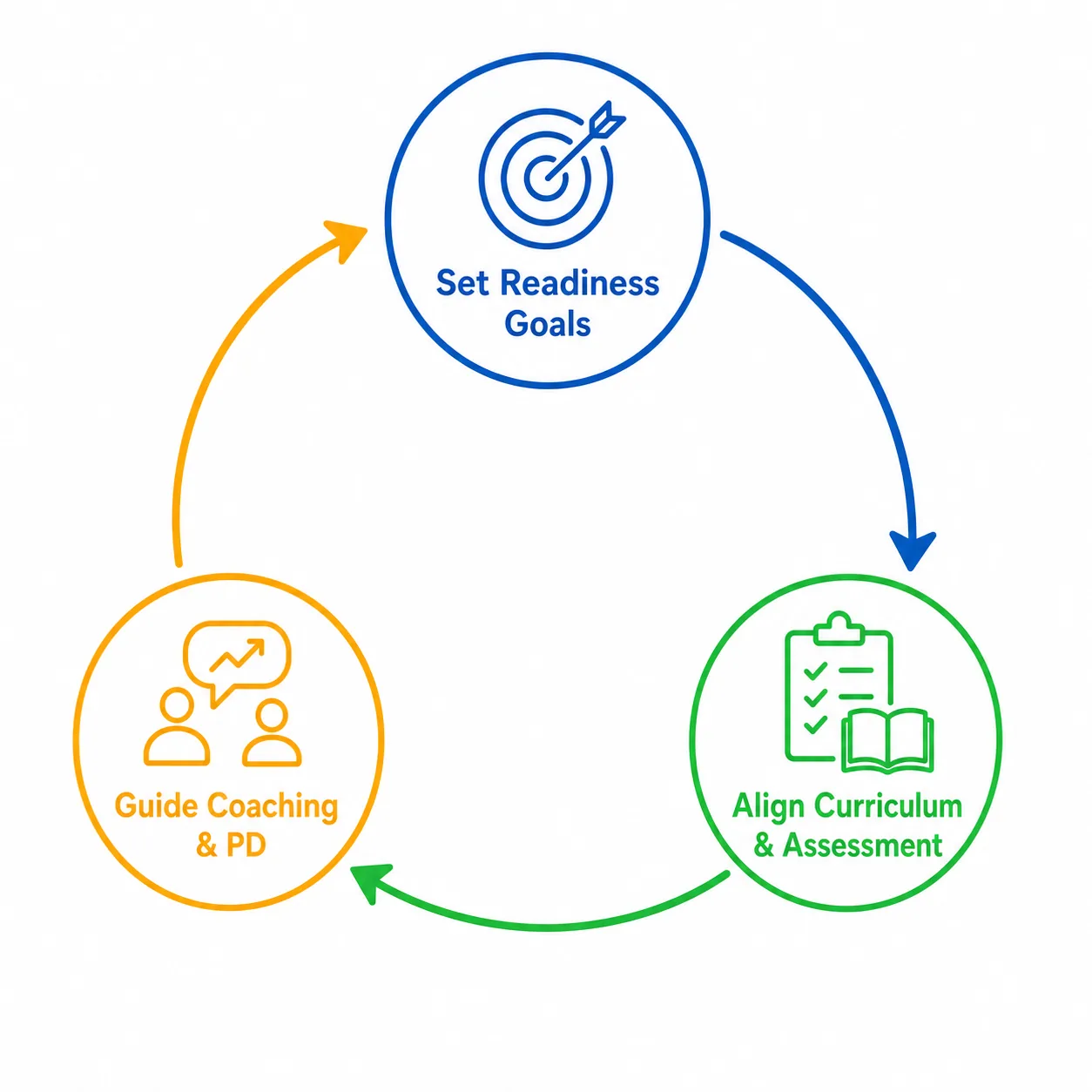
Here’s the “so what do I do with it” part. ELOF is designed to help programs align three things to school-readiness goals: curriculum, child assessment, and professional development. Think of it as a loop. You teach toward the goals, you observe and assess where each child is on the progression, and you adjust instruction based on what you see.
Many programs pair this with the Classroom Assessment Scoring System (CLASS) as an observation lens for the quality of teacher-child interactions.
For Head Start grantees, this alignment is a compliance reality, not a nice-to-have. Doing it by hand, cross-referencing lessons against the framework page by page, eats hours.
That’s why many programs choose a curriculum aligned to state standards and Head Start ELOF so the mapping is built in. (If you want the step-by-step of that alignment work, that’s a topic worth its own deep dive.)
VELS are aligned with the: Head Start Early Learning Outcomes Framework Common Core State Standards (English Language Arts and Mathematics)Read on LinkedIn ↗
Where to find the ELOF PDF and a quick-reference cheat sheet

The official framework is free. You can download the full PDF and use the interactive online version, both hosted on HeadStart.gov, along with the ELOF2GO mobile app and other interactive tools that make it easier to browse domains and goals on the go.
Want the one-glance version? Here’s the whole framework in five lines:
| Domain | What It Covers |
|---|---|
| Approaches to Learning | Curiosity, persistence, self-regulation |
| Social and Emotional Development | Relationships, feelings, sense of self |
| Language and Literacy | Communication, vocabulary, early reading and writing |
| Cognition | Math, scientific reasoning, problem-solving |
| Perceptual, Motor, and Physical Development | Motor skills, health, safety |
Pin that near your planning space and you’ve got a working cheat sheet.
Frequently asked questions
Is ELOF a curriculum?
What ages does the Head Start ELOF cover?
How many domains are in the ELOF?
Is ELOF required for non-Head Start programs?
Where can I download the ELOF PDF or cheat sheet?
Keeping your program aligned without the paperwork
Understanding ELOF is the easy part. Keeping curriculum, teaching, and professional development aligned to all five domains, week after week, is the work that wears teachers down.
That’s where an all-in-one, cloud-based curriculum built around the framework earns its keep: Infant through Pre-K 4 in one place, bilingual English and Spanish content, embedded professional development, and ELBY, a virtual instructional coach that answers teachers’ questions in the moment.
Alignment is baked into the daily lessons, so your staff spend less time cross-referencing documents and more time with the children.
If you’d like to see how that looks in a real classroom, watch a quick demo and try it in your own program.