
Choosing a preschool curriculum is rarely a quick yes-or-no decision. Directors have to weigh lesson quality, teacher support, assessment, family communication, bilingual resources, budget, state standards, and whether the curriculum will actually work on a busy Tuesday morning with a short-staffed classroom.
This guide compares the strongest Teaching Strategies alternatives for childcare centers, preschools, Head Start programs, family childcare providers, and multi-site early learning organizations. The goal is not to crown one winner for every program. It is to show where each curriculum fits best, where it may fall short, and what directors should check before they switch.
When people search for Teaching Strategies alternatives, they may mean two different things. Some are looking for new classroom teaching methods, such as instructional strategies examples, co-teaching models, parallel teaching, station teaching, or different types of teaching styles. That is a separate topic.
This article focuses on alternatives to the Teaching Strategies early childhood ecosystem, especially The Creative Curriculum and GOLD assessment. For many preschool directors, that is the real search intent. They already know Teaching Strategies has a strong name in early childhood education. Now they want to know what else is available, how those options compare, and whether another curriculum may be a better fit for their teachers, families, and budget.
Teaching Strategies can be a strong choice for programs that want a broad connected ecosystem with curriculum, assessment, professional development, reporting, family engagement, and classroom materials. Its preschool solutions position the company around a single connected platform for curriculum, assessment, family engagement, classroom materials, and professional development. GOLD also gives administrators a formative assessment tool aligned to state early learning standards and the Head Start Early Learning Outcomes Framework.
Still, not every program wants the same level of system depth. Some directors want a lighter lift. Some want a cloud-based curriculum with less paper. Some need stronger day-to-day support for newer teachers. Others want a curriculum that feels easier to budget, easier to roll out, or easier to use across classrooms without a long implementation runway. That is where Teaching Strategies alternatives deserve a close look.
A good curriculum is more than a list of lesson plans. It shapes classroom teaching, daily routines, observation habits, family communication, and the way teachers respond to children’s interests. The best early childhood curriculum should support effective teaching practices without making teachers feel boxed in.
Google’s guidance for high-quality review content recommends that comparisons evaluate products from a user’s perspective, show knowledge of the category, explain what sets products apart, and provide useful evidence rather than thin summaries. That same standard applies here. A useful comparison of Teaching Strategies alternatives should not just say “this one is better” or “this one is cheaper.” It should help directors see the trade-offs.
A director may care about age coverage first. A Head Start administrator may care more about ELOF alignment, CLASS indicators, assessment, and documentation. A family childcare provider may need mixed-age flexibility. A newer teacher may need practical teaching tips, clear lesson plans, and real-time support. A bilingual program may need English and Spanish resources built into the curriculum, not treated like an add-on.
NAEYC’s Young Children article on playful learning states, “Playful learning pedagogies support development across domains and content areas and increase learning relative to more didactic methods.” That point matters in any curriculum comparison. The right choice should help teachers guide play, extend language, notice development, adapt activities, and build classroom relationships. It should not simply hand teachers a script.
| What Directors Should Compare | Why It Matters in Real Classrooms |
| Age coverage | Some programs need infant, toddler, preschool, and Pre-K support in one place, while others only need a preschool or Pre-K solution. |
| Curriculum format | Cloud-based, print-based, kit-based, and hybrid models all affect how teachers plan and deliver lessons. |
| Teacher support | Newer teachers often need clear guidance, examples of instructional strategies, and coaching support during the day. |
| Assessment and documentation | Programs that report to state, district, Head Start, or QRIS systems need reliable observation and progress tools. |
| Standards alignment | State early learning standards, Head Start ELOF, CLASS indicators, and developmentally appropriate practice should guide curriculum choice. |
| Bilingual access | English and Spanish resources can support dual language learners and strengthen family engagement. |
| Budget clarity | Directors need to understand whether pricing is school-wide, per classroom, per teacher, per child, or enterprise-based. |
| Ease of implementation | A strong curriculum can still struggle if teachers need too much training before they feel confident using it. |
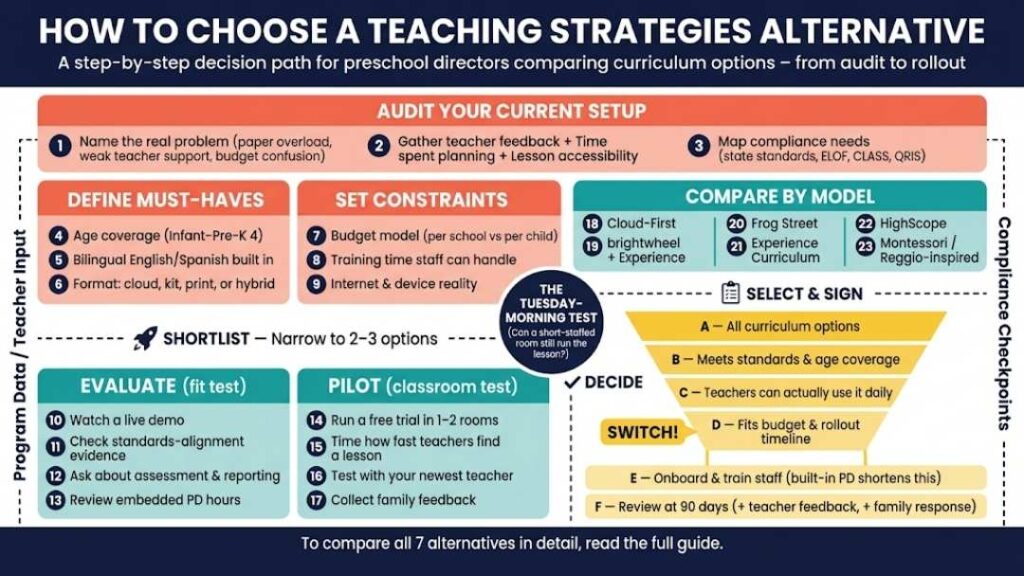
No comparison table can capture every classroom reality, but this side-by-side view helps narrow the choice. Each option below has a clear best-fit use case and a real trade-off.
| Curriculum or Approach | Best For | Format | Strongest Advantage | Main Trade-Off |
| Learning Beyond Paper | Cloud-first childcare centers, smaller programs, newer teachers, bilingual classrooms | 100% cloud-based curriculum | Digital lesson plans, teacher support, bilingual content, professional learning, and school-wide access | Programs that need a deep assessment-first ecosystem may still compare it closely with GOLD |
| Frog Street | Structured Pre-K programs and classrooms that want predictable routines | Print, digital, and kit-supported model | Strong Pre-K structure, dual-language support, and Conscious Discipline integration | Materials and implementation may require more classroom management than a fully digital system |
| HighScope | Programs that value active learning, child choice, and Plan-Do-Review | Philosophy-based curriculum with training and materials | Strong educational model and executive function focus | Requires staff buy-in, training, and fidelity to the model |
| Experience Curriculum | Family childcare and programs that like monthly hands-on materials | Monthly kit-based curriculum with digital support | Ready-to-use materials, lesson plans, assessment tools, and family engagement | Less ideal for programs that want a no-box, fully cloud-based workflow |
| brightwheel Experience Curriculum | Centers that want curriculum inside a broader childcare management platform | App-based curriculum plus operations software | Lesson plans, observations, family communication, billing, and admissions in one platform | Best fit when the program also wants the brightwheel management ecosystem |
| Montessori-Inspired Curriculum | Programs built around independence, choice, and prepared environments | Philosophy-based classroom model | Child-led, hands-on, self-paced learning | Requires trained guides, specific materials, and a consistent classroom environment |
| Reggio Emilia-Inspired Curriculum | Project-based, inquiry-led programs with strong documentation | Philosophy-based approach | Child-led projects, relationships, creativity, and visible learning | Harder to standardize across sites without experienced educators |
The following are the best teaching strategies alternatives
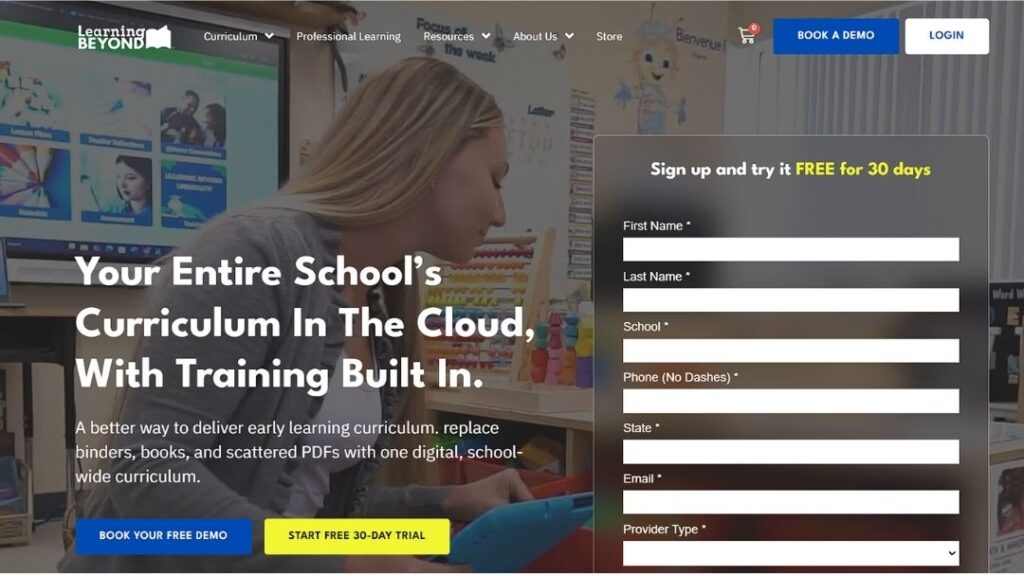
Learning Beyond Paper is one of the clearest Teaching Strategies alternatives for programs that want curriculum to be easier to access, easier to budget, and easier for teachers to use every day. Instead of binders, paper kits, or scattered files, it gives teachers a cloud-based platform with lesson plans, activities, bilingual content, embedded professional learning, and a virtual instructional coach.
The Learning Beyond Paper curriculum includes 52 weeks of developmentally appropriate lesson plans and more than 4,000 hands-on, play-based activities for children from infants through Pre-K 4. Its model is especially relevant for childcare centers that want one curriculum across age groups rather than separate products for each classroom.
Its biggest difference is not only that it is digital. Plenty of early childhood products now include digital tools. The stronger point is that Learning Beyond Paper combines curriculum, teacher guidance, professional development, bilingual family support, and standards alignment inside one platform.
It also includes 49.5 hours of embedded professional development through Learning Beyond University, which gives directors a stronger training foundation without turning professional learning into a separate paid add-on. ELBY, the platform’s virtual instructional coach, helps teachers with lesson support, family engagement, behavior guidance, and classroom questions. That matters for programs with newer teachers who need more than a lesson title and a supply list.
For directors comparing curriculum options, the key point is fit: Learning Beyond Paper may suit programs that want less paper, faster access, and stronger day-to-day teacher support without a heavy setup process. It can also help programs that need clearer school-wide access, especially when multiple classrooms need to stay aligned.
Best for: Childcare centers, preschools, family childcare providers, and multi-site programs that want a cloud-first curriculum from Infant through Pre-K 4.
| Pros | Cons |
| Fully cloud-based | Needs reliable internet |
| Strong teacher support | Assessment needs should be checked |
| Built-in professional development | May not fit kit-based classrooms |
| Bilingual and standards-aligned | Enterprise pricing may vary |
Best-fit question: Do teachers need a curriculum they can open, understand, and use without digging through binders or waiting for extra support?
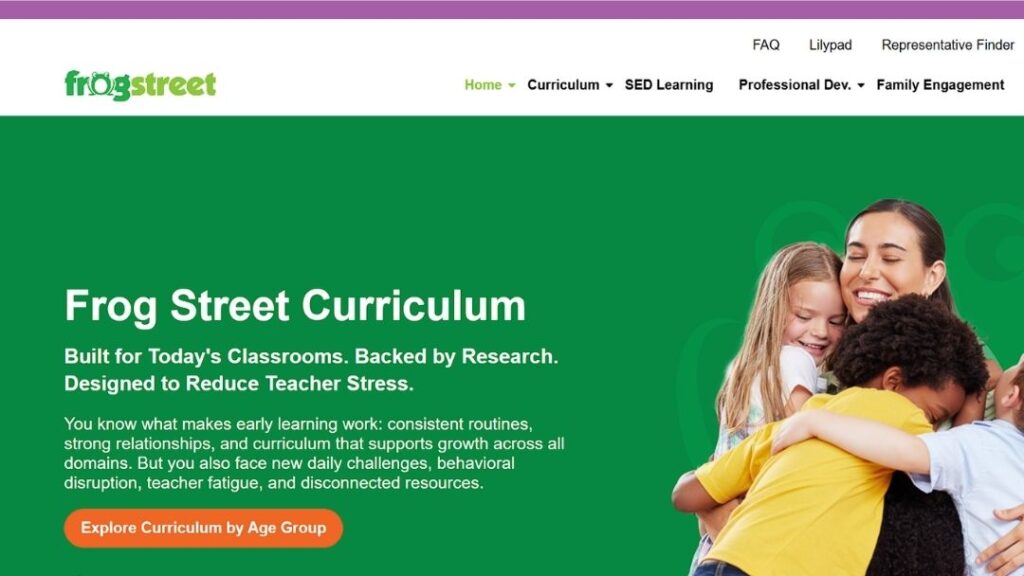
Frog Street is a well-known early childhood curriculum provider and a practical choice for programs that want structured Pre-K support, predictable routines, and dual-language materials. Its Pre-K curriculum highlights kindergarten readiness, pacing support, Head Start and state framework alignment, family tools, and bilingual activities. Frog Street also points to Conscious Discipline integration, which may appeal to programs that want social-emotional development woven into daily classroom practice.
For directors who prefer a more structured teaching methodology, Frog Street can feel reassuring. Teachers get daily and weekly lesson plans with clear objectives, and the curriculum gives classrooms a consistent path. That can be useful for programs where teachers need a steady routine, especially in Pre-K rooms that must prepare children for kindergarten expectations.
The trade-off is that Frog Street may feel more materials-based than a fully cloud-based solution. For some teachers, that is a plus. Having physical materials and clear routines can make lesson delivery feel concrete. For other programs, especially those trying to move away from storage-heavy curriculum systems, it may feel like more to manage.
Best for: Programs that want structured Pre-K lessons, dual-language materials, and social-emotional support through a familiar curriculum model.
| Pros | Cons |
| Strong Pre-K structure | More materials to manage |
| Dual-language support | Less fully paperless |
| Social-emotional focus | Training may be needed |
Best-fit question: Does your Pre-K team need a structured curriculum path with routines, visuals, and bilingual classroom materials?
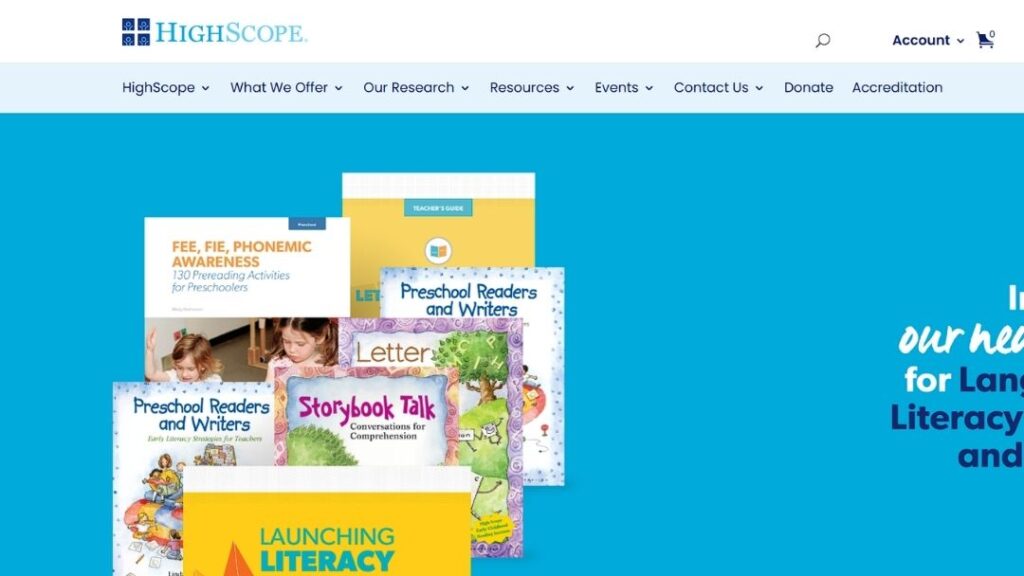
HighScope is different from many Teaching Strategies alternatives because it is not only a curriculum product. It is a full educational approach built around active learning, child choice, adult-child interaction, and the well-known Plan-Do-Review process. HighScope describes Plan-Do-Review as a core part of the daily routine, where children make choices, carry out their ideas, and reflect on their activities with adults and peers.
This approach can be powerful in classrooms where teachers have the confidence and training to follow children’s ideas while still supporting learning goals. It fits programs that value executive function, independence, problem-solving, and authentic child agency.
For directors, the question is not whether HighScope is respected. It is. The real question is whether the program has the staffing, coaching, and culture to implement it well. HighScope may not be the easiest answer for a center that needs ready-to-use preschool lesson plans tomorrow morning. It often works best when leaders are ready to invest in the method and help teachers understand why the daily routine matters.
Best for: Programs that value active learning, child choice, executive function, and a consistent daily routine built around Plan-Do-Review.
| Pros | Cons |
| Strong learning philosophy | Training is important |
| Supports independence | Requires staff buy-in |
| Good for hands-on classrooms | Not always open-and-go |
| Builds thinking skills | Fidelity matters |
Best-fit question: Is your team ready to commit to an active learning model, not just adopt a new set of lesson plans?
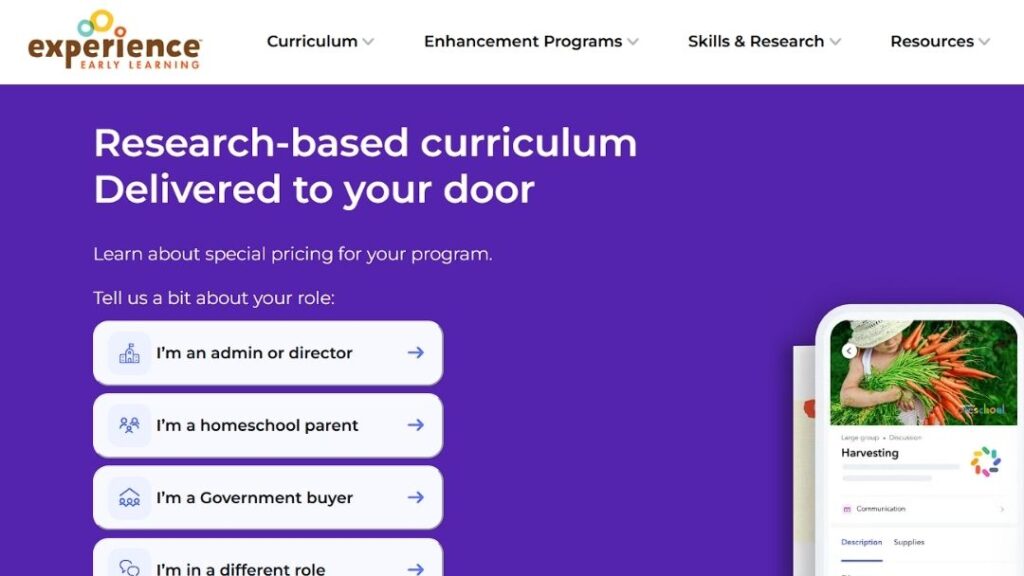
Experience Curriculum, also known by many educators through Mother Goose Time. It is a practical option for family childcare providers and smaller programs that like physical materials delivered with lesson plans. Its curriculum model includes lesson plans, learning materials, assessment tools, and family engagement resources for a month of hands-on learning.
This type of curriculum can work well for providers who want a box to arrive with the materials they need. That can save planning time and reduce the stress of creating everything from scratch. It may also appeal to teachers who prefer tactile materials over a fully digital workflow.
The trade-off is simple: monthly kits create a different kind of management task. Materials need to be received, stored, sorted, and used at the right time. Some programs love that rhythm. Others may prefer a digital curriculum that updates in the cloud and does not depend on boxes, binders, or material delivery.
Best for: Family childcare, smaller centers, and educators who want ready-to-use monthly materials with lesson plans and family engagement tools.
| Pros | Cons |
| Hands-on materials included | Requires storage space |
| Simple lesson planning | Less fully digital |
| Family engagement support | Delivery-based workflow |
| Practical for small settings | May feel less scalable |
Best-fit question: Would your teachers benefit from pre-planned hands-on materials, or would physical kits create more work for your team?
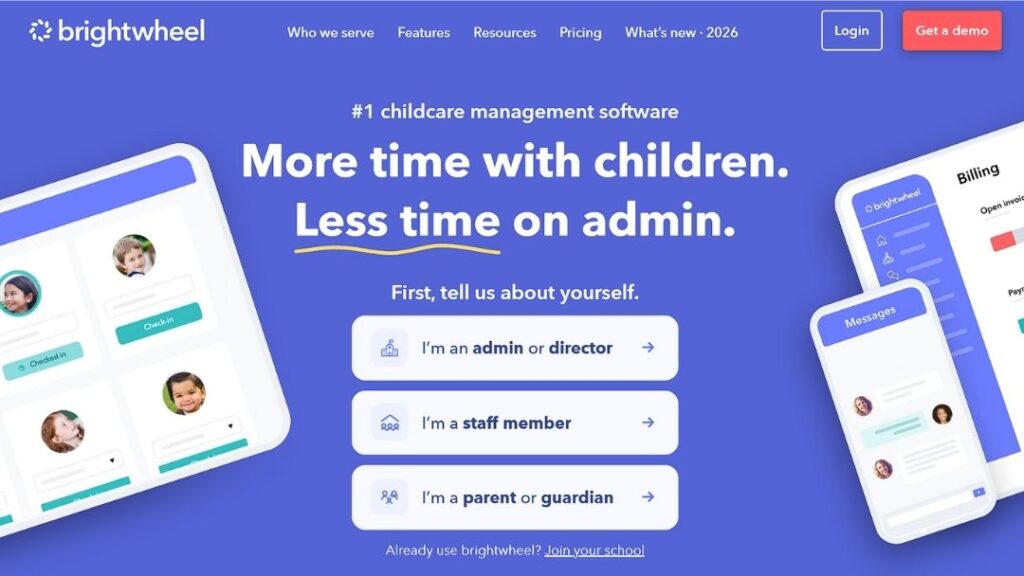
Brightwheel is not only a curriculum provider. Many directors know it as a childcare management platform for communication, billing, admissions, and classroom operations. Through Experience Curriculum in brightwheel, programs can access lessons, monitor child development, share progress with families, and connect curriculum work with daily center operations.
This makes brightwheel a strong fit for centers that want curriculum connected to daily operations. Teachers can use digital lesson plans, log observations, share family updates, and keep learning records inside a platform the center may already use. That can reduce tool-switching, which matters when teachers are short on time.
Still, brightwheel is best compared as an ecosystem choice, not just a curriculum choice. If a program wants curriculum plus billing, communication, admissions, and family updates, it may make sense. If the director only wants to replace a curriculum and does not want to shift operations into the brightwheel ecosystem, another option may be cleaner.
Best for: Centers that want curriculum, observations, family communication, and childcare management tools inside one platform.
| Pros | Cons |
| Connects curriculum with observations | Broader than curriculum only |
| Strong family communication tools | May be more than some centers need |
| Supports center operations | Platform fit matters |
| Useful for current brightwheel users | Less ideal for standalone curriculum buyers |
Best-fit question: Do you want curriculum inside your operations platform, or do you need a dedicated curriculum solution first?
A Montessori-inspired curriculum is a teaching approach built around independence, hands-on materials, self-paced work, and a carefully prepared environment. The Association Montessori Internationale describes Montessori environments as spaces with accessible furniture, varied work areas, and materials available for children’s free choice.
For programs that deeply value child independence, concentration, order, and self-directed learning, Montessori can be a strong fit. It offers a clear classroom identity and a recognizable philosophy that many families understand.
The challenge is fidelity. A Montessori-inspired classroom depends on trained guides, the right materials, a prepared environment, and a consistent view of the teacher’s role. It is not simply a set of creative teaching strategies that can be added to any classroom in a week. Directors should also consider whether their licensing demands, staffing model, and family expectations match the Montessori approach.
Best for: Programs centered on independence, self-paced work, hands-on materials, and prepared environments.
| Pros | Cons |
| Supports independence | Requires trained teachers |
| Strong classroom philosophy | Needs specific materials |
| Hands-on learning | Harder to standardize |
| Family appeal | Less open-and-go |
Best-fit question: Is your program built around Montessori principles, or are you only looking for a few child-led classroom ideas?
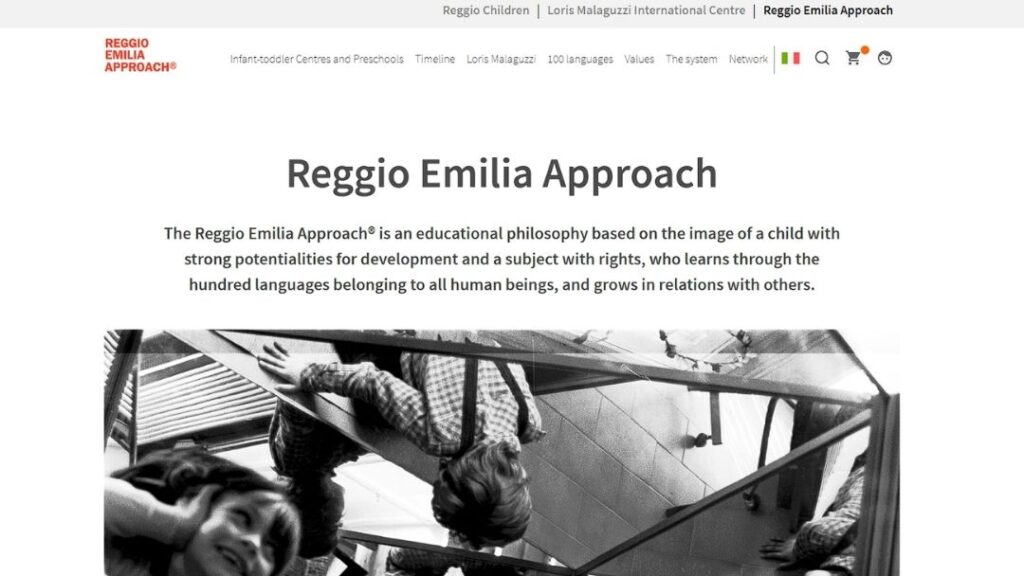
The Reggio Emilia approach is also a philosophy rather than a direct curriculum product. Reggio Children describes it as an educational philosophy based on the image of the child as capable, full of potential, and able to learn through relationships and many forms of expression. The Reggio Emilia approach is often associated with inquiry, projects, documentation, creativity, and the “hundred languages” of children.
A Reggio-inspired program may be a strong fit for teachers who can observe children’s interests, develop project work, document learning, and involve families in meaningful ways. It can make children’s thinking visible, which supports both family engagement and reflective teaching practice.
The challenge is that Reggio-inspired work can be harder to standardize. It depends heavily on teacher skill, observation, planning, and documentation. Directors with many sites or many newer teachers may need strong coaching systems before they can keep quality consistent.
Best for: Programs that value child-led inquiry, projects, creativity, documentation, and family-community relationships.
| Pros | Cons |
| Child-led learning | Harder to standardize |
| Strong creativity focus | Requires skilled teachers |
| Meaningful documentation | Less open-and-go |
| Relationship-centered approach | Can take more planning time |
Best-fit question: Do your teachers have the time and confidence to build curriculum from children’s questions and document learning well?
| Option | Best For | Not Best For |
| Learning Beyond Paper | Programs that want cloud-based curriculum access, bilingual support, embedded PD, and practical support for new teachers | Programs that want GOLD-style assessment to remain the center of the curriculum system |
| Teaching Strategies | Larger programs, Head Start agencies, districts, and teams that need a mature curriculum-assessment ecosystem | Smaller centers that want a lighter, simpler, cloud-first curriculum workflow |
| Frog Street | Pre-K teams that prefer structured routines, dual-language resources, and social-emotional support | Programs that want to avoid materials-heavy curriculum management |
| HighScope | Programs ready to commit to active learning and Plan-Do-Review with fidelity | Centers that need an easier open-and-use lesson plan system |
| Experience Curriculum | Family childcare and small programs that prefer hands-on monthly kits | Centers that want a fully paperless curriculum model |
| brightwheel Experience Curriculum | Centers that want curriculum inside childcare management software | Programs that only want curriculum, not a broader operations platform |
| Montessori-Inspired Curriculum | Schools built around independence, self-paced work, and prepared environments | Programs that need a standardized curriculum with easier staff turnover support |
| Reggio Emilia-Inspired Curriculum | Project-based programs with experienced teachers and strong documentation habits | Multi-site programs that need tighter standardization across classrooms |
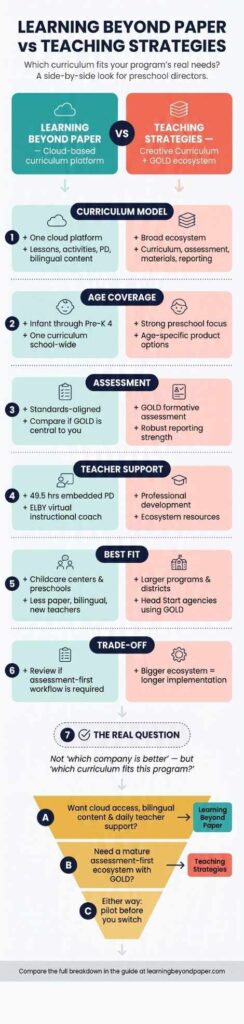
The most useful comparison is not “Which company is better?” The better question is, “Which curriculum fits this program’s real needs?”
Teaching Strategies Creative Curriculum may be a strong fit for larger programs, Head Start agencies, districts, and organizations that want a mature ecosystem with curriculum, GOLD assessment, family engagement, reporting, professional development, and classroom materials. The Creative Curriculum for Preschool is described as a research-based, play-based preschool curriculum for 3- and 4-year-olds with adaptability for children up to age 5. It also supports multilingual learners and offers flexibility in lesson planning.
Learning Beyond Paper may be a better fit for childcare centers that want cloud-based access, school-wide curriculum coverage from infant through Pre-K 4, bilingual English and Spanish resources, teacher guidance, and embedded professional development without relying on binders or physical curriculum kits. For smaller programs, its school-wide subscription can make budgeting clearer for directors; for larger or enterprise customers, pricing may vary based on scale and specific requirements.
| Decision Point | Teaching Strategies Creative Curriculum | Learning Beyond Paper |
| Curriculum model | Broad ecosystem with curriculum, assessment, family engagement, PD, reporting, and classroom materials. | Cloud-based curriculum platform with lesson plans, activities, teacher support, bilingual content, and embedded professional learning. |
| Age coverage | Strong preschool and age-specific curriculum options, with broader ecosystem support. | Infant through Pre-K 4 included in the core early childhood curriculum. |
| Assessment | GOLD is a major strength for programs that need robust formative assessment and reporting. | Standards alignment and teacher support are strong, but programs should compare assessment needs if GOLD is central to their process. |
| Teacher support | Professional development and ecosystem resources support implementation. | Embedded professional learning, 49.5 hours of on-demand PD, and the virtual instructional coach can help newer teachers during daily classroom work. |
| Best fit | Larger programs, districts, Head Start agencies, and teams already using GOLD or a connected Teaching Strategies ecosystem. | Childcare centers and preschools that want a simpler cloud-based curriculum, less paper, bilingual support, and practical teacher guidance. |
| Trade-off | May require a broader implementation plan due to the size of the ecosystem. | May require review if a program needs the deepest assessment-first workflow. |
The best Teaching Strategies alternatives depend on what problem you are really trying to solve. A director who wants stronger assessment may not choose the same option as a director who wants less planning stress. A Head Start administrator may have different priorities from a family childcare provider. That is why “best” should be tied to fit.
| Program Need | Best-Fit Option |
| Fully cloud-based curriculum for Infant through Pre-K 4 | Learning Beyond Paper |
| Strong connected ecosystem with assessment and reporting | Teaching Strategies |
| Structured Pre-K with routines and dual-language support | Frog Street |
| Active learning and Plan-Do-Review | HighScope |
| Monthly hands-on materials | Experience Curriculum |
| Curriculum inside childcare management software | brightwheel Experience Curriculum |
| Child independence and prepared environments | Montessori-inspired curriculum |
| Project-based inquiry and documentation | Reggio Emilia-inspired curriculum |
The Head Start Early Learning Outcomes Framework also matters for many buyers. Head Start ELOF presents five central domains of early learning for children from birth to age five. Programs that serve Head Start children, dual language learners, or children with disabilities should compare curriculum claims against those domains, not just against a sales page.
One common mistake is choosing by name recognition alone. A well-known curriculum can be the right fit, but only if teachers can use it well. The daily classroom test matters. If teachers cannot find lessons quickly, adapt them to children’s needs, or document progress without stress, the curriculum may not deliver the value leaders expected.
Another mistake is choosing by price alone. A lower-cost curriculum can become expensive if teachers need hours of extra planning or directors need to buy additional training, materials, or tools. At the same time, a higher-cost ecosystem may be worth it for programs that need assessment, reporting, compliance support, and district-level oversight.
Directors should also avoid comparing only the lesson plan library. Lesson plans are important, but early childhood teaching is relational. Effective teaching strategies depend on conversation, observation, play, classroom routines, and responsive support. A curriculum should help teachers make better choices, not simply keep them busy.
Bilingual support is another area where the details matter. A curriculum that includes English and Spanish content as part of the core experience may serve families differently from one that treats translation as a separate resource. For centers with dual language learners, this can affect teacher confidence and family trust.
Finally, implementation should never be an afterthought. A curriculum that looks impressive in a demo may still be hard to roll out if teachers feel overwhelmed. Directors should ask how long onboarding takes, what support teachers receive, how new staff learn the system, and whether the curriculum can survive staff turnover.
Before a center changes curriculum, the smartest step is to separate “what looks good” from “what will work here.” A curriculum switch affects teachers, families, records, standards, training, and daily classroom rhythm. These questions can help directors compare Teaching Strategies alternatives with less guesswork.
| Question | Why It Matters |
| Are we replacing curriculum only, or curriculum plus assessment? | Teaching Strategies GOLD may be central to some programs, so directors should check how assessment and reporting will work after any switch. |
| Do teachers need more daily lesson support? | This is where Learning Beyond Paper can stand out, especially for newer teachers who need practical help during the day. |
| Do we need English and Spanish resources built in? | Bilingual support is a key comparison factor for programs that serve dual language learners and multilingual families. |
| How much training can our staff realistically handle? | Some curriculum models need deeper staff training, coaching, and fidelity checks before teachers feel confident. |
| Do we want a cloud-first curriculum or a hybrid/kit-based model? | This separates Learning Beyond Paper from more materials-heavy options such as kit-based or print-supported programs. |
| What does our budget look like for one classroom versus the whole school? | Directors need true cost clarity, not surface pricing that changes after add-ons, training, or extra classrooms are included. |
No. Learning Beyond Paper and Teaching Strategies both support early childhood education, but they are built differently. Teaching Strategies is known for The Creative Curriculum, GOLD assessment, and a broad connected ecosystem. Learning Beyond Paper is a cloud-based early childhood curriculum with lesson plans, bilingual content, embedded professional development, and a virtual instructional coach for teacher support.
Learning Beyond Paper may be a strong Creative Curriculum alternative for childcare centers that want cloud-based access, school-wide curriculum coverage, less paper, bilingual resources, and practical support for newer teachers. Frog Street, HighScope, and Experience Curriculum may also fit, depending on the program’s preferred teaching methodology and implementation style.
Teaching Strategies is often considered by Head Start programs because of its GOLD assessment and broad ecosystem. Learning Beyond Paper, Frog Street, HighScope, and brightwheel Experience Curriculum may also be relevant if they meet the program’s ELOF, state standards, CLASS, documentation, and professional development needs. Head Start buyers should compare alignment evidence, reporting needs, and teacher support before choosing.
Learning Beyond Paper and Frog Street both deserve attention for bilingual classrooms. Learning Beyond Paper includes English and Spanish content inside its cloud-based curriculum, while Frog Street is known for dual-language Pre-K materials. The best choice depends on whether your team prefers a digital-first workflow or a more structured, materials-supported model.
For new teachers, ease depends on clarity, support, and classroom reality. Learning Beyond Paper may be a strong fit because teachers can access digital lesson plans, bilingual resources, professional learning, and help from a virtual instructional coach. Experience Curriculum may also help teachers who prefer hands-on kits and ready-to-use materials.
Teaching Strategies may be better for programs that want a mature ecosystem with strong assessment and reporting through GOLD. Learning Beyond Paper may be better for programs that want a cloud-based curriculum, school-wide access, less paper, bilingual content, embedded professional development, and practical daily teacher support. The better choice depends on the program’s staff, budget, compliance needs, and classroom workflow.
Directors should compare age coverage, lesson quality, teacher support, professional development, assessment tools, standards alignment, bilingual resources, family engagement, cost structure, onboarding, and the time teachers need to use the curriculum well. A curriculum switch should make teaching clearer, not add another layer of work.
The best curriculum is the one teachers can use with confidence, children can experience with joy, and directors can support without constant workarounds. Teaching Strategies has a strong place in early childhood education, especially for programs that want a broad ecosystem with assessment, reporting, professional development, and family engagement. It deserves a fair comparison, not a quick dismissal.
At the same time, many programs are ready to compare Teaching Strategies alternatives because their needs have changed. They may want a cloud-based curriculum, fewer paper materials, clearer budgeting, stronger bilingual support, or more practical help for teachers who are still building confidence in the classroom.
For childcare centers and preschools that want a digital curriculum with daily lesson support, bilingual English and Spanish content, embedded professional learning, and a virtual instructional coach, Learning Beyond Paper may be worth a closer look. Directors can review the platform, compare it with their current curriculum process, and decide whether it gives teachers the kind of support they need to spend less time searching for plans and more time with children.
To see how the curriculum works in practice, visit Learning Beyond Paper’s curriculum overview or schedule a walkthrough through the demo and booking.