
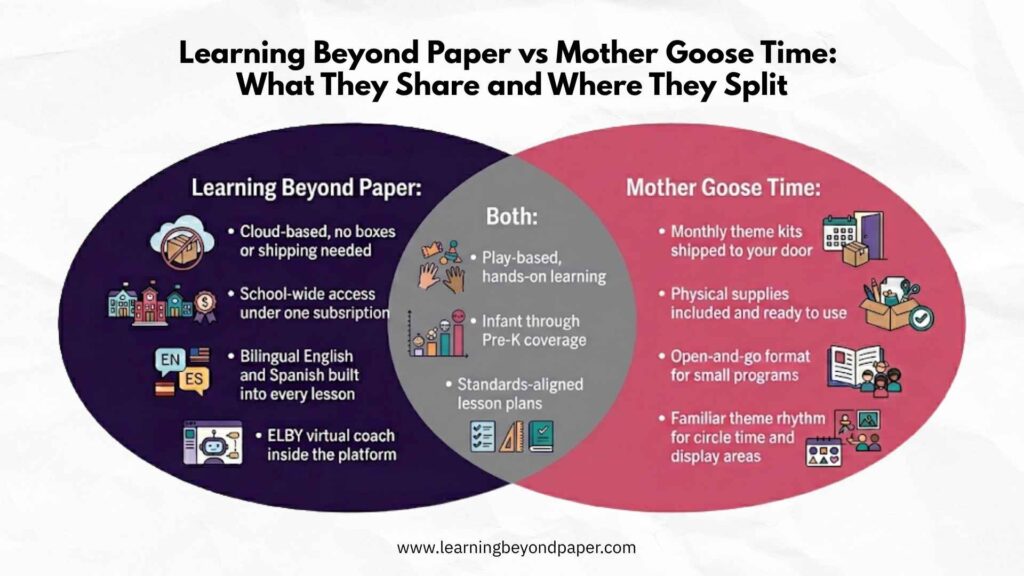
Choosing between Learning Beyond Paper and Mother Goose Time comes down to one main question: Does your program need a fully digital, school-wide curriculum system, or a monthly theme-based curriculum kit with physical materials? Both programs support early learning, play-based lessons, and preschool development. The difference lies in how each one fits into a real childcare day, how much prep it requires of teachers, and how easily it scales across classrooms.
Learning Beyond Paper vs Mother Goose Time is not a simple “good curriculum versus bad curriculum” choice. Both serve early childhood classrooms, and both aim to save teachers’ time. The better choice depends on the way your center runs.
Learning Beyond Paper is built for childcare centers, preschools, family childcare homes, Head Start programs, and school districts that want a cloud-based early childhood curriculum with lesson plans, bilingual resources, professional learning, family engagement, and a virtual instructional coach in one place. It is especially useful for programs that want less paper, faster access, and more consistency across rooms.
Mother Goose Time, now part of Experience Curriculum, is better known for its monthly theme-based curriculum boxes. It provides teachers with ready-to-use materials, hands-on activities, and daily lesson support that can be very practical for small programs, homeschool settings, and classrooms that prefer physical kits.
Here’s the thing: the best early childhood curriculum is not just the one with the prettiest materials. It is the one teachers can use with confidence on a hard Tuesday morning, when a toddler room is loud, one teacher is new, and a director still needs proof that learning goals are met.
| Category | Learning Beyond Paper | Mother Goose Time / Experience Curriculum |
| Best for | Childcare centers, preschools, multi-site operators, Head Start programs, school districts, and digital-ready teams | Family childcare providers, homeschool users, small programs, and classrooms that prefer monthly physical kits |
| Delivery model | 100% cloud-based curriculum | Monthly theme-based curriculum materials delivered to the door, with digital support |
| Age range | Infant through Pre-K 4 | Baby, toddler, preschool, and multi-age options |
| Lesson format | Digital lesson plans and activities accessible from devices | Printed and physical materials arranged around monthly themes |
| Teacher support | Built-in professional learning and ELBY, a virtual instructional coach | Teacher guides, prepared materials, coaching, and support resources |
| Bilingual support | English and Spanish are included in the platform | Available support varies by package and current Experience Curriculum options |
| Pricing model | Flat school-wide subscription message for smaller programs (enterprise pricing varies based on scale and requirements) | Customized pricing based on program details |
| Strongest fit | Programs that want paperless growth and a consistent curriculum use | Programs that want hands-on materials shipped and ready to open |
Many directors still search for Mother Goose Time because the brand has been around for years. Today, the company uses the Experience Curriculum name, while Mother Goose Time still appears in search, reviews, help documents, and older curriculum discussions. In practical terms, when people say mother goose time, mother goose curriculum, mothergoose time, or mother goose preschool curriculum, they are usually talking about the same product family now connected to Experience Early Learning.
It also affects how buyers interpret what they find. A director may hear “Mother Goose Time” from a colleague, search for Mother Goose Time reviews, land on Experience Curriculum, and wonder whether it is the same thing. The short answer is yes: the current Experience Curriculum grew from Mother Goose Time, and its own help content explains that Mother Goose Time was renamed Experience Curriculum in 2018 to better reflect the company’s mission.
The product still leans into the strengths that made Mother Goose Time popular: monthly themes, playful projects, tangible materials, and activities that fit into routines such as circle time, outdoor play, snack time, and small-group lessons.
A preschool program cannot run on cute crafts alone. Strong early childhood curriculum programs need age-appropriate lesson design, child development alignment, teacher usability, family communication, assessment support, and enough flexibility for real classrooms.
That is why the comparison between Learning Beyond Paper vs Mother Goose Time should start with practice, not packaging. Directors need to know whether teachers can plan faster, adapt lessons, document learning, support dual language learners, and keep classrooms consistent.
The National Association for the Education of Young Children gives a useful standard for judging both programs. NAEYC defines developmentally appropriate practice as “methods that promote each child’s optimal development and learning.” That short line should sit at the center of any curriculum decision. If a curriculum saves time but does not support real development, it is not enough. If it is research-based but too hard for teachers to use, it may sit on a shelf.
Learning Beyond Paper answers this problem through a digital curriculum model. It includes 52 weeks of lesson plans and more than 4,000 play-based activities across infant, toddler, preschool, and Pre-K classrooms. Directors can explore how this applies by age through its infant curriculum, young toddler curriculum, older toddler curriculum, preschool curriculum, and Pre-K curriculum.
Mother Goose Time answers the same need differently. Its experience curriculum uses monthly themes, daily materials, and play-based projects that arrive ready for use. For teachers who like to hold the activity pieces in hand, this can feel simple and reassuring.
The clearest difference in Learning Beyond Paper vs Mother Goose Time is delivery.
Learning Beyond Paper is a cloud-based curriculum. Teachers open the platform and access lessons, activities, professional learning, and support without waiting for boxes or sorting physical packets. This can help a director who manages several classrooms, several sites, or a team with frequent staff changes. Everyone works from the same curriculum source, and updates do not depend on a new shipment.
Mother Goose Time uses a monthly theme model. The appeal is easy to understand. Teachers receive materials tied to a monthly theme, often with daily activities and supplies organized in a way that reduces planning stress. For a family childcare provider or small preschool room, that “open the box and go” feeling can be a lifesaver.
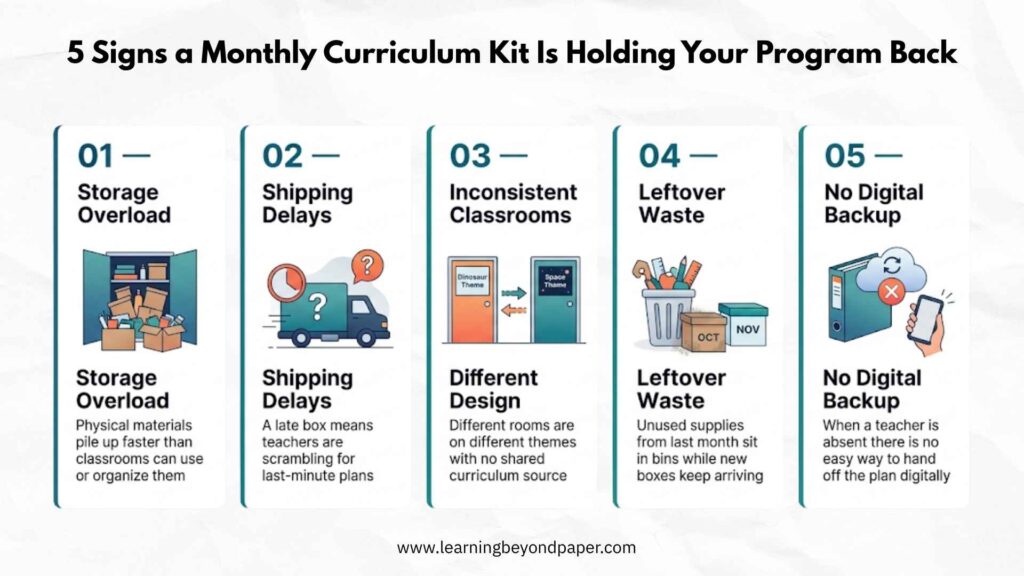
But here’s the problem. A physical kit can also create storage issues, supply tracking, shipping delays, and waste if a classroom skips activities or has too many leftover materials. A digital curriculum avoids those issues, but it may ask teachers to feel comfortable with screens and to use classroom materials already on hand.
A center director should ask a plain question: Do my teachers need materials shipped to them, or do they need a clearer plan and better support?
If the answer is shipped materials, Mother Goose Time may fit. If the answer is a school-wide system with less paper and more consistency, Learning Beyond Paper may be the stronger fit. Programs that are ready to leave binders and scattered PDFs behind may also find moving from paper curriculum to digital curriculum helpful.
Searches for Mother Goose curriculum cost, Mother Goose time curriculum price, and Mother Goose time coupon code show that buyers care about affordability. Fair enough. Curriculum is not a small decision, especially for childcare centers with thin margins.
Learning Beyond Paper’s public-facing message is built around a flat subscription model for smaller programs. The company presents its core curriculum as a school-wide offering, including professional learning, bilingual content, and ELBY, which makes budgeting more predictable for directors. For larger or enterprise customers, pricing may vary based on scale and specific requirements. This positioning remains simple to understand and helps reduce concerns about add-on costs.
Mother Goose Time, through Experience Curriculum, uses a customized pricing approach. Its pricing section asks about the buyer’s role, program type, and enrollment details before giving a quote. That can be useful if pricing truly adjusts to program size. Still, some directors prefer to know the number before they book a call.
| Cost factor | Learning Beyond Paper | Mother Goose Time / Experience Curriculum |
| Public pricing clarity | Stronger flat-price message for smaller programs (enterprise pricing varies by scale and requirements) | Quote-based pricing |
| Materials cost | Uses classroom materials already available | Materials arrive monthly as part of the kit model |
| Storage and shipping | No physical curriculum shipment needed | Monthly boxes need storage and delivery management |
| Professional learning | Included in the LBP model | Support and coaching depend on the current package details |
| Best value for | Centers that want one digital system across classrooms | Programs that value physical supplies and monthly themes |
Cost should not be judged by subscription price alone. A director should also count teacher prep hours, training needs, materials waste, printing, storage, and the time lost when staff cannot find what they need.
That is where Learning Beyond Paper may have an edge for larger centers. A school-wide curriculum can help reduce inconsistency from room to room. Mother Goose Time may hold the edge for programs where teachers want ready-packed materials and a familiar monthly rhythm.
Curriculum often fails for one boring reason: implementation. The lesson plan may look good, but teachers still need to know what to do, how to adapt it, and how to document what children learn.
Learning Beyond Paper puts teacher support close to the curriculum through embedded professional learning and ELBY, its virtual instructional coach. That matters for digital-native teachers and newer staff who may need answers in the moment. Instead of flipping through binders or waiting for a director, a teacher can get support while the lesson is still relevant.
This can help with real classroom challenges such as toddler transitions, behavior guidance, language development, and family communication. For example, a teacher who needs better structure for toddlers may benefit from structured activities for young toddlers or ideas for a developmentally appropriate toddler curriculum.
Mother Goose Time supports teachers through prepared guides, monthly materials, and a planned routine. Teachers who prefer a tactile program may appreciate that. There is less guesswork around supplies because many items arrive in the kit. In a small program, it can reduce decision fatigue.
The tradeoff is that physical materials do not replace ongoing coaching. They help with prep, but they may not answer a teacher’s question when a child refuses to join circle time or when a lesson needs quick adaptation.
Mother Goose Time is closely associated with monthly theme plans and circle time activities. That can be a major strength. Themes help children connect ideas across stories, songs, art, movement, and pretend play. They also help teachers organize a month without starting from scratch every Monday.
Learning Beyond Paper also supports structured routines, but the product is not built around mailed theme boxes. Its value lies in digital access, age-level lesson plans, and adaptable activities. A preschool teacher can still plan circle time, music, STEAM, story, and small-group work, but the materials do not arrive as a monthly kit.
If circle time is a major focus for a preschool team, directors should compare how each curriculum helps teachers move from welcome songs to active participation, language prompts, story questions, and calm transitions. Understanding how to plan circle time for preschoolers, which can support teachers even before a full curriculum decision.
In short, Mother Goose Time may feel more familiar to teachers who like theme kits. Learning Beyond Paper may suit teams that want the structure without the boxes.
Directors do not choose curriculum only for classroom charm. They also need proof. Licensing visits, Head Start reviews, QRIS requirements, school readiness goals, and family communication all ask for documentation.
Learning Beyond Paper states that its curriculum aligns with all 50 state early learning standards, Head Start ELOF, and CLASS indicators. Directors who need to prove that alignment during a review can follow our step-by-step ELOF alignment process for directors, which covers mapping domains and building the documentation reviewers ask for.
It also supports documentation through its digital structure. That can help a director who wants cleaner records and less manual tracking, especially when considering Texas curriculum alignment, Florida curriculum resources, Georgia early learning support, New York curriculum support, and Massachusetts early childhood curriculum.
Mother Goose Time also promotes alignment with state and national standards, NAEYC, and Head Start. Its curriculum uses research-based skills and play-based projects. For programs that need an approved curriculum, the key step is to check the exact state, funding source, or agency requirement before purchase. “Approved curriculum” can mean different things in different contexts.
The Head Start Early Learning Outcomes Framework is useful here because it focuses on developmental domains and school readiness. Programs can also use the official Head Start ELOF resources to check whether any curriculum supports the domains they must document.
Learning Beyond Paper’s documenting learning outcomes in early childhood is a relevant resource for directors who want to strengthen classroom records.
Learning Beyond Paperworks best when a program wants one curriculum source across rooms, ages, and teachers. It is not just about going digital; it is about making daily planning easier to manage.
| Pros | Cons |
| Gives directors and teachers one cloud-based curriculum source instead of binders, printed packets, and scattered files. | Teachers who prefer printed materials or theme boxes may need time to adjust. |
| Supports infant, toddler, preschool, and Pre-K classrooms in one system. | Classrooms still need basic supplies for hands-on activities. |
| Includes bilingual English and Spanish content, which helps programs serve more families. | A weak internet setup can slow down access unless the center has a backup routine. |
| ELBY, the virtual instructional coach, gives teachers support while they work through lessons. | Some staff may need onboarding before they feel fully comfortable with the platform. |
| Built-in professional learning can help newer teachers gain confidence without a separate training product. | Programs that want physical curriculum kits delivered each month may find the digital model less familiar. |
| Helps multi-classroom centers keep lesson planning, standards alignment, and documentation more consistent. | Small programs that only need a simple monthly activity box may not use every feature. |
For centers that want less paper, clearer teacher support, and stronger curriculum control, Learning Beyond Paper is likely the more practical fit.
Mother Goose Time, now known through Experience Curriculum, has a different appeal. It gives teachers a planned monthly rhythm, which can feel useful in small programs where one person handles nearly everything.
| Pros | Cons |
| Monthly theme kits give teachers a clear structure for stories, art, songs, circle time, and hands-on activities. | Physical materials require storage, sorting, and cleanup. |
| Shipped materials can reduce the time teachers spend gathering supplies. | Shipping delays or missing pieces can affect the classroom plan. |
| The theme-based format feels familiar to many preschool and family childcare teachers. | Quote-based pricing may feel less clear to buyers who want a number upfront. |
| Helpful for providers who like tangible materials and open-and-go planning. | It may be harder to keep several classrooms or locations fully aligned. |
| Older Mother Goose Time reviews show strong recognition among homeschool and early learning users. | Some reviews are outdated because the brand now operates through Experience Curriculum. |
| Works well for programs that enjoy monthly displays, theme bins, and physical activity pieces. | Programs trying to reduce paper and boxes may find the model less convenient. |
Mother Goose Time can still make sense for programs that value shipped materials and a familiar theme-based routine more than a fully digital curriculum system.
The right choice depends less on which curriculum looks better on paper and more on how the program actually runs during a busy week.
| Program type | Better fit | Why it may fit |
| Large childcare center | Learning Beyond Paper | A digital system can help keep lesson plans, teacher support, and documentation more consistent across rooms. |
| Small preschool | Either, depending on staff preference | Learning Beyond Paper may fit if the team wants less paper. Mother Goose Time may fit if teachers prefer physical materials. |
| Family childcare home | Mother Goose Time | A monthly kit can help one provider plan themes and activities without building everything from scratch. |
| Multi-site childcare operator | Learning Beyond Paper | Cloud-based access makes it easier to support several locations from one curriculum source. |
| Head Start or public Pre-K program | Learning Beyond Paper, after approval check | Its alignment message, documentation support, and professional learning may help, but local approval rules still matter. |
| Homeschool preschool setting | Mother Goose Time | The kit model can feel simple and hands-on for home use. |
| Program with many new teachers | Learning Beyond Paper | ELBY and built-in professional learning can support teachers who need guidance during lesson use. |
| Program with limited digital comfort | Mother Goose Time | Physical guides and materials may feel easier at first for teachers who do not want a platform-based workflow. |
| Program trying to reduce paper and storage | Learning Beyond Paper | No monthly curriculum boxes means less clutter and fewer materials to manage. |
| A program that loves monthly themes | Mother Goose Time | The theme-kit model gives teachers a ready rhythm for circle time, art, music, and display areas. |
A quick rule helps here: choose Learning Beyond Paper when consistency, digital access, and teacher support matter most. Choose Mother Goose Time when physical materials and monthly themes are the bigger priority.
Most directors do not compare only two products. They may also look at Frog Street Press, Brightwheel curriculum, Creative Curriculum, HighScope, or other early childhood curriculum programs.
Frog Street Press is known for comprehensive infant, toddler, preschool, and Pre-K curriculum with social-emotional learning and bilingual support. Brightwheel curriculum content often connects curriculum with childcare management and assessment workflows. Teaching Strategies and Creative Curriculum have strong market recognition, especially among public and Head Start programs.
That broader market context helps explain why Learning Beyond Paper vs Mother Goose Time is such a specific and useful comparison. It is not only about curriculum philosophy. It is about the delivery model. Paper kit, hybrid platform, or cloud-based system? That choice affects training, budget, teacher stress, and classroom consistency.
Directors who want a broader perspective can refer to Learning Beyond Paper’s material on what a preschool curriculum should include.
Both programs offer lesson plans, but they package them differently.
Mother Goose Time lesson plans are tied to monthly themes. That gives teachers a clear rhythm and plenty of prepared activities. For a preschool program that loves seasonal, thematic, and hands-on work, that structure can feel natural.
Learning Beyond Paper lesson plans are digital, developmentally appropriate, and organized across infant through Pre-K classrooms. The platform is better suited to directors who want lesson access from any device and more control across rooms. For teachers who need help with specific age groups, LBP also offers weekly lesson plan ideas for infants, age-appropriate activities for 2-year-olds, and STEM activities for preschoolers.
The better lesson plan is the one your teachers will actually use. If your team needs a box with supplies, Mother Goose Time may win. If your team needs a reliable digital plan with support built in, Learning Beyond Paper has the advantage.
Yes. Many older Mother Goose time reviews come from homeschool families. Those reviews often praise the monthly box, art supplies, music, literacy materials, and open-and-go feel. That is useful feedback, but a homeschool parent and a childcare director do not face the same pressures.
A childcare director must think about staffing, multiple classrooms, standards, licensing, family communication, assessment, training, and budget. A homeschool parent may care more about ease, enjoyment, and child engagement at home.
That is why a mother goose homeschool review may not answer the full question for a center. It can show how children respond to the materials, but it may not prove whether the system fits a multi-room childcare operation.
Mother Goose Time is now associated with Experience Curriculum. Many educators still use the old name in search, reviews, and conversation, but current buyers usually interact with Experience Early Learning.
Learning Beyond Paper states that its curriculum aligns with all 50 state early learning standards, Head Start ELOF, and CLASS indicators. Directors should still confirm approval rules with their state, agency, QRIS body, or funding source because “approved curriculum” can vary by location.
For many daycare centers, Learning Beyond Paper may be the better fit if the goal is school-wide digital access, teacher support, bilingual resources, and less paper. Mother Goose Time may be better for smaller programs that want monthly physical materials.
Learning Beyond Paper is stronger for digital lesson planning across several classrooms. Mother Goose Time is stronger for monthly theme-based planning with shipped materials.
Searches for Mother Goose time coupon codes are common, but discounts change often. The safest option is to check Experience Curriculum’s current pricing page or request a quote. Avoid relying on old coupon posts because pricing and offers can expire.
No. It can work for small programs too, but its strongest value appears when a director wants one curriculum system across classrooms, ages, and teachers.
Both can save time in different ways. Mother Goose Time saves time by shipping planned materials. Learning Beyond Paper saves time by placing lesson plans, support, training, and curriculum alignment in one digital system.
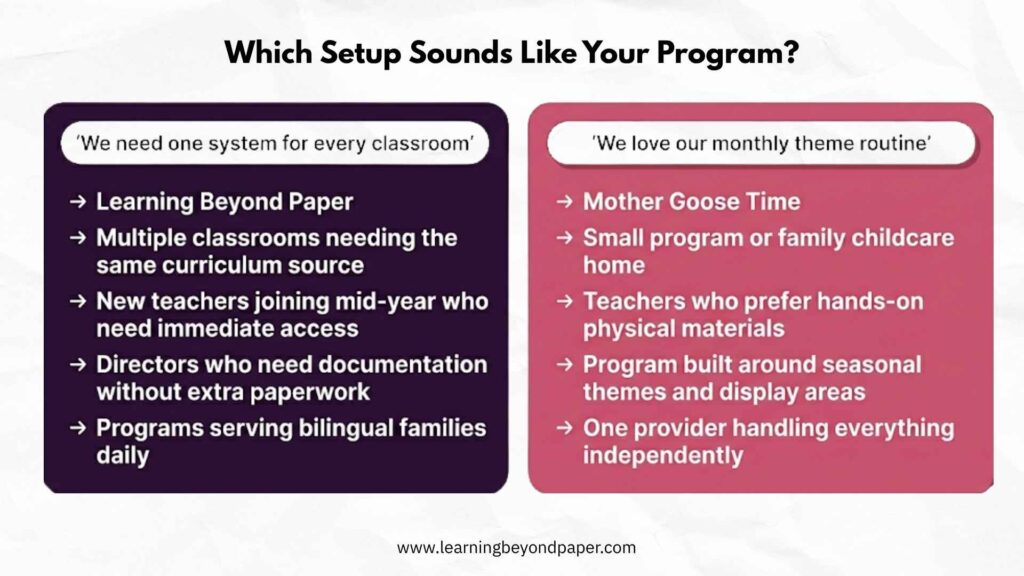
Learning Beyond Paper vs Mother Goose Time is really a choice between two operating styles. Mother Goose Time, now Experience Curriculum, gives programs a familiar monthly theme kit with hands-on materials and a long history in early learning. Learning Beyond Paper gives programs a cloud-based curriculum built for consistency, teacher support, bilingual access, and school-wide use.
For a small provider who wants materials delivered each month, Mother Goose Time may be the more comfortable fit. For a childcare center that wants to reduce paper, support new teachers, document learning, and keep every classroom aligned, Learning Beyond Paper is likely the stronger long-term choice.
The next step is simple: compare the way your teachers plan today with the way you want them to plan six months from now. If the goal is less clutter, clearer support, and a curriculum system that can grow with your program, review the full Learning Beyond Paper curriculum or visit Learning Beyond Paper to see whether a digital model fits your center.