
This guide covers age-matched activities for 12, 15, and 18-month-old toddlers across sensory play, language exposure, gross motor movement, fine motor skills, and practical life tasks.
You will also find realistic guidance on session length, safe setup, and how to keep a routine going when attention moves fast.
Place a few household items with different textures, a smooth spoon, a soft towel, a rough sponge, in front of the child and name each one slowly as they reach for it. This simple narrated sensory moment builds vocabulary and tactile awareness at the same time.
Make a simple sound near the child, a tongue click, a soft clap, a gentle knock on a surface, then pause and wait. Name the sound each time (“clap, clap”). This builds early listening skills and the beginning of back-and-forth communication.
Drop a soft ball into a cup or box and encourage the child to do the same. This cause-and-effect activity supports fine motor control and the beginning of sequential thinking, and most toddlers want to repeat it several times.
Cover a favorite toy with a small blanket and let the child pull it away. This builds object permanence, the understanding that things exist even when out of sight, which is a core cognitive milestone at this stage.
Place a soft toy on a low surface, a cushion, a step, or the edge of the sofa, and encourage the child to stand and reach for it. This supports balance, leg strength, and early spatial confidence without needing any special equipment.
Ask the child to carry a soft ball from one spot to a basket a short distance away. This practical task combines gross motor coordination with early routine-building, and it is one that children often want to repeat on their own once they have done it once.
Sit across from your toddler and clap twice slowly. Pause. Wait for them to copy. Then try tapping the floor, waving, or patting your head. This back-and-forth is not just playful.
It is how early social cognition and motor control develop together, and the CDC specifically identifies imitation as a key milestone at this age.
Place two small containers side by side and offer a mix of blocks in two colors. Guide the child to drop one color into each container. Do not correct mistakes. The sorting attempt itself is the developmental work, not the accuracy.
Set a stuffed animal in front of the child with a toy spoon or small cup. Demonstrate once, then step back. Simple pretend play supports early imagination, language development, and the beginning of empathy, all in a single short activity.
Set up a low basket and let the child drop soft items in, one at a time. A toddler dropping a sock into a basket is not doing laundry. They are building spatial awareness, motor control, and a genuine sense of contribution that matters for early self-confidence.
Open a board book to a picture of a familiar object (a ball, a cup, a dog) and point to the real version nearby. Say “same” and let the child look between them. This builds visual recognition and early language at the same time, using materials most households already have.
Play a short piece of music and move alongside the child. When the music stops, pause and encourage the child to freeze too. This builds gross motor coordination, listening skills, and the early ability to regulate movement on a simple cue.
Here are six activities well-matched to this stage, each building directly on skills introduced in the earlier months:
Offer a mix of red and blue items (blocks, balls, fabric pieces) alongside two containers. Show the child where each color goes and let them work through it. Sorting by category is a meaningful cognitive step forward from the simple drop-in tasks of the 12-month stage.
Set up a small space with a stuffed animal, a toy cup, and a blanket. Demonstrate feeding the animal, then putting it to sleep. Step back and invite the child to try. Pretend play is a critical milestone that appears by 18 months in 85% of children, and it supports imagination, language, and emotional development together.
Lay a strip of tape across the floor as a simple road and show the child how to push a toy car along it. Adding a clear path to movement play builds sustained attention and directional coordination without any preparation beyond a single piece of tape.
Offer one chunky crayon and a piece of paper. Make a mark and encourage the child to do the same. Scribbling at this stage is not about the result. It is about grip strength, hand-eye coordination, and the beginning of creative expression.
Sing a simple song with three actions in order (pat your head, clap your hands, stomp your feet) and slow it down so the child can follow along.
Stringing two or three actions together in sequence builds early working memory, which is a genuine developmental step forward from simple one-action imitation.
Ask the child to carry a small bowl of soft objects from one side of the room to a basket on the other. This practical life task builds motor control, spatial awareness, and a real sense of purpose, all within a routine short enough to repeat several times.
Pairing these moments with a developmentally appropriate curriculum for toddlers gives each activity a clear place within a broader learning sequence, so sessions feel connected rather than improvised day to day.
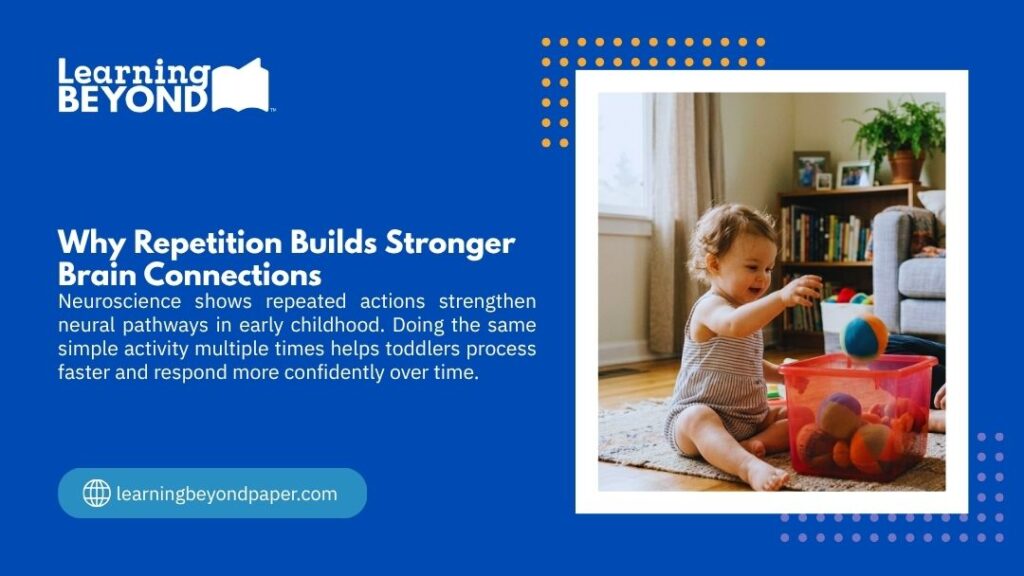
If your toddler only stays focused for a minute or two, the activity has not failed.
Research confirms that children can sustain focused attention for roughly 2 to 3 minutes per year of age on adult-directed tasks. For toddlers across the 12 to 18-month range, short and consistent sessions matter far more than longer and irregular ones.
| Daily Routine Example | ||
| Time of Day | Activity Type | Example |
| Morning (post-breakfast) | Sensory or fine motor | Texture exploration, block stacking |
| Midday | Gross motor | Push-toy play, carry-and-drop |
| Afternoon | Imitation or pretend | Copy game, feeding a toy animal |
Knowing how to create a lesson plan for toddlers in daycare gives educators a practical framework for organizing these moments without overcomplicating the daily rhythm.
The goal is to stop before frustration builds. A toddler who walks away is finished, and that is completely appropriate for this age.
| Activity Type | Ideal Time | When to Stop |
| Sensory exploration | 2 to 4 min | Child looks away or moves off |
| Imitation games | 2 to 3 min | Child stops responding to prompts |
| Gross motor play | 3 to 7 min | Child sits down or seeks a new space |
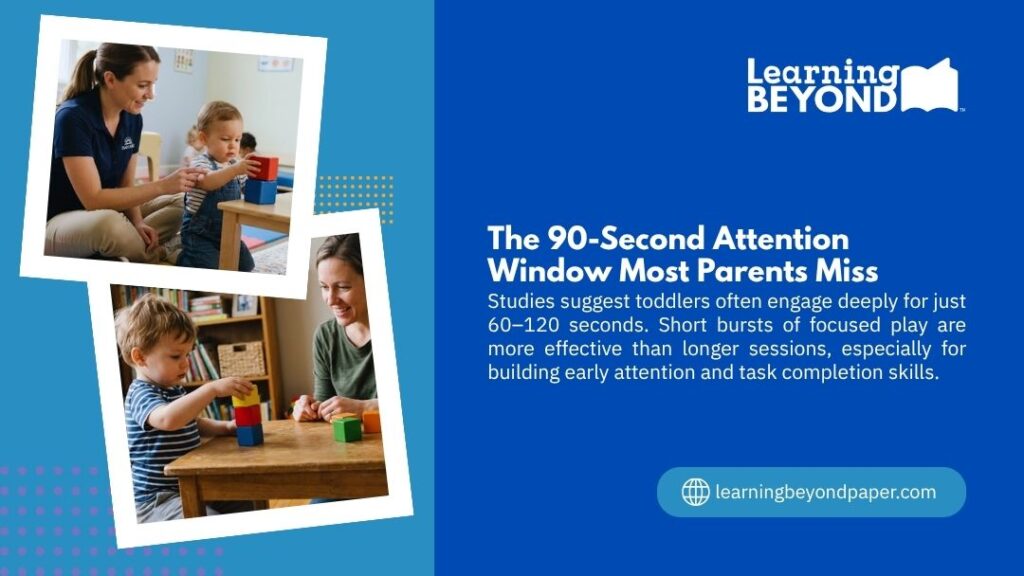
Most structured activities for young toddlers 12-18 months need no special equipment. But a safe setup always matters more than a creative one. A quick check before each session, surfaces cleared, hazards removed, adults nearby, is enough to make most spaces ready.
Here is a simple do-and-do-not reference:
| Safe Item | Risky Item | Supervision Note |
| Soft fabric scraps | Small buttons or beads | Never leave unattended |
| Large wooden blocks | Small LEGO pieces | Check size before offering |
| Plastic cups and spoons | Sharp utensils | Stay within arm’s reach |
| Board books | Thin magazine pages | Guide handling gently |
| Large pompoms | Marbles or coins | Always watch for mouthing |
Short, adult-guided play moments designed to build language, movement, fine motor skills, and early independence. They do not need to be long or formal to be effective.
Typically 2 to 5 minutes per session is enough, especially when the child is genuinely engaged. Ending before frustration sets in keeps the experience positive and worth repeating.
Simple movement, imitation, early language, sensory exploration, and basic problem-solving. These map directly to CDC developmental milestones across this stage.
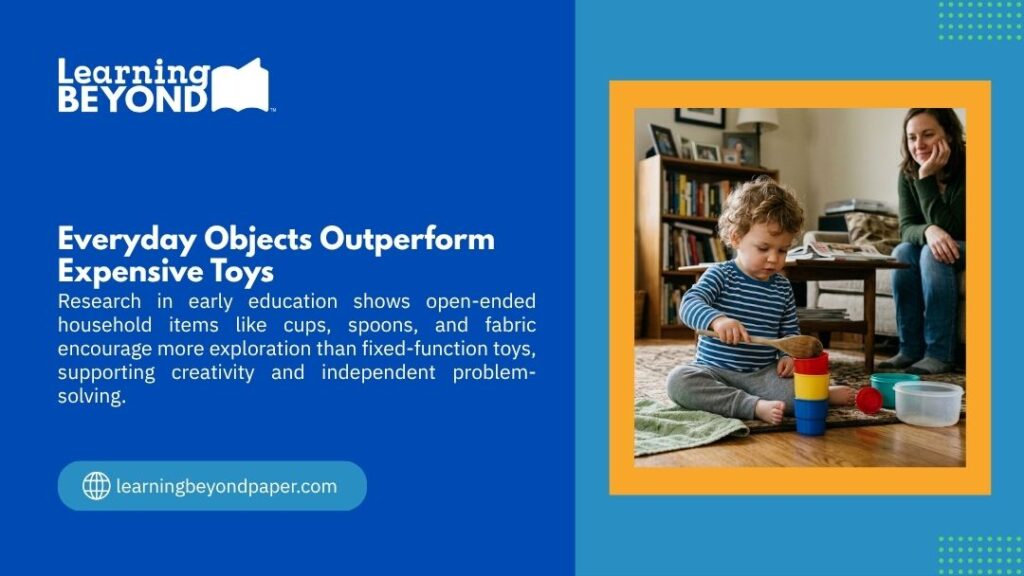
No, household items such as cups, boxes, fabric scraps, and board books work extremely well. The adult interaction around the activity matters more than the object itself.
Yes, and it is worth doing. Repetition is how toddlers build mastery. Offering the same activity two or three times across a week, with small variations, deepens learning far more than constant novelty.
Structured activities for young toddlers 12-18 months do not need to look impressive to work. A soft scarf and a few words. A basket and some blocks. Five minutes after breakfast.
Done consistently, these short sessions build the language, coordination, and confidence that carry forward into every stage of early learning.
Learning Beyond Paper has supported over 160,000 children across more than 3,000 schools with curriculum resources built for educators and caregivers who want every session to count.
Book a free demo today and see how structured, intentional learning fits naturally into your daily routine.