
This article covers the core definition, the principles behind it, what it includes across developmental areas, and what it looks like in practice for both parents and educators.
A developmentally appropriate curriculum for toddlers is a structured but flexible approach to early learning that matches activities, expectations, and adult support to what toddlers can realistically do at each developmental stage.
It is built around play, routine, language, movement, and relationships, not worksheets or formal lessons.
The National Association for the Education of Young Children (NAEYC) defines developmentally appropriate practice as education that meets children where they are and supports growth across all domains while respecting individual variation.
In a real toddler room or home setting, a developmentally appropriate curriculum for toddlers does not look like a formal lesson plan with seats and fixed objectives.
| Principle | What It Looks Like in Practice |
| Short attention spans are respected | Activities last 2 to 5 minutes, not 20 |
| Repetition is built in | The same song, routine, or game repeats across the week |
| Play is the vehicle for learning | Stacking, sorting, pouring, and pretending are the method |
| Adults guide without directing | A prompt is offered, then the adult steps back |
| Routine creates emotional safety | Predictable sequences reduce anxiety and build confidence |
A developmentally appropriate curriculum for toddlers is not:
The goal is not to accelerate childhood. It is to support it at the pace it naturally moves.
Toddler learning is broad and uneven by design. A two-year-old who stacks six blocks may not yet manage turn-taking. A child using twenty words clearly may still struggle to regulate frustration.
That is completely normal, and a strong developmentally appropriate curriculum for toddlers accounts for all of it.
There are five core developmental domains every toddler curriculum should address with equal priority.
| Domain | Core Goal | Example Toddler Activity |
| Social-Emotional | Turn-taking, empathy, self-regulation | Pretend play, simple group games |
| Language | Vocabulary, listening, early communication | Narrating daily routines out loud |
| Cognitive | Problem-solving, cause and effect | Stacking cups, hiding and finding objects |
| Gross Motor | Strength, balance, coordination | Climbing, carrying, pushing tasks |
| Fine Motor and Sensory | Hand control, tactile awareness | Pouring, scooping, fabric textures |
These two domains are often the most underestimated. Social-emotional development at this age is not about sharing perfectly or following multi-step directions. It is about:
Language grows the same way, through daily exposure and adult narration during ordinary moments.
Research from Zero to Three shows that children spoken to frequently know around 300 more words by age 2 compared to those who receive less verbal interaction. That gap does not require flashcards. It requires conversation.
Climbing, pouring, carrying, and sorting are not filler activities. They are curriculum. The physical and sensory domain is where toddlers build hand strength, body awareness, and spatial understanding that support writing and self-care later on.
Self-help skills, such as attempting to feed themselves or tidy up objects, also belong inside the plan. They build independence, confidence, and practical ability all at once.
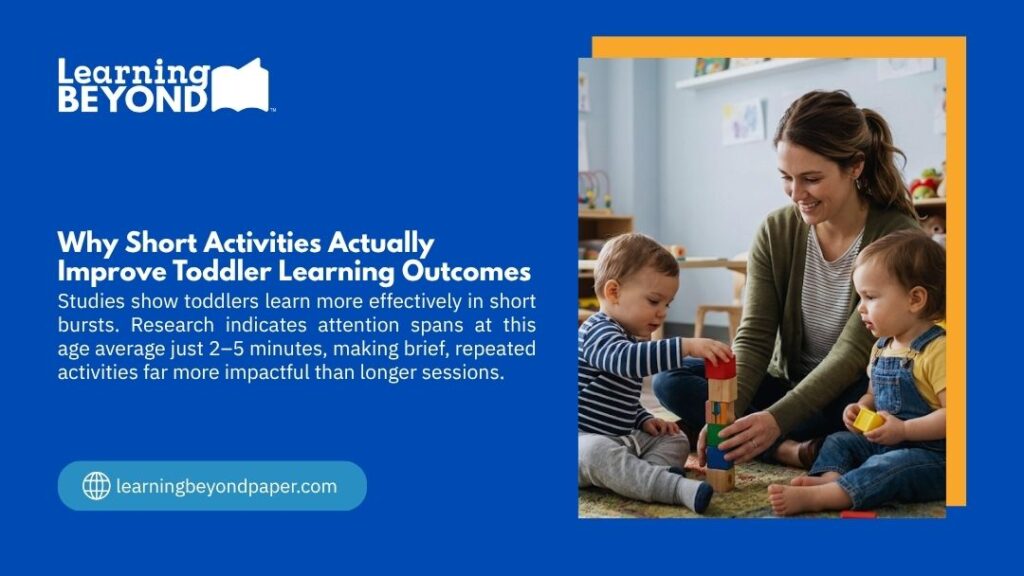
Knowing the theory is useful. Knowing what to actually build into the plan is what most parents and educators are really searching for.
A well-structured developmentally appropriate curriculum for toddlers includes six core components:
| Curriculum Component | Why It Matters | Example |
| Play-based activity | Primary method of toddler learning | Sensory bin, block play, pretend sequences |
| Predictable routine | Reduces anxiety, builds daily confidence | Same morning arrival sequence each day |
| Responsive adult | Scaffolds learning without forcing outcomes | “What happens if you push it harder?” |
| Simple learning goals | Keeps focus without pressure | “Practices stacking to four blocks” |
| Observation | Identifies each child’s next developmental step | Notes on what a child avoids or repeats |
For educators building this into a weekly structure, how to create a lesson plan for toddlers in daycare offers a practical framework that connects these components into a usable, sustainable format.
Play is not a break from learning. It is where toddler learning happens.
A strong developmentally appropriate curriculum for toddlers balances adult-guided activity with child-led exploration throughout the day. Both matter.
Structured play, where an adult offers a specific material and a light prompt, produces different developmental outcomes than free play alone.
Daily routines carry equal weight. Mealtimes, nap transitions, and arrival moments are all curriculum opportunities. Narrating what is happening, naming emotions, and offering simple choices during these moments builds language and self-regulation with no extra preparation needed.
A fixed curriculum that never changes based on what a child actually does is not developmentally appropriate. It is just a schedule.
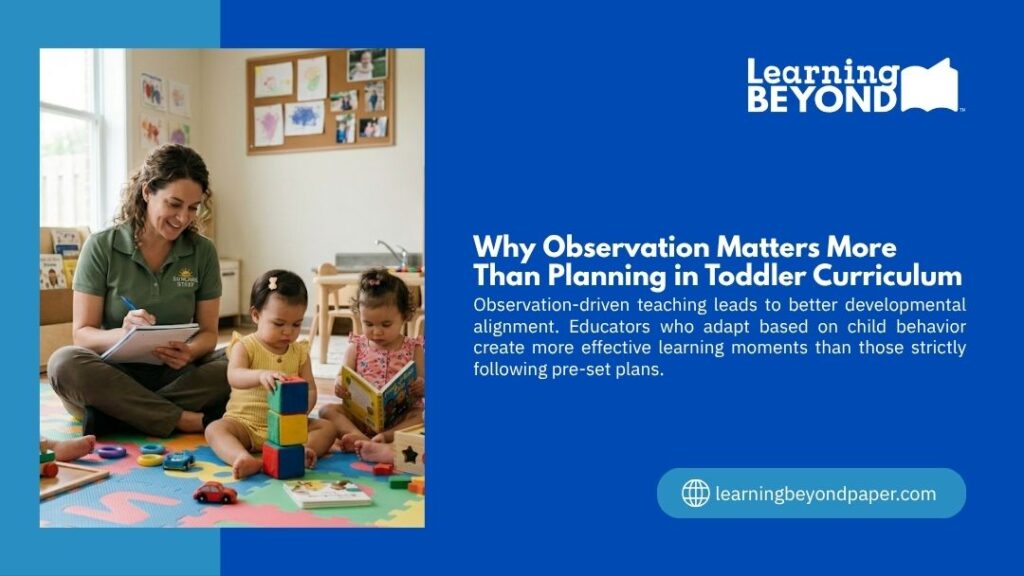
Observation is what separates good toddler curriculum design from a generic activity list. When an educator notices a child consistently avoiding fine motor tasks, or clearly ready for a more complex challenge, the plan should shift.
This does not require formal assessment tools. A short weekly note on what each child engaged with, avoided, or surprised you with is enough to keep the curriculum genuinely responsive.
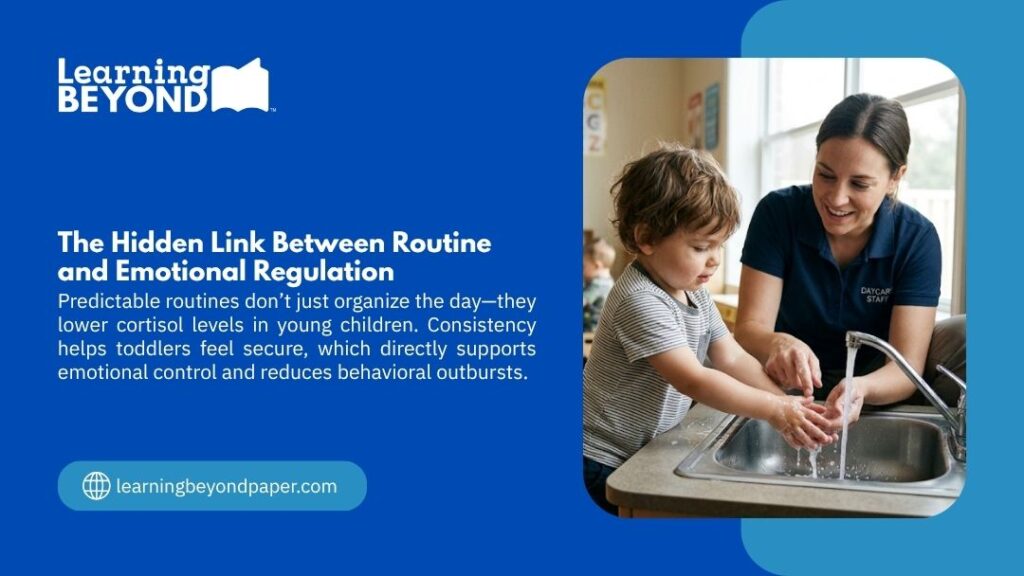
Here is how a developmentally appropriate curriculum for toddlers shifts as children grow through the early years.
| Age Band | Focus | Example Activities | Adult Role |
| 12 to 18 months | Sensory, repetition, simple motor | Fabric textures, carry-and-drop, peek-a-boo | Name everything, follow the child’s lead |
| 18 to 24 months | Imitation, early pretend, language | Feed a toy, simple sorting, action songs | Demonstrate once, then step back |
| 24 to 36 months | Choice-making, problem-solving, turn-taking | Simple puzzles, pretend sequences, water play | Offer choices, ask open questions |
For toddlers between 12 and 18 months, the curriculum should feel like guided sensory exploration.
Structured activities for young toddlers 12-18 months at this stage build cause-and-effect thinking, early language, and basic motor control through simple, repeatable tasks.
Good examples include:
None of these require special materials. All of them support real developmental goals that connect to later learning.
Between 24 and 36 months, toddlers show stronger preferences, longer attention spans, and early problem-solving ability. The curriculum can begin to include:
The adult role shifts slightly here. Less narration, more open-ended questions: “What do you think will happen?” or “Where does this one go?”
A learning framework that matches activities and expectations to what toddlers are realistically ready for at each stage. It is play-based, flexible, and built on child development research.
Yes, but not a formal or academic one. A structured framework gives toddlers consistent learning support without pressure or rigid expectations.
Play-based activities, predictable routines, responsive adult interaction, simple learning goals, and regular observation of each child’s progress across all five developmental domains.
Play is the primary way toddlers explore, practice skills, and learn. A strong toddler curriculum treats play as the method, not the break between learning moments.
Stacking, sorting, simple pretend play, action songs, sensory exploration, and carry-and-drop tasks. All support real developmental goals using everyday household materials.
A developmentally appropriate curriculum for toddlers does not need to be complicated. It needs to be intentional. When activities connect to real developmental goals, when routines carry learning, and when adults follow the child’s lead, the curriculum takes shape naturally.
Learning Beyond Paper has supported over 160,000 children across more than 3,000 schools with curriculum resources built for early childhood educators who want every session to count.
Book a free demo today and see how a genuinely developmentally appropriate curriculum can work across your whole center.