
Most educators notice learning happening every single day. The challenge is turning those moments into records that show real growth, support future planning, and make sense to families and colleagues alike.
This guide covers how to document learning outcomes in early childhood from start to finish.
You will learn what outcomes actually are, how to build a repeatable documentation habit, what strong writing looks like in practice, and how to avoid the patterns that make the whole process harder than it needs to be.
An observation captures what a child did. A learning outcome explains what that action reveals about their current skills and understanding.
Keeping these two things separate is the foundation of documentation that actually works.
When notes move beyond describing the event and start connecting behavior to real development, they become genuinely useful for assessment, planning, and family communication.
A Swiss longitudinal study found that systematic observation, documentation, and planning by educators protected children from the long-term effects of early family risks on conduct problems and emotional development.
How you document learning outcomes in early childhood shapes real developmental progress, well beyond what any compliance checklist captures.
If you are still building your broader program structure, what should a preschool curriculum include shows how documentation connects to your full planning cycle.
A learning outcome is the skill, behavior, understanding, or disposition a child is demonstrating through their actions.
Observable examples across development areas:
| Observable Wording | Non-Observable Wording |
| “Counted 8 objects with one-to-one correspondence” | “Is good with numbers” |
| “Persisted through three attempts without adult support” | “Tried hard” |
| “Used positional language: above, beside, under” | “Showed spatial awareness” |
Many educators treat documentation as something that satisfies a regulator or passes an inspection. In practice, it does far more than that.
Strong records inform your next planning cycle, support team continuity when staff change, and give families a genuine window into their child’s progress.
Research consistently shows that family engagement in early learning significantly improves developmental and academic outcomes over time, and well-written documentation is one of the primary tools that makes that engagement possible.
Research by Nobel Laureate Professor James Heckman also found that high-quality, birth-to-five early childhood programs deliver a 13% per-child annual return on investment through improved outcomes in education, health, and employment.
What educators document and plan from that documentation is part of what makes those programs work at a high level.
Here is a clear, repeatable four-step process for turning any classroom moment into strong, usable documentation.
| Step | What to Do | What to Write | Common Mistake |
| 1 | Record what you saw | Objective details: who, what, when, where | Adding interpretation too early |
| 2 | Identify the learning | Name the skill or understanding shown | Staying too close to the activity description |
| 3 | Link to a framework | Reference the relevant developmental area | Skipping this step entirely |
| 4 | Write the next step | How you will extend or support this learning | Leaving the note with no forward action |
Start with the facts. Where were you? What was the child doing? What did they say or produce?
Include in every observation note:
Example: At free play (9:15am), Marcus spent 12 minutes at the block area, rebuilding a tower after two collapses. He adjusted each layer and narrated his thinking: “This one’s too big for the top.”
This level of detail gives you the evidence you need for the next step without over-interpreting the moment before you have finished describing it.
Once the observation is recorded, ask: what is this activity actually showing?
Play reveals far more than the surface action. A block tower can show spatial reasoning, persistence, and self-directed problem-solving at the same time.
A moment in the sandpit can reflect self-regulation, communication skills, and empathy simultaneously.
Look for the skill underneath the action, not just the activity name.
To match observed behaviors to developmental expectations by age, our article on “what is a developmentally appropriate curriculum for toddlers” gives a clear reference for what skills typically emerge across different stages.
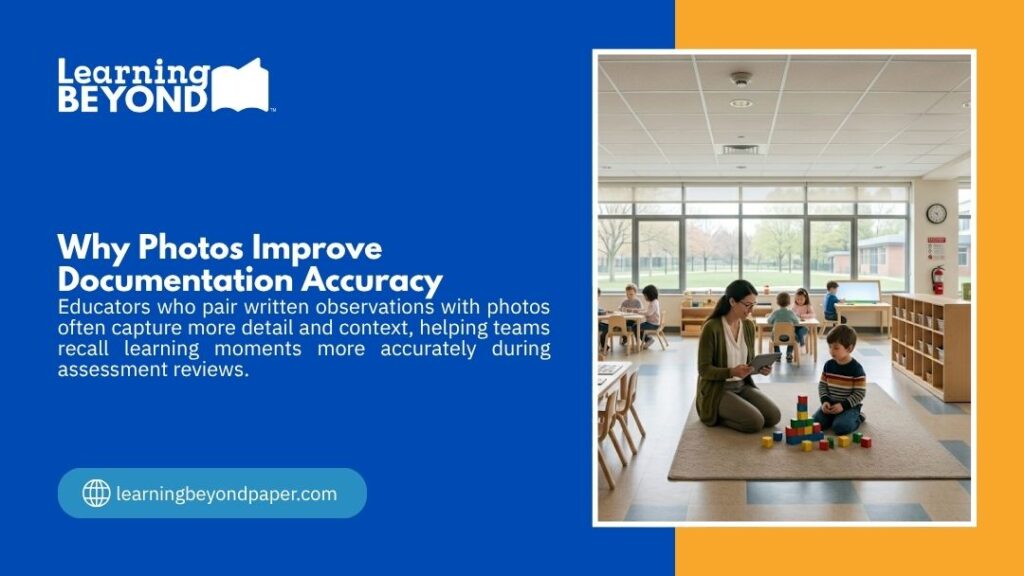
There is no single correct frequency. Most settings find that quality matters far more than volume.
| Documentation Type | Suggested Frequency |
| Anecdotal observation notes | 2-3 per child per week |
| Learning stories | 1 per child per month |
| Portfolio updates | Monthly or per term |
| Significant moment records | As they arise |
A consistent pattern of meaningful evidence tells a much stronger story than a high volume of surface-level notes filed every day.
Some notes feel flat. Others clearly show real learning. The difference usually comes down to three elements: specific language, brief analysis, and one forward-looking next step.
The process of learning how to document learning outcomes in early childhood is largely about building this analysis habit, rather than just improving the way you write.
| Weak Note | Strong Note | Why It Works |
| “Played with blocks. Did well.” | “Built a three-level tower, adjusting after two collapses. Demonstrates persistence and spatial problem-solving.” | Specific verbs, observable behavior, named outcome |
| “Was kind to a friend.” | “Noticed a peer was upset and offered her book unprompted. Shows emerging empathy and social awareness.” | Describes the action and names the developmental outcome |
| “Counted some objects.” | “Counted 8 blocks with one-to-one correspondence, self-correcting at 6. Demonstrates early number sense.” | Shows the level of skill, not just the activity |
Avoid phrases like “did well,” “seemed to understand,” or “enjoyed the activity.” These descriptions could apply to any child on any given day.
Use action verbs that describe exactly what happened:
“Played with blocks” is a description. “Used trial and error to balance the structure, showing early problem-solving skills” is documentation.
One additional sentence connects the action to the outcome. It does not need to be long, and it does not need to reference a specific framework standard in every single note.
Every note should point somewhere. What will you do because of what you observed?
Example next step: Introduce materials with different weights to extend sorting and balancing challenges in the construction area.
A single line like this connects documentation directly to teaching decisions. If you want to build stronger planning habits around your observations, how to create a lesson plan for toddlers in daycare walks through the full lesson structure.
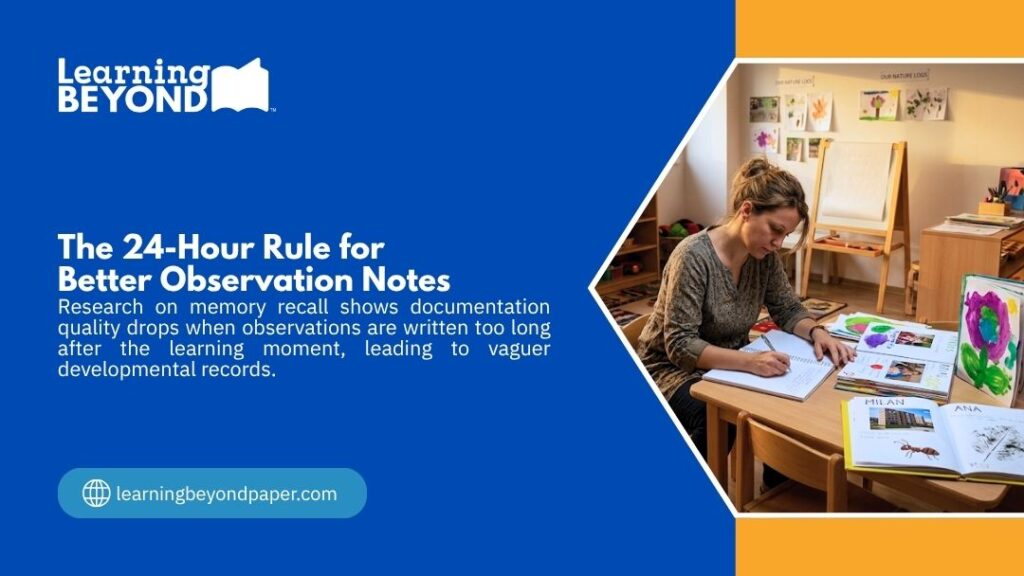
Seeing the method applied makes it easier to document learning outcomes in early childhood settings across different children, ages, and developmental areas.
| Observation | Learning Outcome | Next Step |
| During free play, Zara directed two peers in building a road and placed each block deliberately. | Demonstrates spatial reasoning and emerging leadership. | Provide maps or printed layouts to extend planning and directional language. |
| Eli became frustrated when his tower fell. He tried again without adult support. | Shows emerging self-regulation and persistence under challenge. | Acknowledge his self-management strategy and introduce a visible building goal. |
| Amara counted 7 cups during snack prep, touching each one. She self-corrected at 5. | Demonstrates one-to-one correspondence and early number sense. | Extend to irregular arrangements to deepen number understanding. |
Play is the richest source of documentation in early childhood classrooms. A child directing imaginative play shows communication, creativity, and executive function all at once. The observation practically writes itself when you know what to look for underneath the activity.
Social moments are among the hardest to capture in the moment but often reflect the most significant developmental progress. A child managing frustration, comforting a peer, or joining a group independently each connects to real, documentable outcomes worth recording.
When a child uses new vocabulary unprompted, identifies a pattern, or compares quantities with purpose, those are legitimate learning outcomes. Keep the language concrete so the note is readable to families and accessible to any colleague who picks up the file.
Even experienced educators run into the same patterns. Identifying them is what makes documenting learning outcomes in early childhood faster and more consistent over time.
| Mistake | Why It Weakens Documentation | Better Approach |
| Over-describing the activity | Leaves no room for analysis | One observation line, then one interpretation line |
| Vague conclusions | Does not connect to individual growth | Name the specific skill or behavior shown |
| No next step included | Note has no planning value | Always end with one forward action |
| Notes too long | Hard to scan or use quickly | Aim for 3-5 sentences per note |
| Generic wording | Interchangeable across children | Use specific actions and words the child used |
The most frequent issue is writing long descriptions with no analysis. Length does not improve documentation quality.
Watch for these patterns in your own notes:
The NAEYC’s February 2024 survey found that 46% of educators reported worsening burnout since 2023. Clunky, time-consuming documentation practices are one of the contributing factors.
Fixing these habits benefits both the quality of your records and your own wellbeing over the long term.
OECD TALIS 2024 data shows 52% of teachers globally cite excessive administrative workload as a top stressor.
The time pressure around documentation is a real and documented problem. When workload starts to wear staff down, our guide on practical strategies to reduce teacher burnout offers early childhood educators concrete relief.
A few habits reduce documentation time without cutting quality:
If your center is exploring digital systems to streamline this process, how to transition from paper curriculum to digital in childcare covers the full transition in practical steps.
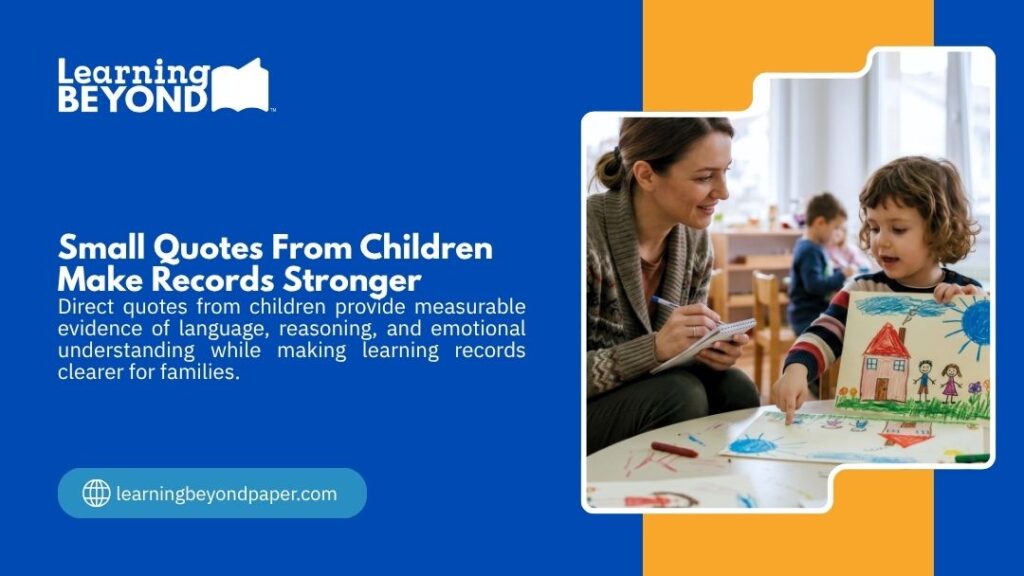
Write what you saw using specific actions and language. Then add one line connecting it to the child’s development, and finish with a clear next step for your planning. Three to five sentences total is usually all you need.
Ask what skill, behavior, or understanding the activity reveals. A child sorting objects shows classification skills. A child re-reading a book shows emerging literacy habits. Connect the action to the developmental area it reflects rather than describing the activity again.
Three to five sentences is usually enough. One for the observation, one or two for the learning shown, and one next step. Longer notes are rarely stronger notes, and they take more time to write and read.
Anything observable qualifies: what the child did, said, made, or attempted. Work samples, photos, and direct quotes all support written notes as valid evidence and help tell a more complete picture of a child’s growth.
Aim for two to three observation notes per child per week in most settings. More formal records such as learning stories or portfolio updates work well on a monthly or per-term basis.
Knowing how to document learning outcomes in early childhood is only part of the work. The real value comes from building the habit consistently, note by note, across the year.
According to the 2024 Early Childhood Workforce Index, around 2.2 million educators are responsible for the care and education of more than 9.7 million children under five.
The records those educators write shape the decisions that move each child forward. That work extends far beyond the file it ends up in.
The format, the length, and the system matter less than the intention behind each note. Start with one structured observation today, follow the four steps, and build from there.