
A thoughtful STEM activities for preschoolers lesson plan gives children aged 3 to 5 their first real experience with curiosity, testing, and early problem-solving.
This guide covers what that plan needs, a simple framework to follow, and three classroom-ready examples you can use right away.
Most articles give you a list of activities. Few explain how to turn those ideas into a complete lesson. Before anything runs, the plan needs a clear structure behind it.
A solid STEM activities for preschoolers lesson plan includes these core parts:
| Lesson Part | Purpose | Example |
| Objective | What the child explores | Predict which objects sink or float |
| Materials | What is needed before starting | Water tub, small objects |
| Setup | How the space is arranged | Objects on a tray, water tub centered |
| Activity Steps | What happens during the lesson | Predict, test, observe, discuss |
| Teacher Prompts | Questions to guide thinking | “What do you think will happen?” |
| Extension | A follow-up challenge | Sort objects by outcome |
| Quick Assessment | How learning is noticed | Observe vocabulary and predictions made |
Knowing what should a preschool curriculum include before building individual lessons helps connect each activity to a broader developmental goal.
Preschool STEM is not about drilling content or following rigid steps. It is about creating moments where children notice, test, and ask questions on their own.
If a child is stacking blocks and wondering why the tower keeps falling, that is engineering thinking. Sorting leaves by size is early science. The activity does not need a formal label. It needs space for curiosity and trial and error.
Research shows that children who learn through hands-on, inquiry-based methods develop stronger cognitive flexibility and school readiness than those following passive instruction. Play is the method, not a detour from learning.
One practical swap worth making: replace any pre-activity explanation with a single guiding question. “What do you think will happen if we add one more block?” moves children into active thinking before the activity even begins.
A strong stem activities for preschoolers lesson plan is built around outcomes that match where children are developmentally. At this stage, skill-building matters far more than content knowledge.
| Learning Outcome | Why It Matters at This Age |
| Observation | Builds scientific thinking from day one |
| Problem-solving | Develops persistence and flexibility |
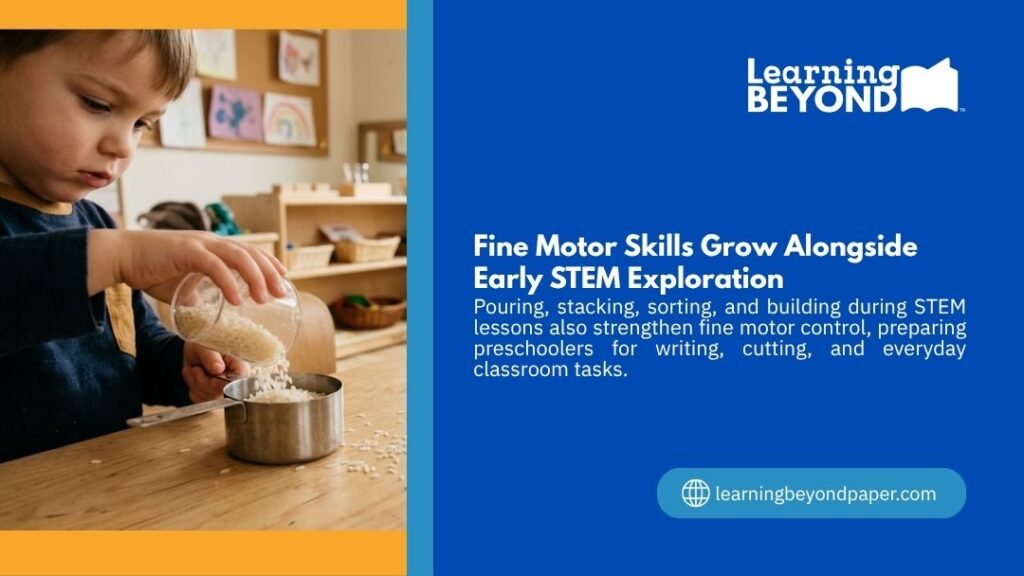
| Fine motor skills | Supported through building, pouring, and sorting |
| Language development | Strengthened through discussion and new vocabulary |
| Confidence | Grows when children are trusted to test and try freely |
A meta-analysis of nearly 36,000 preschoolers found that early math skills are the strongest single predictor of long-term academic success, outperforming both early reading and attention skills.
Every counting, sorting, and measuring activity matters well beyond that single classroom day.
A Simple Preschool STEM Lesson Plan Framework
How do you keep a preschool lesson short, clear, and engaging without overplanning? A four-part framework gives you a repeatable structure that works in centers, small groups, and whole-class settings alike.
| Phase | Teacher Action | Child Action | Timing |
| Warm-Up Question | Ask a prediction question | Share ideas and guesses | 2-3 min |
| Hands-On Exploration | Set out materials and observe | Test, build, sort, compare | 7-8 min |
| Guided Discussion | Ask reflection questions | Explain what they noticed | 3-4 min |
| Close or Extension | Introduce one follow-up challenge | Try again or compare results | 2-3 min |
For those building their planning process from scratch, this guide on how to create a lesson plan for toddlers in daycare walks through the full structure step by step.
Every effective stem activity for a preschooler’s lesson plan starts with a question, not an explanation. The opening question creates curiosity before any material is touched.
Try these to get started:
Keep every question open-ended. There is no wrong answer, and that openness keeps each child involved from the very first moment.
This is the center of every lesson. Children should be touching, testing, building, pouring, and comparing throughout the activity.
Materials that work well without any specialist kits:
The simpler the setup, the more children focus on the actual learning rather than managing materials around them.
This step is often missing from activity lists, but it is what turns a hands-on moment into a complete lesson.
After exploration, bring children together and ask:
Two to three minutes of guided conversation reinforces vocabulary and helps children process what just happened in their own words.
STEM activities for preschoolers lesson plan are fully structured with an objective, materials, step-by-step instructions, and an extension idea.
| Objective | Materials | Time | Core Skill |
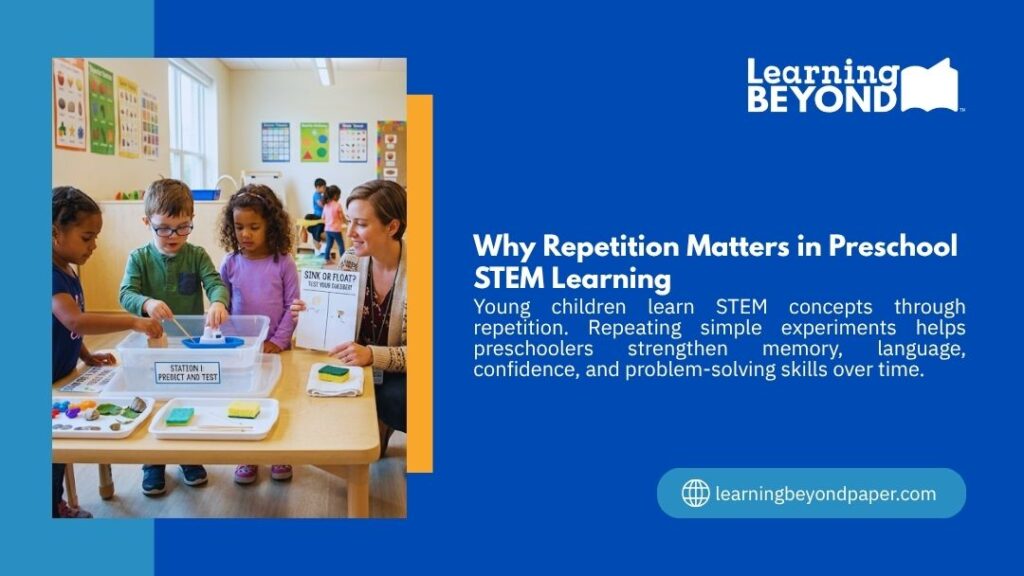
| Predict and test which objects sink or float | Water tub, spoon, cork, coin, leaf | 15 min | Observation, prediction, vocabulary |
Steps:
Extension: Try the same objects in a shallower container. Ask if anything changes and why.
| Objective | Materials | Time | Core Skill |
| Engineer a structure using limited materials | Blocks, cups, cardboard pieces | 15 min | Balance, engineering, trial and error |
Steps:
For ideas on tracking what children learn during hands-on activities like this one, explore how to document learning outcomes in early childhood.
| Story | Challenge | Extension |
| The Three Little Pigs | Build a house that holds a book on top | Test three different materials |
Steps:
Storybook-linked activities are consistently highlighted by early educators as one of the most memorable and re-engageable formats for this age group.
How to Adapt Preschool STEM Lessons by Age, Time, and Materials
Will this still work with only 10 minutes, mixed ages, or basic classroom supplies? Yes. Small adjustments make a real difference.
| Scenario | What to Change | Teacher Tip |
| Younger preschoolers (age 3) | Fewer materials, one step at a time | One choice, one test, one short discussion |
| Older preschoolers (age 4-5) | Add a second round of testing | Ask: “Which design worked better and why?” |
| Limited time (10 min) | Remove the extension step | Stick to prediction and one test only |
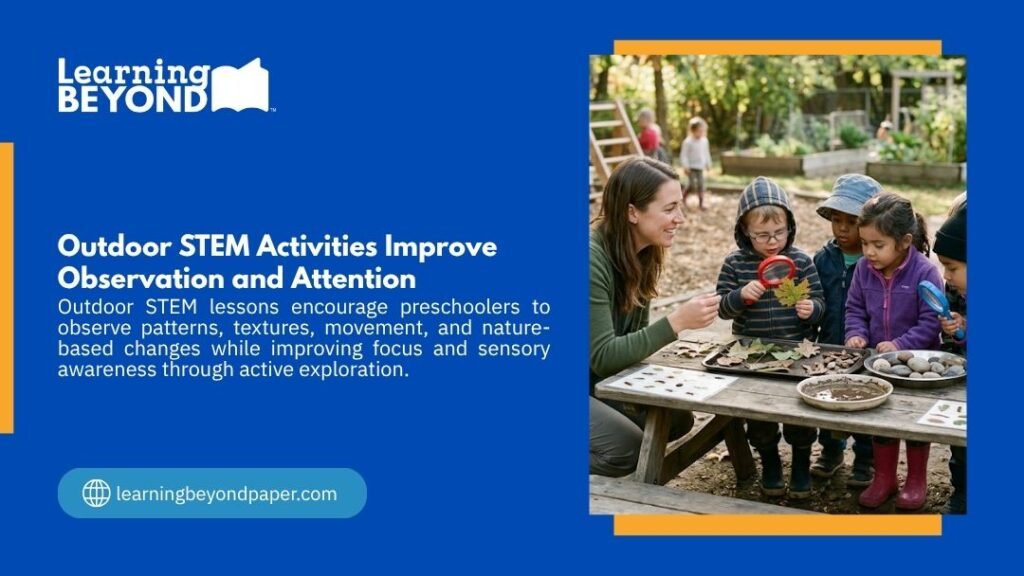
| Outdoor setting | Use natural materials | Observation activities work best outside |
| Low-budget classroom | Use classroom objects: cups, spoons, paper | No kits needed for a full STEM activities for preschoolers lesson plan |
With three-year-olds, one choice and one test is enough. Fewer materials and very concrete language keeps the experience focused and manageable.
Reviewing what is a developmentally appropriate curriculum for toddlers helps you calibrate what feels challenging but still within reach at this age.
For four and five-year-olds, a second round of testing or a simple comparison challenge works well. “Which design worked better and why?” stretches reasoning at this stage without overwhelming them.
Children here are ready to reflect, compare, and retry with a specific goal in mind.
| Mistake | Why It Fails | Better Approach |
| Too much instruction upfront | Children disengage before starting | Start with one question, then explore |
| No clear learning goal | Fun without direction does not build skills | Attach one skill to every activity |
| Too many materials | Creates distraction and management problems | Limit to 3 to 4 items per activity |
| Skipping reflection | Children miss the sense-making moment | Add 2 to 3 minutes of guided discussion |
| No cleanup plan | Transitions fall apart and reset time is lost | Build cleanup into your lesson timing from the start |
The longer the pre-activity explanation, the less engaged children are when the lesson actually begins. Replace lengthy instructions with one guiding question and let children move directly into exploration. That single shift changes the energy of the whole lesson.
Stem activities for preschoolers’ lesson plan needs one core skill attached to it, such as observing, predicting, building, or sorting. Without a clear goal, the activity is just an activity. With one, every choice you make in the lesson serves a purpose.
Preschool lessons need structure from start to finish, including cleanup. Build one minute into your timing and use a consistent visual cue or signal to make transitions smooth without breaking the energy of the room.
FAQs
At minimum: a clear objective, materials list, activity steps, teacher prompts, and a short reflection. Keep it simple enough to prepare quickly and flexible enough to adjust on the day.
Focus on open-ended exploration rather than correct answers. Use everyday materials, keep each step short, and give children space to test and retry freely. Learning happens in the process, not the outcome.
The strongest STEM activities for preschoolers lesson plan formats rely on physical materials. Technology is optional and rarely necessary for ages 3 to 5.
Around 15 minutes works well for most groups. That includes a warm-up question, hands-on exploration, and a brief reflection at the close.
Sink or float challenges, tower building, and storybook builds are among the most reliable options. Each uses simple materials, fits a short time window, and supports multiple learning outcomes at once.
A strong STEM activities for preschoolers lesson plan does not need expensive materials, specialist training, or hours of preparation. It needs one clear question, time to explore, and a brief conversation at the close.
That repeatable structure works across any setting for children aged 3 to 5.
At Learning Beyond Paper, every program and workshop is built around hands-on, experience-led learning.
Whether you are an educator building your first lesson or a parent looking for meaningful skill-building activities at home, our resources are designed to help children learn well beyond any worksheet or passive routine. Explore our programs and find an approach that fits your classroom and your learners.