
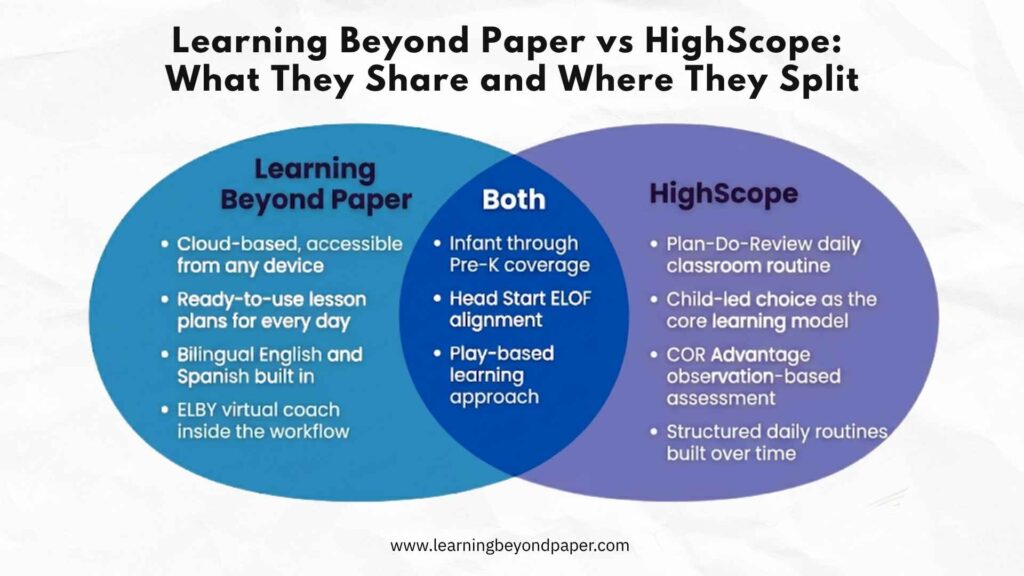
Learning Beyond Paper vs HighScope comes down to program fit: Learning Beyond Paper is a cloud-based early childhood curriculum built for fast lesson access, bilingual support, documentation, and day-to-day teacher guidance, while HighScope is a long-established active learning model centered on child choice, daily routines, and plan-do-review.
This article helps childcare owners, preschool directors, Head Start leaders, and Pre-K administrators clearly compare the two options so they can choose the curriculum that best fits their classrooms, staff capacity, budget, and daily teaching needs.
Learning Beyond Paper vs HighScope is best understood as a comparison between a digital curriculum platform and a research-based curriculum approach.
Learning Beyond Paper is a 100% cloud-based early childhood curriculum for infants through Pre-K 4. It gives teachers 52 weeks of developmentally appropriate lesson plans, more than 4,000 play-based activities, bilingual English and Spanish content, embedded professional development, and support from ELBY, its virtual instructional coach. Programs can explore Learning Beyond Paper’s early childhood curriculum at Learning Beyond Paper’s curriculum overview.
HighScope, by contrast, is a well-known early childhood curriculum model built around active participatory learning. Its preschool curriculum uses child choice, organized classrooms, daily routines, teacher-child interaction, and the plan-do-review process to help children build independence, problem-solving ability, social skills, and school readiness. Directors can review HighScope’s preschool curriculum model on HighScope’s official preschool curriculum.
The better choice depends on what your program needs most. If your center needs a ready-to-use, digital, standards-aligned daycare preschool curriculum with built-in support, Learning Beyond Paper may fit better. If your team is deeply committed to the HighScope curriculum model and has the time, training, and systems to implement it well, HighScope may be the stronger match.
| Comparison Area | Learning Beyond Paper | HighScope |
| Core identity | Cloud-based early childhood curriculum platform | Research-based active learning curriculum model |
| Main age range | Infant through Pre-K 4 | Infant-toddler and preschool through age five |
| Delivery format | Digital, accessible on devices | Curriculum resources, training, assessment tools, and implementation model |
| Teaching style | Play-based, standards-aligned, ready-to-use lesson plans | Active participatory learning with plan-do-review |
| Teacher support | Embedded professional development and ELBY virtual instructional coach | Professional learning courses and implementation support |
| Bilingual support | English and Spanish included | Assessment and training tools may support observation-based planning |
| Best fit | Centers that need quick adoption, digital access, and consistent lesson planning | Programs that want a classic active learning model with strong fidelity training |
Before comparing features, look at how each curriculum would work during a normal week: teacher planning time, staff confidence, classroom routines, documentation needs, and family communication. This table gives directors a practical way to match each option with the conditions already inside their program.
| Choose Learning Beyond Paper If… | Choose HighScope If… |
| You need a digital curriculum that teachers can use quickly | You want a full active learning model |
| You need bilingual English/Spanish content included | You already have HighScope-trained staff |
| You need documentation and standards alignment built in | You can invest more time in fidelity training |
| You want support for newer teachers | You want plan-do-review as the classroom foundation |
A curriculum can look strong on paper and still fall short if it does not fit the people using it every day. Use this comparison as a first filter, then review training needs, implementation time, and classroom support before making a final choice.
Learning Beyond Paper is an early childhood EdTech curriculum platform built for childcare centers, preschools, family childcare providers, Head Start programs, and school-based Pre-K classrooms. Its core promise is simple: replace binders, paper packets, scattered PDFs, and long prep sessions with one digital curriculum teachers can use from any device.
The platform covers infants, young toddlers, older toddlers, preschool, and Pre-K. Teachers receive a full year of lesson plans with hands-on activities, learning objectives, family engagement tools, and support across developmental domains. For directors, the appeal is consistency. Every classroom can work from the same system without each teacher having to build a curriculum from scratch.
That matters more than it may seem. Many early childhood programs are not short on care. They are short on time, staff stability, and planning bandwidth. A curriculum that is easy to open, understand, and use can help teachers spend less time searching and more time with children.
Programs that want age-specific examples can review Learning Beyond Paper’s infant curriculum, young toddler curriculum, older toddler curriculum, preschool curriculum, and Pre-K curriculum.
HighScope is one of the better-known names in early childhood education. The HighScope preschool curriculum is built on active learning, where children make choices, work with materials, interact with adults and peers, and reflect on what they did.
Its signature plan-do-review routine gives children a chance to plan an activity, carry it out, and talk about it afterward. In a well-run HighScope classroom, children are not simply told what to do. They make decisions, test ideas, solve small problems, and revisit their own experiences with teacher support.
That plan-do-review structure is one of HighScope’s clearest strengths. It can support independence, language, reflection, social problem-solving, and ownership of the learning process.
HighScope also offers COR Advantage, an observation-based child assessment tool. Teachers can use it to capture child development through anecdotes, photos, and videos, then use that information to support planning based on child and classroom progress.
HighScope also has a professional learning ecosystem, with in-person and online options designed to support program implementation. Directors who are considering HighScope should review its professional learning options alongside curriculum costs and staff capacity.
The biggest difference between Learning Beyond Paper vs HighScope is not whether children should play. Both support active, hands-on learning. The difference is how the curriculum reaches the classroom.
Learning Beyond Paper starts with daily usability. Teachers log in, find the lesson, read the objective, gather simple materials, and teach. The system is built to reduce planning friction. It also supports documentation, family engagement, bilingual access, and standards alignment from inside the platform.
HighScope starts with a curriculum philosophy. Its classroom model is built around active participatory learning, consistent daily routines, adult-child interaction, and plan-do-review. It is less about giving teachers a digital lesson for each day and more about helping the whole classroom operate through the HighScope approach.
Neither route is automatically better. A director should ask a more grounded question: which model will your teachers actually implement well?
NAEYC defines developmentally appropriate practice as methods that support each child’s development through a strengths-based, play-based approach to joyful learning. In other words, the best preschool curriculum is not always the one with the longest history or the longest feature list. It is the one that helps teachers make strong decisions for real children in real classrooms.
Teacher support is one of the clearest places where the two programs differ.
Learning Beyond Paper includes embedded professional development through Learning Beyond LBP University. Its platform also includes ELBY, a virtual instructional coach that helps teachers with lesson support, behavior guidance, family engagement, and classroom questions. For programs with newer educators or frequent turnover, that type of in-the-moment support can make the curriculum easier to use.
HighScope also offers professional learning, but the model is more tied to training teachers to implement the HighScope approach with fidelity. That is valuable, especially for programs that want a full instructional culture rather than a set of daily lesson plans. The tradeoff is time. Teachers need training, coaching, and consistency across the program.
| Area | Learning Beyond Paper Pros | Learning Beyond Paper Cons | HighScope Pros | HighScope Cons |
| Teacher onboarding | Easy digital access can help new teachers start faster | New users still need time to learn the platform | Strong training model for long-term skill development | May take more time and staff commitment |
| Lesson planning | Ready-to-use lesson plans reduce prep load | Less ideal for programs that want teachers to design most activities from scratch | Encourages intentional teacher planning and observation | Planning may feel heavier for teams with limited time |
| Classroom model | Flexible and practical for busy centers | Digital access requires a reliable device and internet use | Deep active learning structure | Fidelity can vary if staff are not well-trained |
| Professional learning | Built into the platform experience | Some programs may still prefer live coaching | Strong curriculum-specific training options | Training may require added budget, time, or scheduling |
For many directors, curriculum choice is also a compliance choice. A curriculum has to support state standards, licensing expectations, Head Start requirements, and documentation needs.
Learning Beyond Paper has a strong advantage here because it is built around digital standards alignment. Its curriculum aligns with all 50 state early learning standards, Head Start ELOF, and CLASS indicators. Directors can access Learning Beyond Paper’s curriculum alignment details through the company’s dedicated curriculum alignment section. If you are working through this process yourself, our step-by-step guide to aligning your daycare curriculum with the Head Start ELOF walks directors through crosswalking domains, documenting evidence, and closing gaps.
This matters for directors who need evidence without building separate spreadsheets or binders. If teachers can document learning outcomes as part of normal curriculum use, the administrative burden drops. Learning Beyond Paper also offers a practical guide on how to document learning outcomes in early childhood.
HighScope also supports child development documentation through COR Advantage and its Key Developmental Indicators. Programs that already use HighScope with fidelity may find the assessment and curriculum connection useful. Still, directors should look closely at what tools are included, what must be purchased separately, and how much training teachers need to document well.
Head Start’s Early Learning Outcomes Framework describes key areas of early learning for infants, toddlers, and preschoolers. Programs that serve Head Start or Early Head Start children should review curriculum alignment carefully through the official Head Start ELOF resource.
Cost is one of the most sensitive parts. It is also one of the most useful.
Learning Beyond Paper’s pricing model is positioned around school-wide access for smaller programs rather than per-teacher pricing, with enterprise pricing varying based on scale and specific requirements. The company also includes bilingual content, professional development, standards alignment, and ELBY support in the platform.
HighScope pricing can depend on which curriculum materials, assessment tools, and professional learning options a program chooses. A center may buy curriculum resources, training, assessment products, or other supports. That does not make HighScope worse. It means directors should compare the total cost of ownership, not just the name of the curriculum.
For a childcare center director, the real cost includes staff hours, training days, prep time, documentation time, substitute coverage during professional development, and how quickly a new teacher can use the curriculum on a Monday morning.
If your staff already knows HighScope, the transition cost may be lower. If your program is starting from scratch and needs a complete digital system, Learning Beyond Paper may require less curriculum assembly because lesson plans, bilingual content, professional development, and teacher support are housed in one digital platform.
Learning Beyond Paper includes bilingual English and Spanish content, which can help programs that serve dual-language families. For many centers, bilingual preschool curriculum is no longer a nice extra. It is part of family trust, clear communication, and inclusive practice.
HighScope offers assessment and professional learning tools that can support observation-based planning, while Learning Beyond Paper’s built-in bilingual English/Spanish resources may be more direct for programs that need day-to-day bilingual curriculum access.
Family engagement also differs by format. Learning Beyond Paper includes family communication tools in the platform. HighScope places strong value on adult-child interaction, child observation, and family partnership, but programs may need to manage parts of that process through their own systems or additional tools.
The debate around play-based vs academic preschool often creates a false choice. Young children need play, but they also need intentional teaching. They need freedom to explore, but they also need adults who know how to extend language, math, social problem-solving, and curiosity.
HighScope is clearly rooted in active learning. It gives children choice and voice, while teachers guide the learning process. Its plan-do-review routine can support early executive function, language development, and social reflection.
Learning Beyond Paper is also play-based, but it gives teachers a more direct day-by-day structure. Its lessons support early literacy, STEAM, math concepts, physical development, emotional development, and family engagement. Teachers still use hands-on activities, but they do not have to build the curriculum map themselves.
For programs that ask, “What is a good preschool curriculum?” the answer is not one-size-fits-all. A good curriculum should be developmentally appropriate, teacher-friendly, standards-aligned, flexible, culturally responsive, and realistic for the staff who must use it.
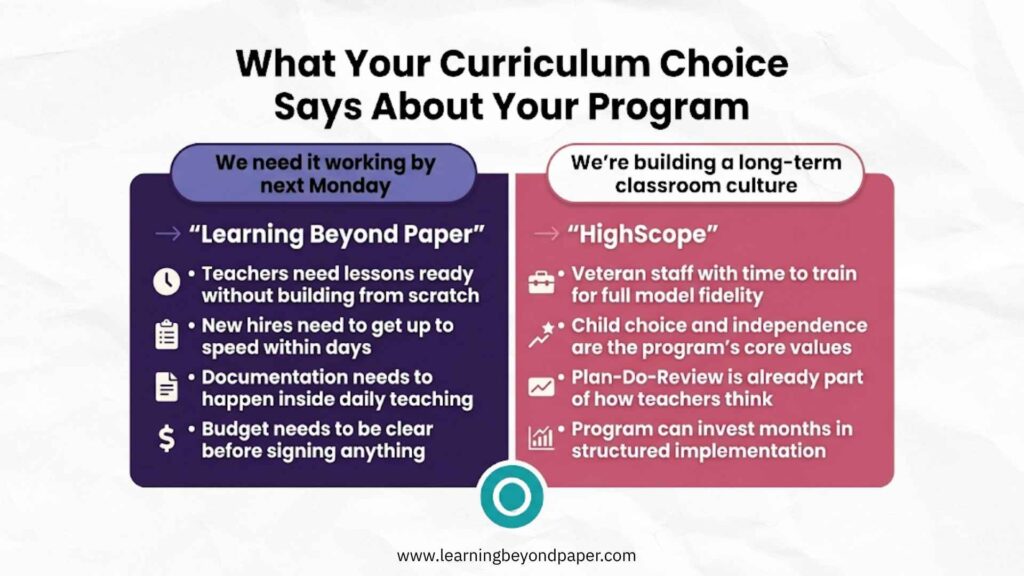
Learning Beyond Paper may be a better fit for childcare centers that need a full daycare preschool curriculum, easy digital access, bilingual content, built-in professional development, and support for teachers with different experience levels. It may also fit multi-site programs that need consistency across classrooms.
HighScope may be a better fit for programs that want a deeply established early childhood model, have the budget and time for staff training, and value a classroom culture built around active participatory learning and plan-do-review.
| Program Need | Better Fit | Why |
| Fast curriculum rollout across several classrooms | Learning Beyond Paper | Digital access and ready-to-use lessons reduce setup friction |
| Deep active learning model with strong classroom routines | HighScope | Plan-do-review and child choice are central to the model |
| Built-in bilingual English/Spanish content | Learning Beyond Paper | Bilingual resources are part of the platform |
| Long-standing research legacy | HighScope | HighScope has decades of recognition in early childhood education |
| New-teacher support | Learning Beyond Paper | ELBY and embedded professional development can help teachers in the moment |
| Fidelity-based professional learning | HighScope | Training is designed around the HighScope curriculum model |
| Standards documentation | Learning Beyond Paper | Digital alignment and documentation support are built into daily use |
| Programs already trained in HighScope | HighScope | Existing staff knowledge may make implementation easier |
Learning Beyond Paper vs HighScope is not a contest between modern and outdated. It is a choice between two different routes to quality.
HighScope is strong when a program wants a deeply rooted, active learning model and has the time to train teachers well. It respects children’s choices, supports social and emotional development, and gives classrooms a clear plan-do-review rhythm.
Learning Beyond Paper is strong when a program needs a complete preschool curriculum that teachers can open and use without chasing paper binders, building lessons from scratch, or managing separate support tools. It may be especially useful for centers that need bilingual preschool curriculum, standards documentation, and teacher support built into one system.
If your program is asking, what is the best preschool curriculum?” the better question may be this: Which curriculum will your teachers use well, day after day, with the children in front of them?
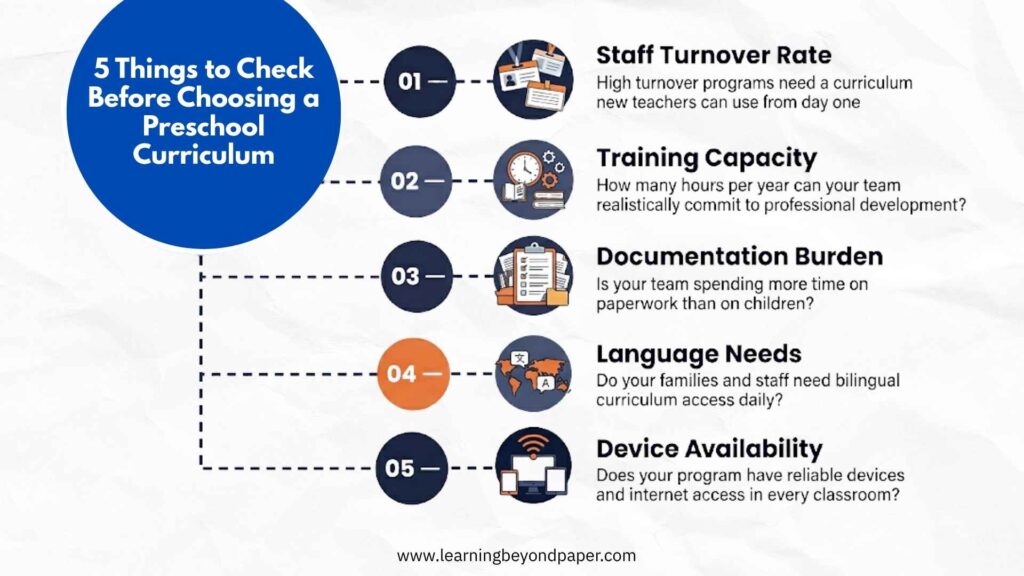
Before you choose between Learning Beyond Paper vs HighScope, review your staff capacity, budget, program goals, and classroom reality. A curriculum can look excellent on paper and still fail if teachers do not have the time, training, or confidence to use it.
Ask whether your teachers need ready-made lesson plans or deeper model-based training. Ask whether bilingual resources are essential. Ask whether documentation is currently a burden. Ask how often new teachers join your team. Ask whether your program wants a paper-light system or prefers physical curriculum materials. Ask how much support teachers need during the day, not just during annual training.
If your center needs help with creating toddler lesson plans for daycare, Learning Beyond Paper offers useful support. If you are still defining what a preschool curriculum should include, their material can help clarify key components. Programs planning on transitioning from paper curriculum to digital curriculum in childcare can also find relevant direction there.
Learning Beyond Paper vs HighScope is a useful comparison because both programs speak to real needs in early childhood education. HighScope brings a respected, research-based active learning model. Learning Beyond Paper brings a modern, cloud-based curriculum with built-in teacher support, bilingual access, and practical tools for busy childcare programs.
For a center that wants a long-standing curriculum philosophy and has the time to train for fidelity, HighScope may be a strong fit. For a center that needs a digital, ready-to-use curriculum across infant through Pre-K classrooms, Learning Beyond Paper may be the more practical choice.
If your team is comparing curriculum options, review how each model would work during a real week in your classrooms. For programs that need a paperless curriculum with built-in teacher support, Learning Beyond Paper’s curriculum overview and demo can help you see whether the platform fits your staff, schedule, and classrooms.
No. Learning Beyond Paper is a cloud-based early childhood curriculum platform with ready-to-use digital lesson plans, bilingual content, embedded professional development, and teacher support. HighScope is a research-based curriculum model built around active learning, classroom routines, adult-child interaction, and plan-do-review.
Learning Beyond Paper may be easier for programs that need quick access to daily lesson plans and a paperless curriculum system. HighScope may take more time to implement well because the model depends on staff training, classroom routines, and consistent use of the active learning approach.
Yes. HighScope is rooted in active participatory learning. Children make choices, use materials, interact with adults and peers, and reflect on what they did through routines such as plan-do-review.
Yes. Learning Beyond Paper includes English and Spanish curriculum content, which can help programs that serve bilingual families or dual-language learners.
Learning Beyond Paper may be a stronger fit for newer teachers because it gives them ready-to-use lesson plans, embedded professional development, and support from ELBY, the virtual instructional coach. HighScope can also support teacher growth, but it may require more training to implement the model with confidence.
Directors should compare curriculum philosophy, teacher training needs, documentation support, bilingual resources, daily lesson access, cost, staff capacity, and how each curriculum would work during a normal classroom week.