
You’ve probably sat in a curriculum meeting where someone slides a brochure across the table and says, “This one checks all the boxes.” And it looks great on paper. The goals, the domains, the alignment chart. Beautiful.
Then a teacher tries to use it on a Tuesday morning with fourteen toddlers and no planning period, and it falls apart. That’s the real test. Not the demo. Not the checklist. The Tuesday morning test.
This comparison of Learning Beyond Paper and Frog Street is built around that question: which curriculum actually holds up when the classroom gets messy, staffing gets thin, and teachers are running on coffee and good intentions? Neither product is a bad choice. Both serve real early childhood programs. Both can support infant, toddler, preschool, and Pre-K classrooms. The difference is that they solve different problems, and choosing the wrong fit can create friction that your teachers feel every day.
If you’re a preschool director, childcare center owner, Head Start coordinator, or multi-site operator comparing options for the 2025–2026 school year, this guide is for you. This guide contains a real breakdown of how these two curricula work, where they’re strong, where they struggle, and which one fits which kind of program.
Learning Beyond Paper is a cloud-based, school-wide curriculum platform. Its design assumes that paper-heavy planning, scattered PDFs, and disconnected training resources make early childhood instruction harder than it needs to be. The solution is built around digital access, embedded teacher support, bilingual content, standards alignment, and one connected curriculum model for infant through Pre-K classrooms.
You can explore our curriculum model, including its infant, young toddler, older toddler, preschool, and pre-kindergarten curricula.
Frog Street is a long-established early childhood curriculum system. It’s been in classrooms for decades. It’s built around structured daily routines, age-level program pathways, a strong social-emotional development identity through Conscious Discipline, and a broader ecosystem of materials, training, and family engagement resources.
One leans toward workflow simplicity. The other leans toward structured depth. That is the fork in the road, and almost every practical difference flows from it.
A center with high teacher turnover, limited planning time, and a need for fast onboarding may judge these factors differently than a program with veteran teachers and a long-standing preference for structured curriculum kits.
| Category | Learning Beyond Paper | Frog Street | What Directors Should Know |
| Curriculum model | Fully digital, school-wide platform | Established curriculum system with print, digital previews, kits, and training | LBP fits centers moving away from binders. Frog Street fits programs that prefer a traditional curriculum structure. |
| Age range | Infant through Pre-K under one login | Separate pathways for infants, toddlers, preschool, and Pre-K | Both cover the full age range. The difference is in how they’re packaged and deployed. |
| Pricing transparency | Flat school-wide pricing messaging for smaller programs (enterprise pricing varies based on scale and requirements) | Typically requires a quote based on program, materials, and training package. | LBP is easier to budget for smaller programs. Frog Street may require a longer sales process before knowing the actual cost. |
| Teacher support | ELBY virtual coach + embedded professional learning inside lessons | Formal PD, coaching, and implementation tools outside the daily workflow | LBP’s support lives inside the lesson. Frog Street’s support lives around the lesson. |
| Standards alignment | State standards, Head Start ELOF, CLASS indicators, and documentation built in | State standards, Head Start, QRIS, Pre-K alignment, assessment connections | Both handle compliance. Compare how much manual work teachers still need to do. |
| Social and emotional skills | Relationship and self-management skills are woven throughout curriculum domains | Central identity, Conscious Discipline integration throughout | Frog Street leads with Social Emotional Learning. LBP includes relationship and self-management skills within a broader model. |
| Bilingual access | English and Spanish are included in every lesson | Multilingual materials and family engagement resources are available | Both support diverse classrooms. Confirm exactly what’s included in your package. |
| Best fit | Programs want digital access, pricing clarity, and faster onboarding | Programs wanting structured routines, SEL visibility, and formal implementation support | Choose based on teacher workflow and operational reality, not feature count. |
The short version is this: Learning Beyond Paper offers a clear advantage for programs seeking a digital-first workflow, clearer budgeting through a flat school-wide core curriculum subscription for smaller programs, automatic documentation, and built-in teacher guidance. For larger or enterprise customers, pricing may vary based on scale and specific requirements. Frog Street remains a strong option for programs that value a long-standing curriculum brand, structured classroom routines, professional development pathways, and a visible social-emotional framework.
The better choice is not the one with the longest feature list. It is the one your teachers can use consistently when the day gets hard.
Learning Beyond Paper launched as a direct response to a problem that most childcare directors know intimately: the binder problem.
For roughly three decades, early childhood curriculum meant physical kits, printed lesson packets, laminated cards, and three-ring binders that cost programs up to $40,000 and needed replacing every few years. That model was expensive. It was hard to update. It was hard to keep organized. And when a new teacher walked in mid-year, she was handed a stack of materials and expected to figure it out fast.
Learning Beyond Paper replaced all of that with a cloud-based platform. One login. Every age group. Every lesson. Accessible from a tablet on the classroom floor or a laptop in the break room. The curriculum covers infants through Pre-K, and everything, lesson plans, standards alignment, bilingual content, professional learning, and instructional coaching through ELBY- lives in the same place.
The company was founded by educators with backgrounds in the Department of Education, Early Learning Coalitions, NAEYC professional development, and state curriculum review. They built LBP because they’d watched paper-based curriculum fail teachers from the inside.
Learning Beyond Paper’s core promise is not simply “more activities.” Its stronger promise is a cleaner curriculum workflow: lessons, training, standards, bilingual content, and teacher support in one place.
| Where it’s strong | Considerations before choosing |
| Genuinely digital-first, no binders, no printed packets, no scattered PDFs | Centers accustomed to physical materials and printed lesson kits will need time to adjust |
| Flat school-wide pricing model for smaller programs, covering every age group under one subscription (enterprise pricing may vary based on scale and requirements) | Requires a reliable device and internet access, an operational dependency worth acknowledging |
| Bilingual English and Spanish content included in daily teacher workflow | Newer to the market than Frog Street, which means fewer years of third-party efficacy research |
| ELBY coaching is available inside the lesson when teachers need it | SEL doesn’t have the same named framework visibility as Conscious Discipline |
| Faster onboarding for new and substitute teachers | Directors should request a demo and involve teachers before committing; the workflow shift is real |
Frog Street is one of the most recognized names in early childhood curriculum. It’s been around long enough that many directors encountered it during their own years as classroom teachers, and that familiarity carries real weight in curriculum conversations.
The product is built around structured age-level programs: separate pathways for infants, toddlers, preschool, and Pre-K, each with defined daily routines, lesson sequences, materials, and family engagement tools. Frog Street’s most visible differentiator is its integration with Conscious Discipline, a widely respected social-emotional learning framework that shapes everything from morning meeting language to behavior support strategies.
Frog Street also offers professional development, coaching, implementation support, and a family-facing resource library. For programs that want a curriculum with a clear structure, a strong SEL backbone, and formal rollout support, it’s a serious option.
What Frog Street is not is a digital-first platform. It’s a curriculum ecosystem, broad, established, and structured, that includes digital components but is fundamentally organized around a physical and program-based model.
| Where it’s strong | Considerations before choosing |
| Long-established name in early childhood education, recognized in procurement and licensing conversations | Pricing requires a quote; the total cost can be harder to predict before the sales process |
| Structured daily routines build classroom culture over time, particularly valuable with stable staff | Physical materials mean recurring costs for replacement, storage, and updates |
| Conscious Discipline integration gives SEL a clear, consistent classroom identity | Implementation takes longer before teachers reach fluency, a real challenge for high-turnover programs |
| Strong professional development ecosystem for programs that need formal, documented training | Bilingual and digital access components may not be as seamlessly integrated at the lesson level |
| Physical materials and kits appeal to teachers who prefer tangible, hands-on resources | A more complex product structure means directors need to ask more specific questions during evaluation |
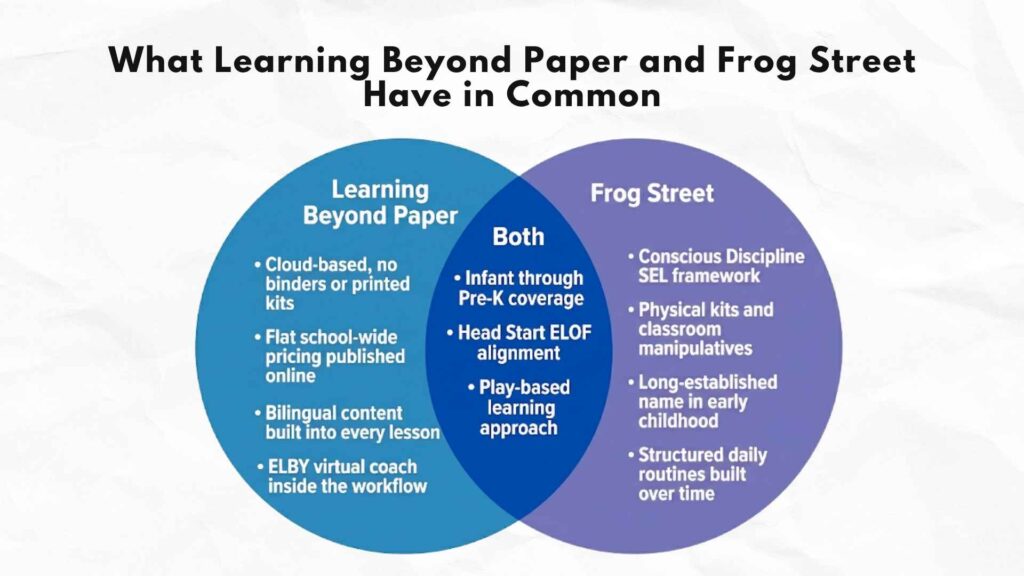
Here’s the honest version of this comparison:
Learning Beyond Paper starts with access. The assumption is that a curriculum nobody uses isn’t a curriculum; it’s an expensive shelf decoration. So the platform is designed to remove every barrier between a teacher and the lesson she needs. Open a device. Find today’s lesson. Teach. Document. Done.
Frog Street starts with structure. The assumption is that good early childhood teaching requires predictable rhythms, the same morning meeting format, the same transition songs, and the same SEL language repeated over and over until it becomes second nature for children and teachers alike.
Both assumptions are reasonable. Both serve real needs. But they create completely different classroom experiences.
A teacher using Learning Beyond Paper will adapt faster. A brand-new hire can open the platform and be teaching a solid lesson by her second day. A teacher using Frog Street will, over time, build a classroom culture with deeper routines, but that takes months of consistent use to develop.
A safer way to frame the tradeoff is this: Learning Beyond Paper may reduce the ramp-up time for teams ready for a digital workflow, while Frog Street may reward programs that can invest time in structured implementation.
For a center with high staff turnover, the faster ramp-up matters enormously. For a center with a stable, veteran team, the deeper structure may be worth the longer implementation timeline.
Both Learning Beyond Paper and Frog Street serve early childhood programs across multiple age groups. That said, directors should look closely at how each curriculum is packaged, accessed, and supported by age. For multi-classroom centers, this difference can affect budgeting, staff training, and long-term consistency.
| Age Group | Learning Beyond Paper | Frog Street | Key Question for Directors |
| Infants (0–12 months) | Included in the school-wide digital model | Infant curriculum pathway available | How does each support responsive caregiving, attachment, and sensory learning? |
| Young Toddlers (12–24 months) | Young toddler curriculum on the platform | Toddler pathway available | Compare language-rich activities and short-attention-span design. |
| Older Toddlers (24–36 months) | Older toddler curriculum included | Toddler pathway available | Look at independence-building and movement-based learning. |
| Preschool (3–4 years) | Standards-aligned digital preschool curriculum | Preschool pathway with Conscious Discipline integration | How long does lesson prep take for an average teacher? |
| Pre-K (4–5 years) | Pre-K curriculum in the school-wide model | Pre-K pathway with school readiness focus | Compare literacy, math, SEL, and kindergarten readiness support directly. |
| Mixed-age rooms | Flexible digital access may help | Requires careful selection across programs | Ask both companies directly how they support blended age groups. |
One practical note: programs running infant, toddler, preschool, and Pre-K rooms under one roof should pay close attention to how each company structures multi-room access. With LBP, the core curriculum is a flat school-wide subscription for smaller programs, which gives directors a clearer way to budget across classrooms. For larger or enterprise customers, pricing may vary based on scale, number of sites, and specific requirements. With Frog Street, coverage across age levels often means multiple programs or packages, and that affects total cost in ways the initial quote may not make obvious.
Let’s return to the opening idea, because this is where curriculum decisions either pay off or fall apart.
Picture a lead preschool teacher. She has 16 kids, one assistant who calls out sick twice a month, a new parent complaint in her inbox, and a lesson that’s supposed to address three early learning standards by 9 a.m. She does not have time to dig through a binder, find the supplemental materials, print the activity sheet, and translate the lesson into something that actually works with her specific group.
Learning Beyond Paper’s design is built around this reality. Lessons are device-accessible, standards are embedded, and ELBY can help her adapt the lesson in real time, all within the same platform. She doesn’t have to leave the workflow to get support. The support is in the workflow.
Frog Street’s response to this same teacher is structured. If she’s been using Frog Street consistently, she already knows the routine. The morning meeting looks the same. The transition cues are familiar. Her kids know what comes next. That predictability can make a hard morning easier, but it requires weeks of consistent implementation before it kicks in.
The honest tradeoff is not easy vs hard. It is faster digital access vs deeper routine-based implementation. Neither is a magic fix. Both require real commitment from staff.
This is the section many directors read twice because it connects to licensing visits, QRIS ratings, Head Start monitoring, state standards, and classroom observations.
Learning Beyond Paper states that its curriculum aligns with all 50 state early learning standards, Head Start ELOF, CLASS indicators, and developmentally appropriate practice. Directors can check curriculum alignment details and how to document learning outcomes.
Frog Street also emphasizes alignment with state standards, Head Start, QRIS, Pre-K requirements, assessment connections, and documentation. Its public curriculum materials present it as a standards-aligned early childhood curriculum with strong social-emotional and family engagement components.
For external credibility, both products appear in approved curriculum conversations. Florida’s approved School Readiness curriculum list includes Learning Beyond Paper and multiple Frog Street products. Pennsylvania’s approved curriculum information also lists Learning Beyond Paper and Frog Street.
That is not a tiebreaker. It does not prove that one curriculum is better. It simply confirms that both belong in serious curriculum-selection conversations.
For Head Start programs, directors should also compare both options against the Head Start Early Learning Outcomes Framework and local grant requirements. An approved curriculum is a starting point, not a complete implementation plan.
The better question is not only, Is it aligned? The better question is: how much time does alignment documentation add to a teacher’s day?
A curriculum that maps standards beautifully but requires teachers to manually log every connection may slowly become harder to use. A curriculum that makes standards visible inside daily lessons can turn compliance into part of teaching rather than an after-hours task.
NAEYC’s guidance on developmentally appropriate practice is also useful here. It reminds programs that curriculum should support joyful, intentional, age-appropriate learning, not just standards coverage.
This is the one area where Frog Street has a genuinely distinct edge, and it’s worth saying clearly.
Conscious Discipline gives Frog Street a visible, named SEL framework that runs through the entire curriculum. Teachers learn consistent language for emotional regulation. Children hear the same words, see the same visual cues, and experience the same community-building routines every day. That consistency is developmentally important, and it gives directors a clear story to tell families, staff, and quality-rating reviewers.
Learning Beyond Paper includes relationship and self-management skills throughout its curriculum domains, and its 4,000+ activities weave social-emotional development into daily learning across every age group. But it doesn’t lead with a named framework the way Frog Street does.
If your program has identified SEL as its primary improvement focus, Frog Street may be the stronger choice. If SEL is one priority alongside digital access, bilingual support, documentation, and cost clarity, Learning Beyond Paper may be the better operational fit.
That is a fair comparison. Frog Street has the stronger SEL brand identity. Learning Beyond Paper has a stronger digital workflow identity.
Bilingual support isn’t a feature many programs debate in theory. In practice, it’s either there when a teacher needs it, or it isn’t.
Learning Beyond Paper includes English and Spanish content as part of the standard school-wide curriculum. That means a bilingual teacher in a dual-language classroom has both versions available inside the same lesson, not in a separate document she has to track down. For centers where a significant portion of families speak Spanish at home, that day-to-day accessibility matters.
Frog Street offers multilingual materials and family engagement resources, but the depth and integration may vary depending on the specific program and package. Directors should ask explicitly: which lesson components are available in Spanish, is it included or an add-on, and how does a teacher access bilingual content mid-lesson?
Both companies support diverse classrooms. The comparison is not whether bilingual support exists; it is how easily teachers can use it during real instruction.
That difference matters for programs serving dual-language learners, bilingual staff, and families who want to understand what their children are learning.
Pricing is one of the clearest differences between Learning Beyond Paper and Frog Street.
| Cost Factor | Learning Beyond Paper | Frog Street | Director Question |
| Pricing visibility | Flat school-wide subscription for smaller programs; enterprise pricing may vary based on scale and requirements | Usually requires a quote | Can smaller programs budget clearly upfront, and what pricing factors change for larger or multi-site organizations? |
| Materials | Digital-first; minimal physical materials needed | Physical kits, teacher guides, and manipulatives, depending on the program | What needs to be purchased, stored, and eventually replaced? |
| Training | Embedded in the platform, included in the subscription | Professional development is available, may be at a separate cost | What does training actually cost, and is it one-time or ongoing? |
| Updates | Cloud-based; updates roll out automatically | Depends on the curriculum version and purchased materials | What happens in year three when content needs refreshing? |
| Staff onboarding | New teachers can access and use the curriculum quickly | Structured training typically needed before full implementation | How fast can a mid-year hire reach competency? |
| Documentation | Built into the workflow | Assessment connections included: manual steps may remain | How much time are teachers spending on compliance paperwork? |
| Multi-site use | School-wide model designed to scale | Should be reviewed through a formal quote | Does the cost scale reasonably as your program grows? |
The honest answer on pricing: Learning Beyond Paper is more transparent upfront. That transparency has real value, especially for smaller operators and nonprofit centers that need to know their annual numbers before signing anything.
Frog Street isn’t necessarily more expensive. But it’s harder to know, and the total cost- curriculum, materials, kits, training, and replacement cycles- can climb beyond the initial quote in ways that catch programs off guard.
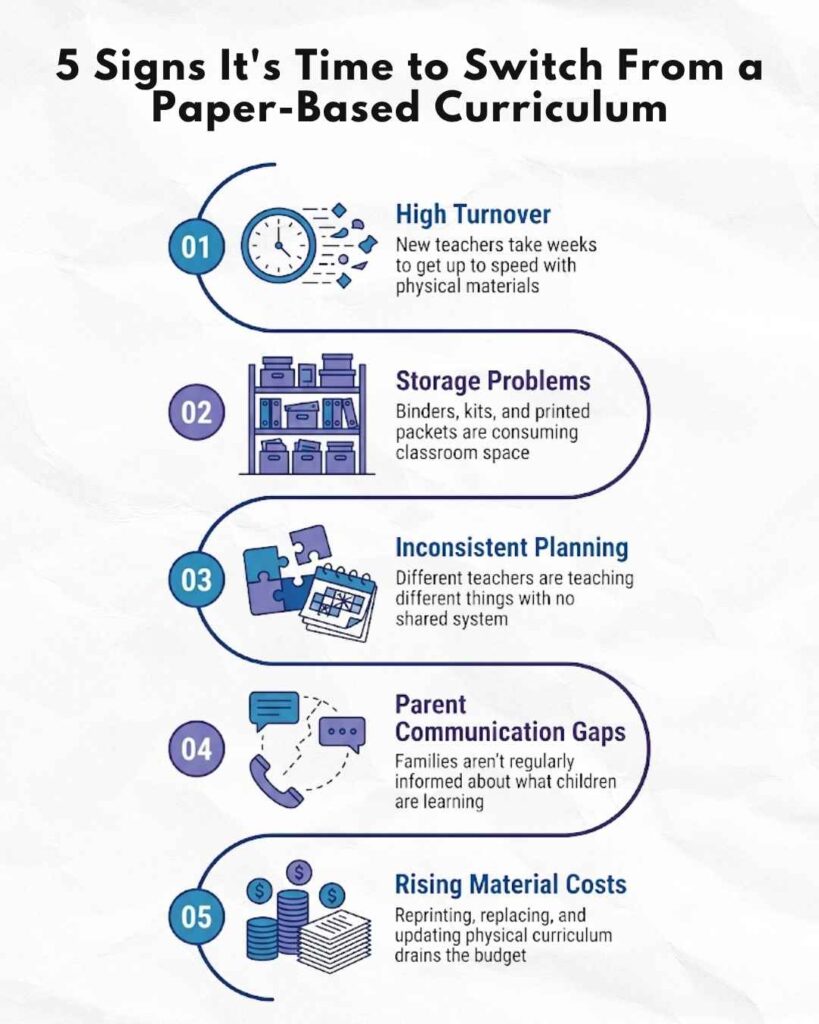
Learning Beyond Paper’s approach is to place support inside the curriculum. ELBY, the platform’s virtual instructional coach, is designed to help teachers with lesson adaptation, instructional support, and implementation guidance within the workflow. Professional learning is also part of the subscription model.
That can help small and mid-size centers where formal PD time is limited. A new teacher may need guidance while planning tomorrow’s lesson, not only during a scheduled training day next month.
Frog Street’s approach is more ecosystem-based. Professional development, coaching, and implementation support are available around the curriculum. For larger organizations, public Pre-K programs, or Head Start settings that need documented PD plans and formal rollout structures, this can be valuable.
Learning Beyond Paper’s professional support is more embedded through Learning Beyond University, with ELBY serving as a virtual instructional coach for lesson support, behavior guidance, family engagement, and classroom questions. Frog Street’s professional support is more formalized. Small centers may prefer embedded support because it reaches teachers during daily planning. Larger programs may prefer Frog Street’s broader PD ecosystem because it supports standardized implementation across classrooms.
| Program Type | Better Fit | Why |
| Small childcare center (1–3 classrooms) | Learning Beyond Paper | Transparent pricing, fast onboarding, no large materials overhead |
| Large multi-site provider | Depends on priorities | LBP for digital consistency at scale; Frog Street for formal rollout infrastructure |
| Head Start program | Review both carefully | Match against ELOF, local monitoring requirements, and PD documentation needs |
| Program with SEL as primary focus | Frog Street | Conscious Discipline gives SEL a named, visible identity throughout the classroom day |
| Center moving away from paper-based curriculum | Learning Beyond Paper | The digital-first workflow directly solves the paper management problem |
| Program with stable, veteran teaching staff | Frog Street | Structured routines build a strong classroom culture when teacher continuity exists |
| Center with high staff turnover | Learning Beyond Paper | Digital access, embedded support, and fast onboarding reduce mid-year disruption |
| Program serving Spanish-speaking families | Learning Beyond Paper | English and Spanish content included in daily lesson workflow |
| Program that values physical classroom materials | Frog Street | Kits, manipulatives, and printed guides appeal to teams that prefer tangible resources |
| Family child care homes | Learning Beyond Paper | Flexible digital access across mixed-age groups without managing separate material sets |
Don’t let a polished demo be the last information you gather. These questions reveal what happens after the contract starts.
| Decision Area | Ask Learning Beyond Paper | Ask Frog Street |
| Daily use | How quickly can a brand-new teacher find and confidently teach tomorrow’s lesson? | How much prep does a teacher need before a lesson runs smoothly? |
| Pricing | For a smaller program, what is included in the flat school-wide subscription, and what factors affect pricing for larger or enterprise customers? | What does the full quote include, and what might cost extra in year two? |
| Age coverage | Does one subscription cover infant, toddler, preschool, and Pre-K classrooms? | Which age-level programs or materials require separate purchase? |
| Standards | How are state standards, Head Start ELOF, and CLASS indicators visible in daily lessons? | How are standards connected to daily lessons, and how is that documented? |
| Teacher support | How does ELBY help a teacher adapt a lesson for a child with different needs? | What training, coaching, and implementation support is available, and what’s the cost? |
| Bilingual access | Is English and Spanish content inside the daily teacher workflow, or separate? | Which lesson components and family materials are available in languages other than English? |
| Documentation | How does the platform help teachers document learning outcomes, and how long does it take? | What documentation is automated, and what remains manual? |
| First 30 days | What does onboarding look like for a full school, including infant and toddler rooms? | What does the rollout timeline look like for a center of our size? |
| Long-term fit | How does the curriculum support new teachers joining mid-year? | How do updates, training renewals, and material replacements work over time? |
The answers to these questions will tell you more than the feature list.
A curriculum is a tool. Like any tool, its value depends on whether the person using it can actually use it, on ordinary days, not just ideal ones.
Learning Beyond Paper built its platform around this: reduce friction so teachers spend energy on children, not on systems. If a teacher is spending ninety minutes every Sunday evening hunting for lesson materials, that’s ninety minutes she’s not resting, not connecting with her own family, not preparing mentally for the week. That cost is real, even if it doesn’t show up in a curriculum evaluation rubric.
Frog Street built its curriculum around something equally real: the power of consistent routines. Children, especially young children, regulate better, engage more deeply, and build language faster in environments with predictable structure. When a teacher has internalized a curriculum’s rhythm so deeply that she doesn’t have to think about it, she has more bandwidth to respond to the child in front of her. That’s also a real benefit.
Both philosophies serve children. Both deserve serious evaluation. What they don’t do is cancel each other out; the right question is which one fits your staff, your program model, and your operating reality.
Neither is universally better. Learning Beyond Paper is a better fit for centers that want a digital-first workflow, transparent pricing, bilingual content, embedded coaching, and faster staff onboarding. Frog Street is a better fit for programs that want structured routines, a recognized SEL framework, formal professional development, and a long-established curriculum ecosystem.
The curriculum model. Learning Beyond Paper is built around digital access and reducing teacher planning friction. Frog Street is built around structured age-level programs, physical materials, social-emotional routines, and a broader training ecosystem.
Yes. Lessons, standards alignment, bilingual content, professional learning, and ELBY coaching all live in a cloud-based platform accessible from any internet-connected device.
Yes. Conscious Discipline integration is one of Frog Street’s most recognized features. It runs through the social-emotional development components of the curriculum and shapes classroom routines, language, and community-building throughout the day.
Both appear in Head Start-aligned curriculum conversations and map to the Head Start ELOF. Our guide walks through the five central domains of school readiness so you can judge each vendor's mapping yourself instead of taking the label at face value. The better choice depends on your local monitoring requirements, PD documentation needs, staff capacity for implementation, and whether your program values embedded digital support or a more formal rollout structure.
Yes. Frog Street offers multilingual materials and family engagement resources. Directors should confirm which specific components are available in which languages, and whether Spanish-language materials are included in the standard package or priced separately.
Yes. The digital access model and flexible lesson design can work across mixed-age settings, which makes it practical for family child care homes and smaller programs without dedicated age-separated classrooms.
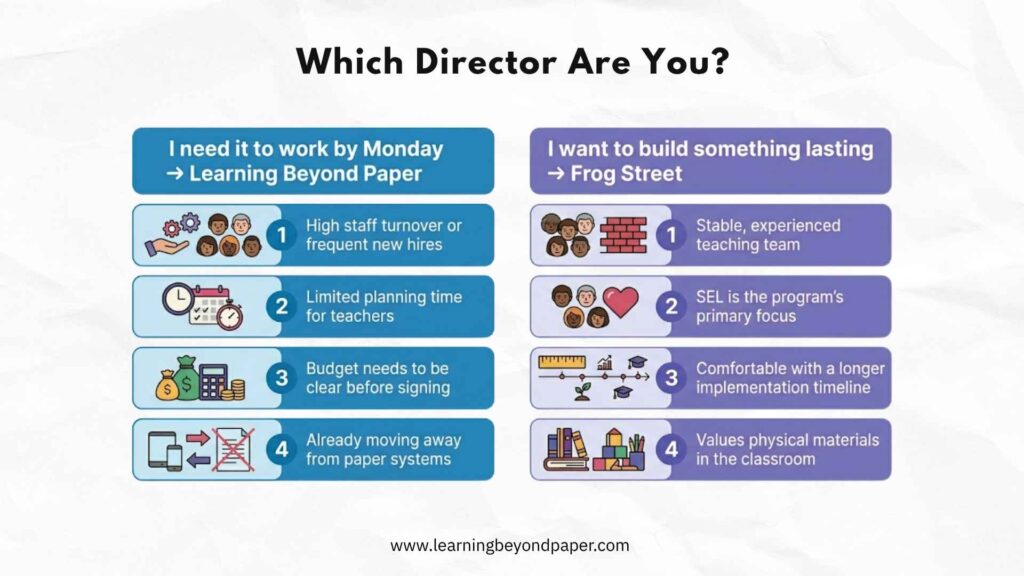
There is no perfect curriculum. There is only the one your teachers can use consistently, your budget can sustain, and your children can benefit from every day.
Learning Beyond Paper is the stronger fit for programs ready to reduce paper-heavy planning, simplify teacher onboarding, access bilingual content, and manage curriculum from one digital platform. Frog Street remains a strong choice for programs that prefer a long-established curriculum system with structured routines, Conscious Discipline, formal training, and physical materials.
Before you decide, test both through the lens of your teachers. Give your team a sample week, compare prep time, review documentation needs, and ask one simple question: which curriculum would they actually use on a busy classroom morning?
If your team is ready to compare options, start with the workflow. Explore Learning Beyond Paper’s curriculum, review a sample week, and see whether the digital model fits the way your teachers actually teach.