
If you have ever sat at the kitchen table on a Sunday night staring at a blank grid, this page is for you. Below are free preschool lesson plan templates: a copy-ready weekly template, a daily template, and one fully filled-in week so you can see what a finished plan looks like. Everything here is built for preschoolers ages 3 to 5.
What a Good Preschool Lesson Plan Template Includes
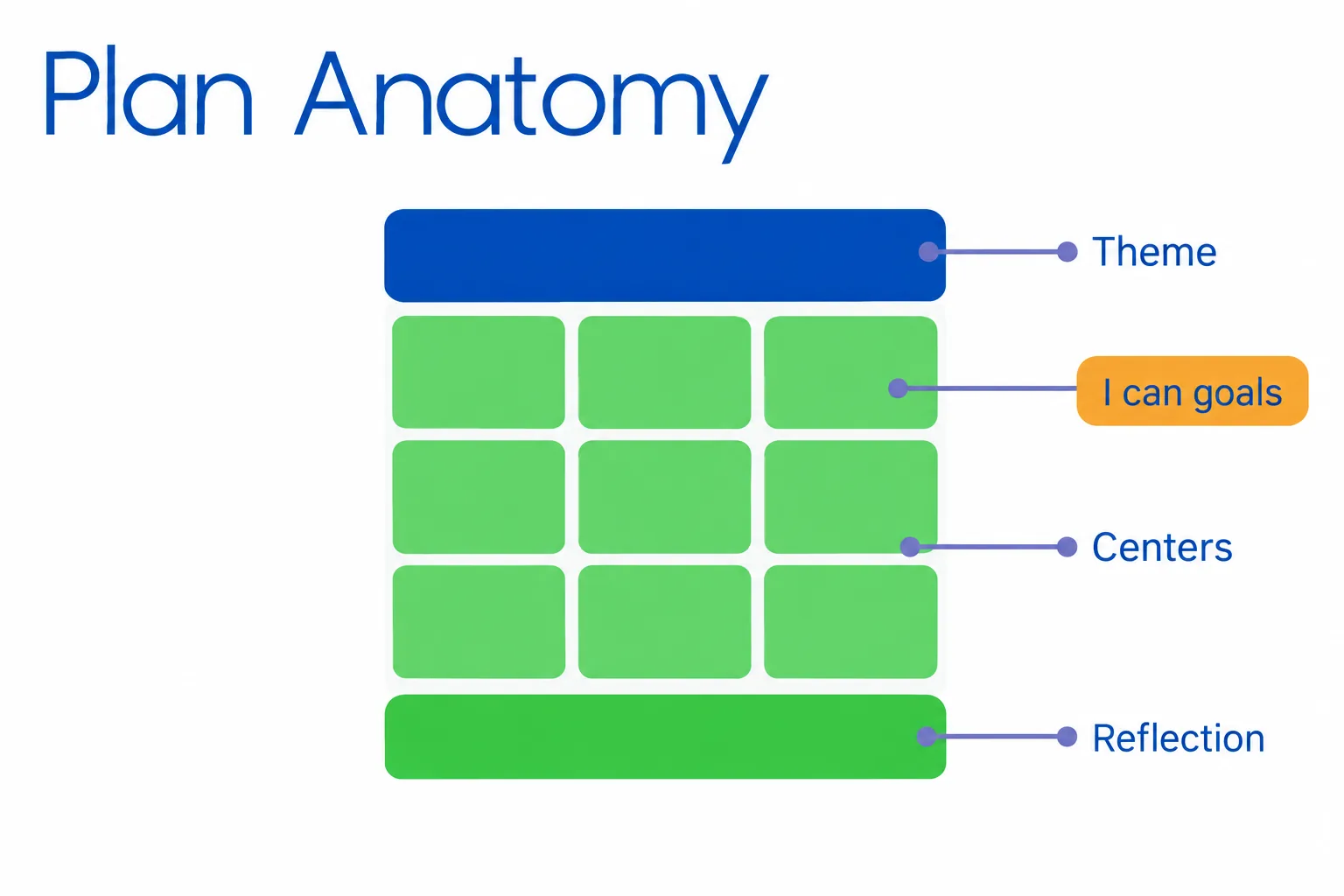
A useful preschool lesson plan template does more than list activities. It holds the thinking behind them, so you, a co-teacher, or a substitute can pick it up and teach with confidence. The strongest preschool lesson plan templates include:
- Theme or unit: the big idea for the week, such as All About Me or Community Helpers.
- Learning domains: which areas of development each activity supports.
- **Objectives as I can statements:** short, observable goals like I can count five objects.
- Daily routine blocks: arrival, circle, small groups, centers, snack, outdoor play, rest, and closing.
- Learning centers: dramatic play, blocks, art, sensory, library, and math or science.
- Materials and prep: a checklist so nothing is missing at 8:55 a.m.
- Differentiation: supports for children who need more help, children ready for a stretch, and dual language learners.
- Assessment and observation notes: quick anecdotes captured during play.
- Family connection: one simple idea families can try at home.
- Teacher reflection: what worked, what children loved, and what to change.
Each section earns its spot. Materials lists mean fewer scrambles. Clear objectives keep activities purposeful. Domain tags make standards documentation faster when a director or monitor asks for it. Observation and reflection fields keep the plan responsive to the children in front of you, which is the heart of developmentally appropriate practice.
To see how these pieces fit together across a full year, look at our preschool curriculum for ages 3 to 5.
Free Weekly Preschool Lesson Plan Template
Copy this layout into a document or spreadsheet. The weekly view is where you plan theme, vocabulary, and materials once, so the daily work gets lighter.
Header fields
- Week of:
- Theme:
- Focus domains:
- Key vocabulary (5 to 8 words):
- Book of the week:
- Letter or sound focus:
| Day | Morning Circle | Small Group (Literacy) | Math and Science | Centers and Play | Outdoor and Gross Motor |
|---|---|---|---|---|---|
| Monday | |||||
| Tuesday | |||||
| Wednesday | |||||
| Thursday | |||||
| Friday |
Footer fields
- Materials checklist:
- Differentiation notes (more support / extension / dual language learners):
- Family connection idea:
- End-of-week reflection:
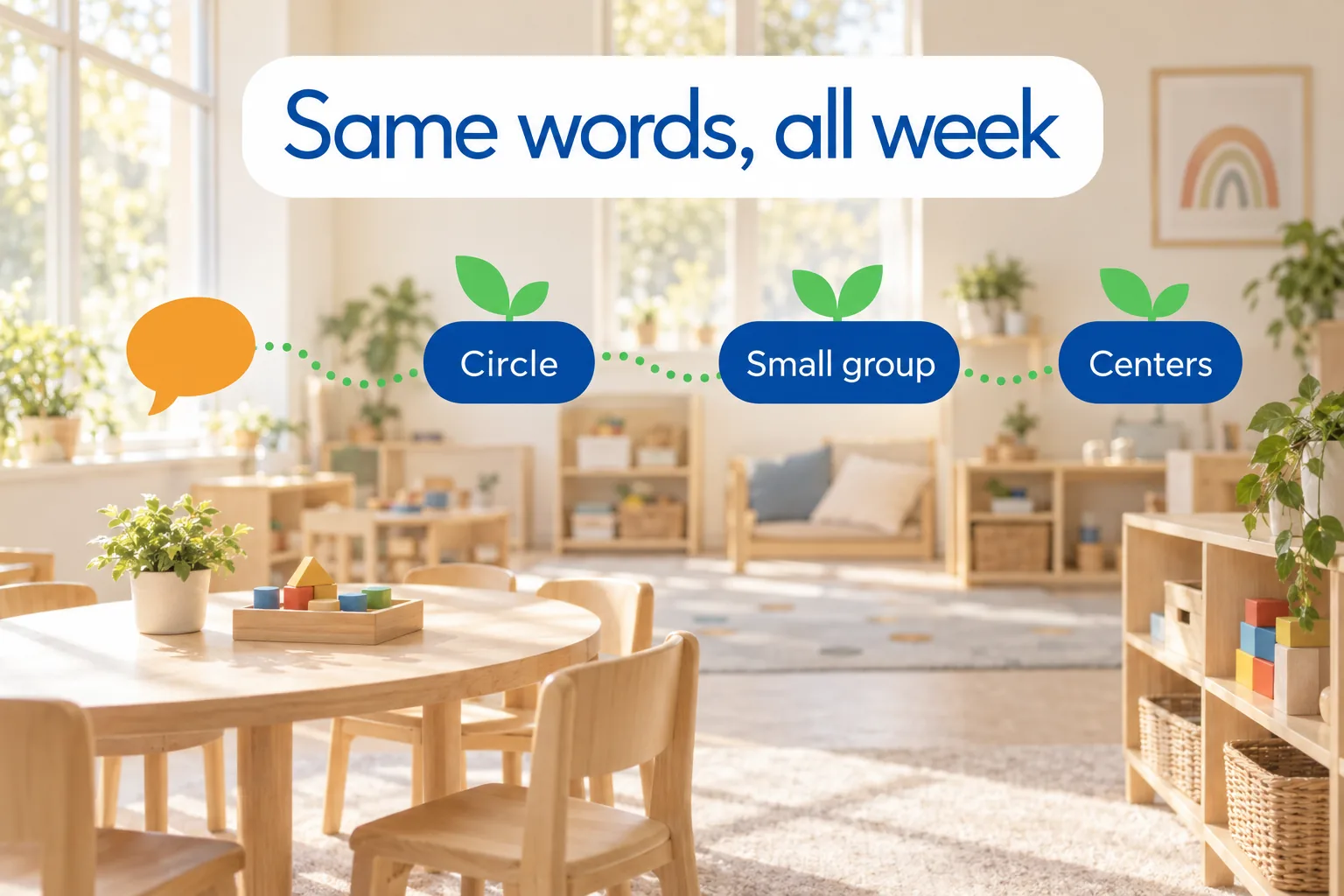
Fill in the theme, vocabulary, and book of the week before you touch the daily boxes.
Tip: fill in the theme, vocabulary, and book of the week before you touch the daily boxes. When the same words show up in circle, small group, and centers, children hear and use them again and again across the week.
Printable or editable? Paste the table into a word processor or Google Doc to edit it, then save or print it as a PDF for the classroom wall or a family newsletter.
Free Daily Preschool Lesson Plan Template
The daily template zooms in on routines and on what you will say, watch for, and adjust.
| Time | Block | Activity |
|---|---|---|
| Arrival and greeting | ||
| Morning circle | ||
| Small groups | ||
| Center time | ||
| Snack | ||
| Outdoor play | ||
| Read-aloud | ||
| Rest | ||
| Closing circle |
For each planned activity, add these fields:
- Activity name
- ELOF domain
- **Objective (I can statement)**
- Materials
- Teacher talk prompts (two or three open-ended questions)
- Differentiation
- Observation notes
Daily plans matter most on the days you are not there. A substitute, floater, or co-teacher can follow a clear daily plan without guessing, and directors get more consistency from room to room. For the first block of the day, see our guide on how to plan circle time for preschoolers.
Filled Example: One Preschool Week Themed “Community Helpers”
Here is the weekly template completed. Book of the week: a picture book about community workers. Key vocabulary: helper, mail carrier, letter, envelope, firefighter, doctor, deliver.
Related readingBack to School Activities for Preschool: Week 1 PlanRead the guide →| Day | Morning Circle | Small Group (Literacy) | Math and Science | Centers and Play | Outdoor | ELOF Domain and Objective |
|---|---|---|---|---|---|---|
| Monday | Who helps us? Picture sort of community workers | Read-aloud, then name the helpers | Count helper hats (1 to 5) | Dramatic play: doctor’s office | Obstacle course “emergency run” | Social and Emotional: I can name a helper in my community. |
| Tuesday | Helper tools guessing bag | Beginning sound /f/ for firefighter | Sort tools by job | Block center: build a fire station | Hose “water” relay with empty bottles | Language and Literacy: I can hear the first sound in a word. |
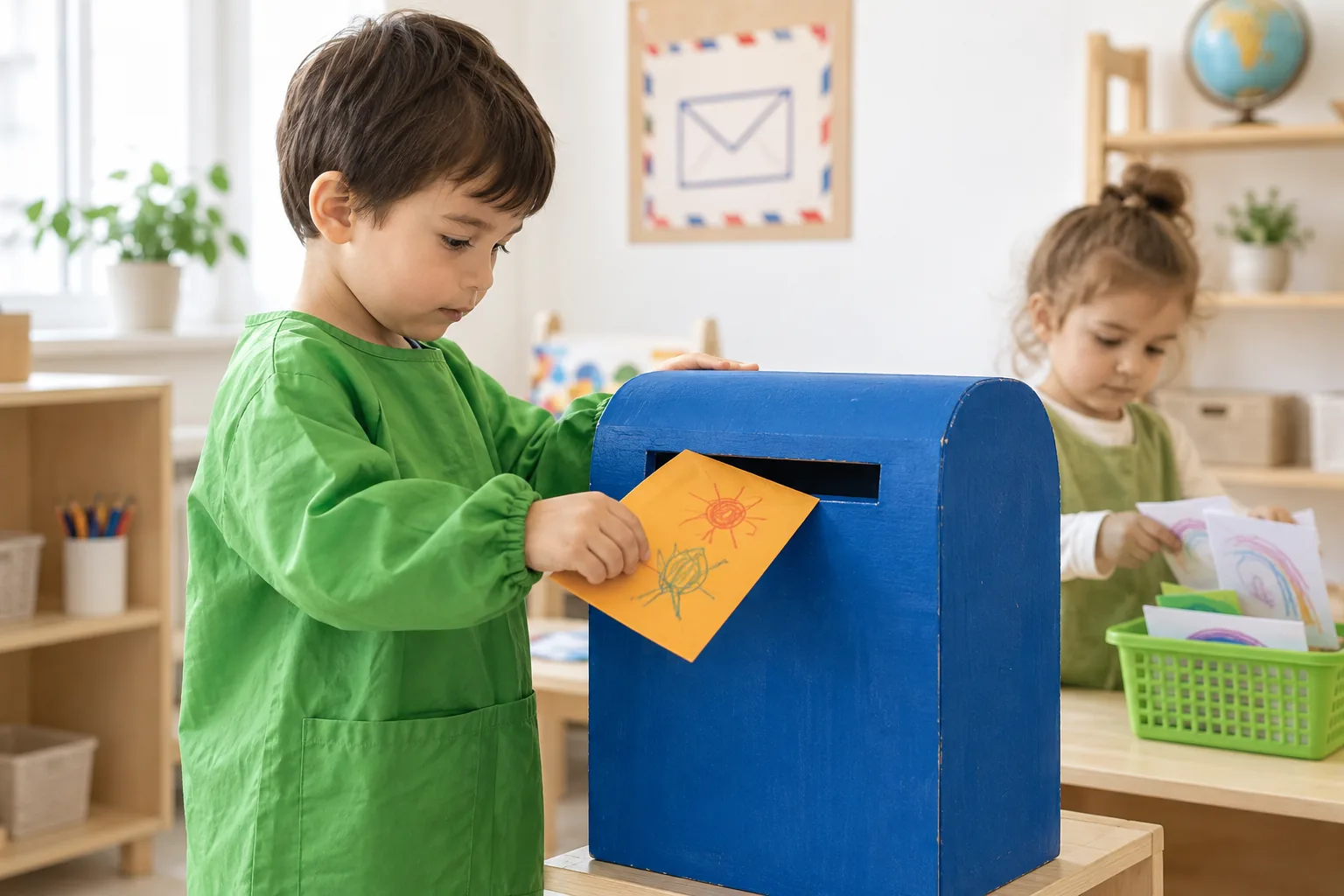
| Wednesday | Mail carrier visit (photo or real) | Write or draw a letter to a friend | Count letters into mailboxes | Dramatic play: post office | Deliver mail around the playground | Cognition: I can count up to 10 objects. |
| Thursday | What do doctors check? | Retell the story with picture cards | Sink or float: helper tools | Art: design a helper vehicle | Ambulance tricycle path | Approaches to Learning: I can try my idea and test it. |
| Friday | Thank-you circle for helpers | Cut out and decorate a group thank-you card | Graph: which helper do you want to be? | Choice of favorite centers | Free play and gross motor games | Perceptual, Motor, and Physical: I can use scissors to cut on a line. |
Weekly materials: helper hats and props, toy stethoscope, envelopes, paper, crayons, scissors, shoeboxes for mailboxes, tub of water, picture cards, blocks, chart paper.
One differentiation note per day:
- Monday: pair children new to the group with a peer buddy for the picture sort.
- Tuesday: offer picture cards for children not yet ready to say the sound aloud.
- Wednesday: use mailboxes numbered 1 to 3 for some children and 1 to 10 for others.
- Thursday: ask children ready for a challenge to predict before testing and explain why.
- Friday: provide spring-loaded scissors and thicker lines for children still building hand strength.
Filled Daily Example: Wednesday of Community Helpers Week
| Time | Block | Activity |
|---|---|---|
| 8:00 | Arrival | Children “check in” by dropping their name card in the class mailbox |
| 8:30 | Morning circle | Look at photos of a mail carrier; introduce letter, envelope, deliver |
| 9:00 | Small groups | Write or draw a letter to a friend; dictate words to the teacher |
| 9:30 | Centers | Dramatic play post office; math: count letters into numbered mailboxes |
| 10:30 | Snack | Talk about what a mail carrier might pack for lunch |
| 10:45 | Outdoor | Deliver envelopes to “houses” around the playground |
| 11:30 | Read-aloud | Community helpers book, pausing to predict |
| 12:30 | Rest | Quiet music |
| 2:30 | Closing circle | Who received mail today? How did it feel? |
Teacher talk prompts:
- “What do you think happens to a letter after it goes in the mailbox?”
- “How could we figure out which mailbox this letter belongs in?”
- “You put three letters in. What would happen if one more came?”
Open-ended questions like these do real work. As a Frontiers in Education analysis of the CLASS Pre-K describes, the tool’s Instructional Support domain looks at how teachers promote higher-order thinking, give feedback, and stimulate language development. Writing prompts into the plan makes those conversations easier to deliver in a busy room.
Differentiation:
- Extra support: mailboxes marked with dots as well as numerals.
- Extension: children write a classmate’s name on the envelope and match it to a name list.
- Dual language learners: post key words in English and Spanish (letter / carta, envelope / sobre, mail carrier / cartero) and invite families to share the words they use at home.
Sample observation notes:
- M. counted 7 envelopes into the mailbox, touching each one. Recounted when asked and got 7 again.
- J. told a friend, “I deliver mail. You sign here,” using new vocabulary in play.
How to Fill In Each Section Without Burning Out
Good preschool lesson plan templates should take decisions off your plate, not add paperwork. A few habits help:
- Objectives: one short, observable I can statement per activity. If you can’t see it or hear it, rewrite it.
- Domains: tag each activity to one ELOF domain. For Head Start programs this matters: the Head Start Program Performance Standards on curricula (45 CFR 1302.32) require developmentally appropriate, research-based curricula aligned with the Early Learning Outcomes Framework. Tagging as you plan beats documenting after the fact.
- Materials: batch prep for the whole week on the weekly template, then gather everything in one trip.
- Differentiation: three quick lines per activity: more support, a stretch, and dual language learner supports.
- Assessment notes: jot brief, objective anecdotes during play instead of pulling children aside for separate testing.
- Reflection: answer two questions at the end of each day. What did children engage with most? What will I change tomorrow?
If you’re working toward alignment across your program, our step-by-step guide to mapping lesson plans to the ELOF domains walks through the full crosswalk.
What Should a Child Learn in Preschool? Mapping Your Template to ELOF
The Head Start ELOF is a helpful answer to this common question. For preschoolers, it organizes learning into five central domains, and each fits naturally into a template:
- Approaches to Learning: curiosity, persistence, and self-regulation. Example: a sink-or-float test where children predict, try, and try again.
- Social and Emotional Development: relationships, feelings, and getting along. Example: a thank-you circle for community helpers.
- Language and Literacy: vocabulary, listening, phonological awareness, and early writing. Example: writing or drawing a letter to a friend.
- Cognition: math, scientific reasoning, and understanding the world. Example: counting letters into numbered mailboxes.
- Perceptual, Motor, and Physical Development: fine and gross motor skills and healthy habits. Example: cutting on a line or an outdoor obstacle course.
Your state’s early learning standards apply too, and many programs crosswalk them with ELOF so one plan covers both. Keep the framing in mind: these domains describe what a plan supports, not guaranteed results for every child on a set timeline.
Building STEM Into Your Preschool Lesson Plan
The easiest way to make sure STEM happens is to give it its own row on the weekly template. Call it Explore and Discover. A few STEM activities for 3- to 5-year-olds that fit almost any theme:
- Ramps and rolling: tilt a block ramp and compare how far cars travel.
- Sink or float: predict, test, and sort objects from the theme.
- Pattern building: extend color or shape patterns with beads, blocks, or stickers.
STEAM doesn’t have to live in a separate block, either. Counting at snack, measuring sand at the sensory table, and building at the block center all count. For a full lesson structure, see what a STEM lesson plan for preschoolers should include.
Language and Early Literacy Fields Worth Adding
Add three small fields to your weekly template: book of the week, vocabulary words, and phonological awareness focus (rhyming, clapping syllables, or beginning sounds). This isn’t busywork. Research on phonological awareness instruction with preschoolers describes the skill as highly predictive of, and causally related to, children’s later ability to read, which is why it sits at the center of Science of Reading approaches for young children.
In practice, it looks playful: clapping the syllables in fire-fight-er, rhyming silly words at transitions, or asking “What sound does mail start with?” Add teacher talk prompts for centers, too, so conversations stay language-rich during play and not just at circle.
Printable PDF vs. Editable Digital Preschool Lesson Plan Templates: Which Fits Your Program?
Printable PDF works well for posting on the classroom wall or sending home to families. The trade-off: every change means reprinting, and sharing plans across classrooms gets messy.
Editable digital templates are easier to duplicate, adjust, and reuse year to year. For directors overseeing several classrooms, digital plans make it simpler to review lessons, keep rooms consistent, and spot gaps before a monitoring visit.
There is a third option: skipping blank preschool lesson plan templates altogether. Learning Beyond Paper provides 52 weeks of research-based lesson plans with domains, objectives, materials, and teacher talk already built in, in English and Spanish, plus ELBY, a virtual instructional coach who helps teachers adapt lessons in the moment.
Here’s how the three options compare.
| Printable PDF template | Editable digital template | Ready-made curriculum (Learning Beyond Paper) | |
|---|---|---|---|
| Cost | Free | Free | Subscription |
| Planning effort | You write every plan | You write every plan, but can reuse and duplicate | Lessons are already written |
| Domains, objectives, materials | You fill them in | You fill them in | Built into every lesson |
| Changes and reuse | Reprint after every change | Easy to copy year to year | Updated in one place |
| Sharing across classrooms | Messy; paper copies | Simple to share and review | Same plans for every room |
| Teacher talk prompts | You write them | You write them | Included |
| Dual language support | You add it | You add it | English and Spanish included |
| In-the-moment help | None | None | ELBY, the virtual instructional coach |
| Best for | Wall posting, family newsletters | Directors managing several rooms | Programs that want to stop writing plans from scratch |
Because it is fully digital, there are no costly paper kits to replace every few years, and it is more affordable than traditional curriculum options.
Planning for Toddlers or 2-Year-Olds Instead?
The templates on this page are built for ages 3 to 5. Two-year-olds and younger toddlers need shorter activities, more flexible routines, and a different kind of plan. Our guide on how to create a lesson plan for toddlers in daycare covers that age group in detail.
Preschool Lesson Plan Templates FAQ
Are there free preschool lesson plan templates I can print as a PDF?
Should I use a weekly or a daily preschool lesson plan template?
How detailed should a preschool lesson plan be?
How do I show ELOF or state standards alignment in a preschool lesson plan?
How do I differentiate a preschool lesson plan for dual language learners?
How far ahead should preschool teachers plan?
See What Ready-Made Preschool Planning Looks Like
A good template helps. But you got into this work to be with children, not to fill in grids late at night.
Learning Beyond Paper puts everything in one place: research-based lesson plans, English and Spanish content, embedded professional development through LBP University, and ELBY, a virtual instructional coach ready to answer questions during the day.
It is aligned to all 50 state standards, Head Start ELOF, and CLASS, and it covers infants through Pre-K 4 in a single subscription.
Spring enrollment and budget planning arrive fast, so now is a good time to get planning settled. Explore our preschool curriculum, or watch the demo and start a free trial to try it in your own classroom.