
Knowing how to plan circle time for preschoolers changes everything about how the session runs. A well-structured circle time is one of the most powerful learning windows in a preschooler’s day.
It builds language, attention, social skills, and emotional regulation simultaneously, and when planned properly, it practically runs itself.
Here is what this guide covers:
Most circle time sessions do not fail because of the activities inside them. They fail because of three things: no clear structure, sessions that run too long, and transitions that arrive without warning.
Circle time should last between 15 and 25 minutes. Beyond that window, even genuinely engaged preschoolers begin to disengage.
The structure inside those 15 to 20 minutes matters just as much as the duration.
| Factor | Effective Circle Time | Ineffective Circle Time |
| Structure | Clear opening, middle, and closing | Activities run without clear order |
| Engagement | Children participate actively | Children listen passively |
| Transitions | Signaled with a song or physical cue | Sudden, unexpected shifts |
| Duration | 15 to 20 minutes | Too long or inconsistently timed |
| Expectations | Set before the session begins | Explained mid-session or skipped |
The second most common problem is passive learning. When children sit and listen without responding, attention drops within minutes.
A strong preschool curriculum builds in movement, response, and choice at every stage so the group stays alert and the session stays productive.
Planning circle time for preschoolers does not require a complex system. A consistent 5-step framework makes each session feel intentional, gives children a predictable rhythm, and removes most guesswork from the planning process.
| Step | Purpose | Example |
| 1. Engage | Open with energy and attention | Welcome song, greeting ritual |
| 2. Warm-Up | Activate bodies and minds | Movement song, weather discussion |
| 3. Teach the Concept | Introduce the session’s main idea | Story, concept card, group question |
| 4. Active Participation | Children respond and interact | Game, call-and-response, sorting task |
| 5. Closing Reflection | Signal the end, settle energy | Calm song, one recap question |
This structure works because it follows how children’s attention actually moves through a session.
They arrive with energy, need a warm-up before focusing, can absorb a short teaching moment, learn better by doing than by watching, and need a clear closing signal before transitioning.
A 2025 study published in the Early Childhood Education Journal confirmed that child-initiated participation and active involvement produced the longest sustained attention spans in preschool children.
Planning circle time for preschoolers starts before a single activity box is opened. The session is won or lost in the planning stage, and the planning stage starts with one question: what do I want children to learn today?
Each session needs one clear goal. One. Attempting to cover multiple skills in a single circle time splits the educator’s attention and fragments the children’s focus.
Choose from one objective category per session:
Themes give children a hook to engage with and make each activity feel connected rather than random. Strong themes for preschool circle time include:
Keep the theme accessible to every child in the room regardless of ability. A lesson plan for toddlers in daycare operates on the same principle: one theme, explored through multiple activity types at varying levels of difficulty.
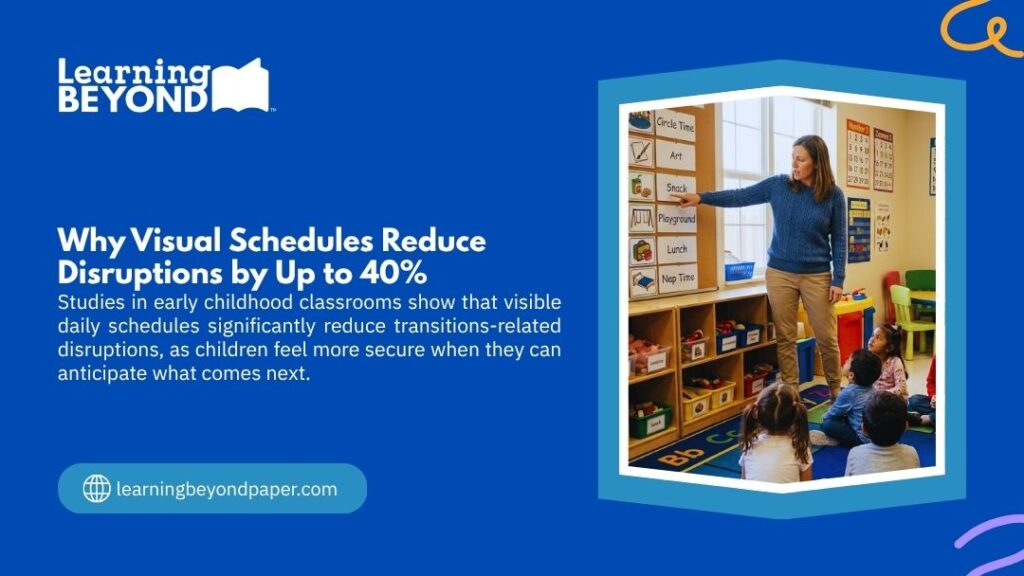
Abrupt transitions break attention and trigger disruption. A reliable signal prevents both.
| Transition Type | When to Use | Example |
| Song signal | Between any two activities | Cleanup song, transition rhyme |
| Countdown | Moving to a calmer segment | “Five, four, three, two, one, freeze” |
| Physical cue | Settling an energetic group | Hands on laps, deep breath together |
| Call-and-response | Regaining attention mid-session | “Hands on top” / “Everybody stop” |
The signal tells children something is changing before it changes. That short warning prevents most of the restlessness that educators routinely blame on the activity itself.
Planning circle time for preschoolers requires adjusting the session for the specific age group in the room. A 3-year-old and a 5-year-old have very different developmental needs, and the same session plan will not work for both.
| Age | Ideal Duration | Primary Focus | Attention Window Per Task |
| 3-year-olds | 10 to 12 minutes | Movement-heavy, very short segments | 3 to 5 minutes |
| 4-year-olds | 12 to 15 minutes | Guided participation, simple questioning | 5 to 7 minutes |
| 5-year-olds | 15 to 20 minutes | Structured learning, pre-academic tasks | 8 to 10 minutes |
At age 3, movement is the organizing principle. Short bursts of activity, action songs, and physical games keep this group present.
Sitting without movement for more than a few minutes causes restlessness, not misbehavior.
Keep each segment under 5 minutes and return to movement before introducing the next concept.
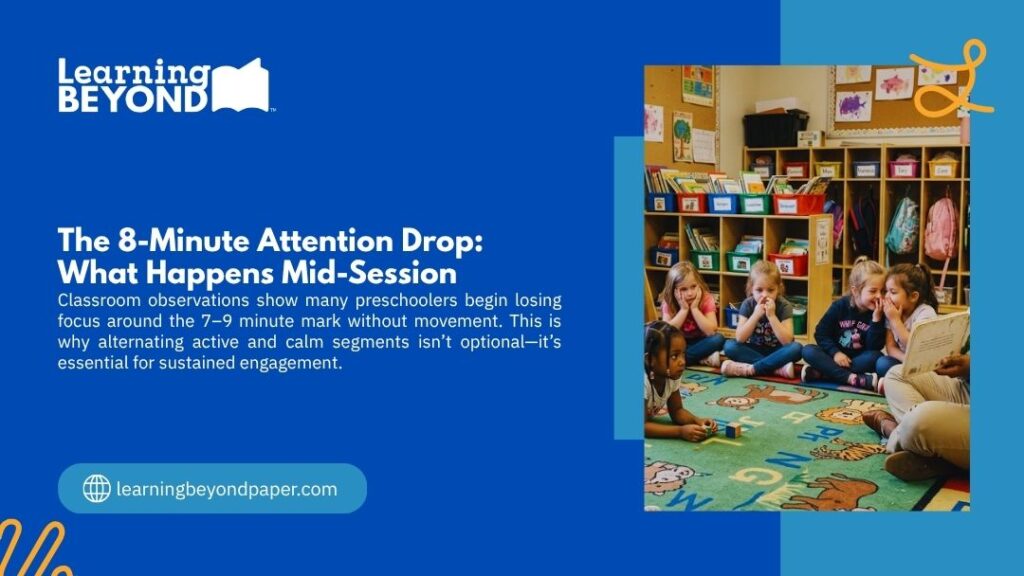
Four-year-olds handle guided participation well. Ask simple questions, invite children to share answers, and introduce one concept per session. This age group enjoys having a visible role in the session.
Call-and-response songs, group sorting games, and short story-based discussions keep 4-year-olds active and engaged.
At 5, children are approaching kindergarten readiness. Circle time can include more structured elements: calendar talk, pattern recognition, early literacy activities, and group problem-solving.
Research published in the Journal of Family Theory and Review (2024) found that consistent preschool routines correlate directly with higher kindergarten reading and math scores.
A strong circle time routine is part of that preparation.
The most effective activities share three qualities: they require active participation, they involve movement or sensory input, and they are short enough to fit comfortably within the session’s time window.
| Activity Type | Skill Developed | Duration |
| Call-and-response songs | Language, listening, memory | 3 to 5 min |
| Movement games (Freeze, Simon Says) | Body control, self-regulation | 4 to 6 min |
| Storytime with guided questions | Comprehension, vocabulary | 5 to 8 min |
| Group sorting or matching | Cognitive development, early math | 5 to 7 min |
| Feelings check-in | Emotional awareness, communication | 3 to 5 min |
Songs deserve particular attention.
A 2025 systematic review found that songs, through rhythm, repetition, and a multisensory approach, significantly improve children’s word learning, speech fluency, and real-time language engagement.
They are among the most efficient tools available for preschool circle time.
Most behavior issues during circle time are predictable. Most are also preventable. The key is front-loading your management strategy before the session begins, not during it.
State three simple rules before sitting down. Keep them positive and concrete: “Sit on your spot, eyes on the teacher, hands in your lap.”
A 2024 research study confirmed that consistent classroom routines significantly reduce disruptions and create a more manageable environment for both children and educators.
Repeat the same rules at the same point every session until they become automatic for the group.
Verbal reminders compete with everything else in the room. Visual and physical cues cut through.
Effective options include:
When a child disrupts, address it without stopping the session for everyone else.
Effective redirection strategies:
| Disruption | Immediate Fix | Prevention Strategy |
| Child leaves the circle | Quietly guide them back without an audience | Assign a specific spot with a visual marker |
| Noise escalation | Switch immediately to a movement activity | Alternate calm and active segments throughout |
| Refusal to participate | Reduce pressure, offer an observer role | Keep sessions short and activity-based |
| Attention loss across the group | Transition without hesitation | Plan fewer activities with shorter windows |
Why do well-planned circle times still fail? The answer is usually one of these patterns.
| Mistake | Impact | Fix |
| Sessions run too long | Children disengage, behavior escalates | End at 15 to 20 minutes, every session |
| Too many activities packed in | Transitions create confusion and chaos | Limit to 2 to 3 activities per session |
| No transition signals | Children feel surprised and resistant | Use the same signal consistently |
| Over-explaining instructions | Children lose focus before activity begins | Demonstrate rather than explain |
One more pattern worth naming: expecting the same response from every child in the group. A developmentally appropriate curriculum for toddlers accounts for individual variation in skill level and readiness, and circle time planning should too.
Offering participation choices so that every child can engage at their own level removes a lot of the pressure that creates resistant behavior.
This 15-minute session is built for a mixed group of 3 to 5-year-olds. The theme is feelings.
| Time | Activity | Purpose |
| 0:00 to 2:00 | Welcome song (“Hello, How Are You?”) | Engagement, language warm-up |
| 2:00 to 5:00 | Feelings check-in with emotion face cards | Emotional vocabulary, turn-taking |
| 5:00 to 9:00 | Short story with questions (“The Colour Monster”) | Comprehension, emotional awareness |
| 9:00 to 12:00 | Feelings freeze dance (show an emotion when music stops) | Movement, self-regulation |
| 12:00 to 15:00 | Closing calm: deep breath together and closing song | Transition, emotional regulation |
Each segment connects to the next.
The session opens with community, moves into concept introduction, applies the concept actively through movement, then closes with a calm, predictable signal.
Children know exactly what is coming and what it means when the closing song starts.
Passive circle time is the primary reason sessions fail. Children sit, listen, and gradually stop listening. The fix is building participation into every single segment.
Three principles that change how a session feels:
For hands-on activity ideas that connect naturally to circle time themes, age appropriate activities for 2 year olds in daycare provides a practical reference for understanding how developmental progression looks across adjacent age groups.
Even well-planned sessions hit problems. Knowing what to do in the moment keeps the session recoverable without abandoning the plan entirely.
| Problem | Immediate Fix | Prevention Strategy |
| Whole group loses attention | Switch to movement immediately, no explanation | Shorten sessions, add more active elements |
| Energy too high, over-excitement | Use a calm signal song, reduce stimulation briefly | Start with a calming activity, not an energizing one |
| Multiple children refuse to participate | Reduce structure, offer brief free choice | Check if session is too long or too passive |
| Noise escalation | Whisper instead of raising your voice | Use visual cues consistently, not verbal commands alone |
If circle time is failing repeatedly across different weeks, the first question to ask is not “which activity should I try next?” It is “is this session too long?” Most chronic circle time problems resolve when duration is reduced and active participation is increased.
For 3-year-olds, 10 to 12 minutes is the right window. For 4-year-olds, aim for 12 to 15 minutes. For 5-year-olds, up to 20 minutes is appropriate. End the session while children are still engaged, not after they have already checked out.
Start with a familiar welcome song or greeting ritual. Children need a consistent opening signal that tells them circle time is beginning. Familiarity here reduces transition resistance and settles the group faster than any other strategy.
Songs, movement games, storytime with questions, group sorting, and feelings check-ins all work consistently. The best activities require children to respond, move, or make a choice rather than sit and listen.
Keep sessions short, alternate active and calm segments, use physical and visual cues for transitions, and give children a role to play in every activity. Participation is what sustains engagement, not content.
Transition immediately to a movement activity. Do not push through a failing segment. A short action song resets the group’s attention and gives you a clean start for the next part of the session.
Learning Beyond Paper has already supported over 160,000 children across more than 3,000 schools with a curriculum built for early childhood educators who want every session to count.
Planning circle time for preschoolers is one of the highest-leverage skills a daycare educator can build. The tools, frameworks, and guided resources at Learning Beyond Paper make that planning faster, clearer, and more effective from day one.
Book a free demo today and see how Learning Beyond Paper supports real learning in real classrooms.