
Choosing a preschool curriculum is no longer just about what children learn. It is also about how that learning reaches teachers, families, and the classroom each day.
The question around cloud based preschool curriculum vs paper based comes up in director meetings and planning conversations more often now.
Clarifying what a preschool curriculum should include is a useful starting point before comparing how each format delivers that content.
The difference is more practical than philosophical. It shapes how teachers plan each week, how families stay informed, and how consistently learning reaches each child.
A cloud based preschool curriculum is accessed through a digital platform or dashboard. Teachers log in from any device, retrieve lesson plans, track observations, and communicate with families.
A paper based curriculum relies on printed materials: binders, activity guides, worksheets, and physical lesson plans that teachers organize and manage by hand.
Both can support strong learning outcomes. The real question is which format supports the adults running the program.
| Feature | Cloud Based | Paper Based |
| Delivery | Digital; accessible from any device | Printed materials and physical guides |
| Access | Anytime, any location with internet | In-person or physical copy only |
| Updates | Automatic; no reprinting needed | Requires new editions or reprinting |
| Storage | Cloud-stored; no physical space needed | Binders, folders, and filing systems |
| Parent Communication | Built-in digital messaging tools | Printed newsletters and paper notes |
A cloud based curriculum lives entirely online. Teachers access daily lesson plans, developmental activities, and assessment tools through a platform, typically from a tablet or laptop.
A teacher in the morning can pull up the day’s activities, log an observation, and send a family update all from the same place.
Paper based curriculum means printed weekly or monthly guides, physical activity cards, and binder-organized lesson plans.
Teachers prepare materials by hand and distribute printed communication to families. The experience is tactile, but the logistics can become demanding over time.
The format matters less than what it enables. A curriculum that keeps teachers overwhelmed with prep leaves less time for what actually moves children forward: interaction, observation, and guided play.
The National Academies of Sciences, Engineering, and Medicine identifies guided play as the “sweet spot” for preschool learning, supporting curiosity, creativity, and early academic skills. Both digital and paper-based formats can deliver that when implementation is strong.
| Learning Factor | Cloud Based | Paper Based |
| Hands-On Learning | Supported through lesson design; physical in practice | Naturally integrated through physical materials |
| Flexibility | High; adaptable from any device | Lower; tied to materials on hand |
| Interactive Elements | Digital tracking, family updates, engagement tools | Tactile, activity-based physical interaction |
| Independent Exploration | Child-led in practice; teacher plans digitally | Fully physical; child-led with materials |
Physical materials, sensory play, and movement are core to how young children build understanding.
A 2025 study in Acta Paediatrica found that parent-child brain synchronization was measurably greater during printed book reading than screen-based reading, pointing to the ongoing value of physical interaction in early learning.
A strong curriculum, digital or printed, keeps children’s hands and bodies actively engaged.
This is the most common concern, and it deserves a direct answer. Cloud based platforms are largely teacher-facing tools.
Teachers use the platform to plan, document, and communicate; children spend their day with blocks, books, art, and sensory activities.
The dominant trend for 2026 continues to point toward intentional, teacher-guided technology use, with children’s learning kept firmly hands-on.
| Advantage | Challenge |
| Anytime access from any device | Requires reliable internet access |
| Automatic content updates | Learning curve for less tech-comfortable staff |
| Built-in parent communication tools | Subscription or licensing costs |
| Reduces planning and documentation time | Some families prefer printed updates |
| Progress tracking tools included | Dependent on device availability |
The clearest benefit is time. Research shows digital workflows in childcare settings can save 10 or more hours weekly per location compared to paper-based processes.
In a field where 1 in 4 early childhood teachers leaves their job every year, reducing that prep burden has a measurable effect on retention.
Cloud based platforms also strengthen family communication. 76% of parents want to hear from their child’s school at least once per week, and 66% disengage when communication is not personalized.
Built-in messaging tools make consistent, individualized outreach manageable without adding to teacher workload.
Here is what consistent cloud based curriculum use tends to produce:
Technology access is not guaranteed for everyone. Only 73% of U.S. families have a stable internet connection, which matters when a platform depends on reliable access.
Staff who are less comfortable with technology also face a steeper onboarding curve, and without proper support, adoption often stalls early.
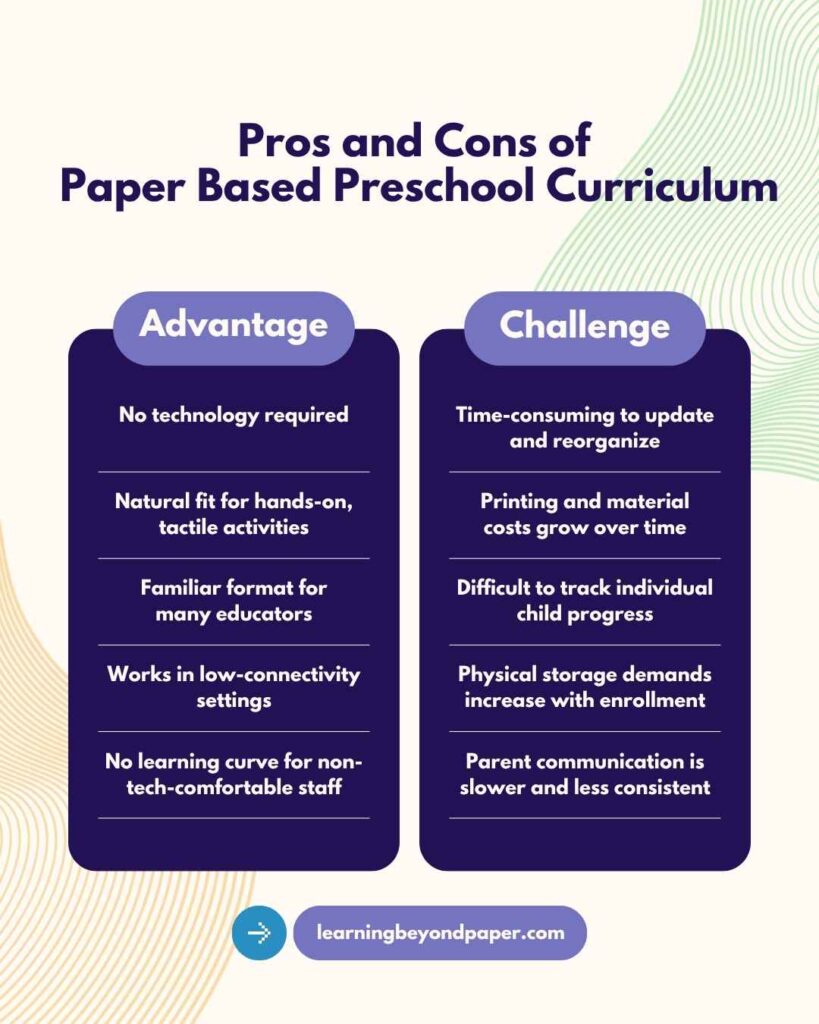
| Advantage | Challenge |
| No technology required | Time-consuming to update and reorganize |
| Natural fit for hands-on, tactile activities | Printing and material costs grow over time |
| Familiar format for many educators | Difficult to track individual child progress |
| Works in low-connectivity settings | Physical storage demands increase with enrollment |
| No learning curve for non-tech-comfortable staff | Parent communication is slower and less consistent |
Paper curriculum works immediately, without a login, device, or internet connection. For educators who prefer tactile planning or work in settings with limited tech, it integrates naturally into the classroom.
Physical materials also pair directly with the hands-on activities preschoolers need most, making implementation feel straightforward.
Knowing how developmentally appropriate curriculum for toddlers is structured helps clarify why physical materials still matter at this age, even when digital options are available.
Costs accumulate steadily. Paper, ink, binders, and storage consume both budget and physical space.
Estimates show $3 to $5 in material costs per paper enrollment packet, and that figure scales with every classroom and update cycle.
For a center processing 25 enrollments monthly, paper-based administrative processes alone can cost more than $1,300 in labor monthly, not counting print materials.
Updating paper materials after curriculum revisions means reprinting entire sections. The creative curriculum vs digital curriculum for preschool comparison explores how these ongoing cost differences factor into real program decisions.
The answer depends on who is using it, where learning takes place, and how much infrastructure exists to support it.
| Situation | Recommended Format | Reason |
| Preschool Center | Cloud based | Scales across classrooms; supports documentation |
| Homeschool or Parent-Led | Paper based or hybrid | Flexible, low-tech, and parent-controlled |
| Hybrid Learning Program | Both | Cloud for planning; physical for child-facing activities |
| Multi-Classroom Program | Cloud based | Consistent delivery across every location |
| Screen-Sensitive Families | Paper based or hybrid | Minimizes child-facing screen exposure |
For centers managing multiple classrooms, cloud based curriculum reduces inconsistency.
Teachers access the same materials, documentation stays centralized, and any content updates reach every room at the same time.
For large programs, this is a practical advantage that paper-based systems cannot easily match.
Paper based curriculum gives homeschool parents immediate, hands-on control. There is no platform to navigate, and printed guides can be used anywhere without the internet.
Many families in this setting also prefer being able to annotate and adjust materials by hand, which paper naturally supports.
For many programs, yes. Teachers use a cloud based platform for planning, tracking, and parent communication while children spend the classroom day with physical materials and hands-on activities.
A 2025 study involving 593 students across 10 early learning centers found reliability scores above .90 across all eight developmental domains in programs combining digital planning with physical classroom learning.
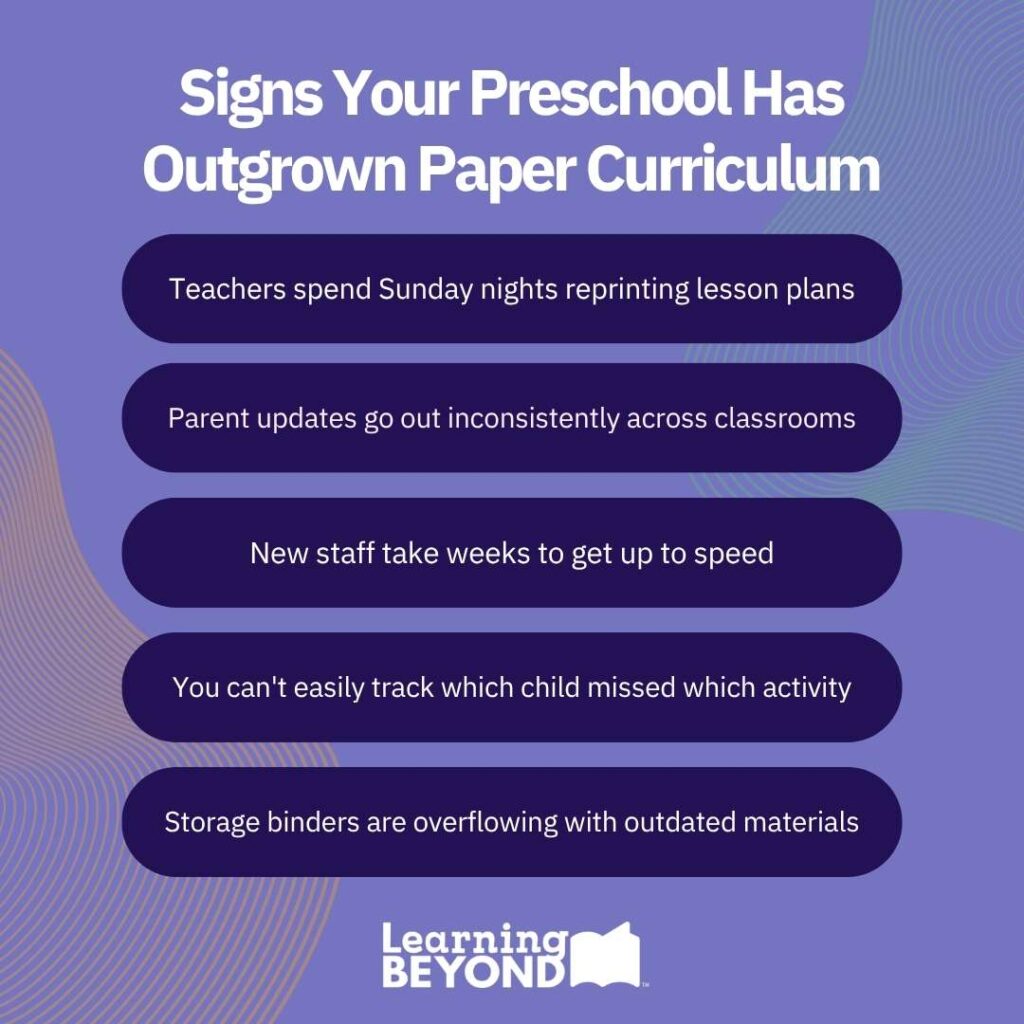
Rather than asking which format is better in theory, start with what your setting actually needs.
| Checklist Question | Points to Cloud Based | Points to Paper Based |
| Do you need multi-site or remote access? | Yes | No |
| Is parent communication a current challenge? | Yes | Manageable manually |
| Are devices and the internet reliably available? | Yes | Not required |
| How much prep time does your team have weekly? | Less with cloud | More manual prep required |
| Are you in a low-connectivity area? | Barrier | Not a factor |
These questions help identify where friction actually sits before choosing a format:
The answers to the first two questions usually point toward a clear direction.
Neither format is universally better. Cloud based curriculum works better for centers needing planning efficiency, documentation, and regular family communication.
Paper based curriculum works better for settings with limited tech access, strong hands-on culture, or teams who prefer physical guides. Adult interaction and how materials are used matters more than the format itself.
For programs ready to move toward a digital format, transitioning from paper curriculum to digital in childcare walks through the practical steps for making the shift without disrupting what is already working.
Yes, especially when the platform is designed primarily for teacher use. Children in most cloud based programs still spend their day with physical materials, guided play, and hands-on activities.
For most programs, cloud based platforms are used by teachers for planning, observation, and family updates. What children do in the classroom remains hands-on and physical, depending on how the teacher structures the day.
Not automatically. Curriculum quality, adult interaction, and implementation matter far more than format. Paper based materials support tactile, hands-on learning well, but digital platforms can deliver equally strong child outcomes when used correctly.
Cloud based systems reduce printing, ink, and storage costs. Paper based systems require less upfront technology.
Over time, most centers find that the labor saved by digital planning tools offsets the subscription cost, particularly in centers with high planning and documentation demands.
Yes, many programs run a cloud based platform for planning and family communication while keeping children’s learning entirely physical. A hybrid approach is one of the most practical solutions for programs with mixed preferences or limited tech access.
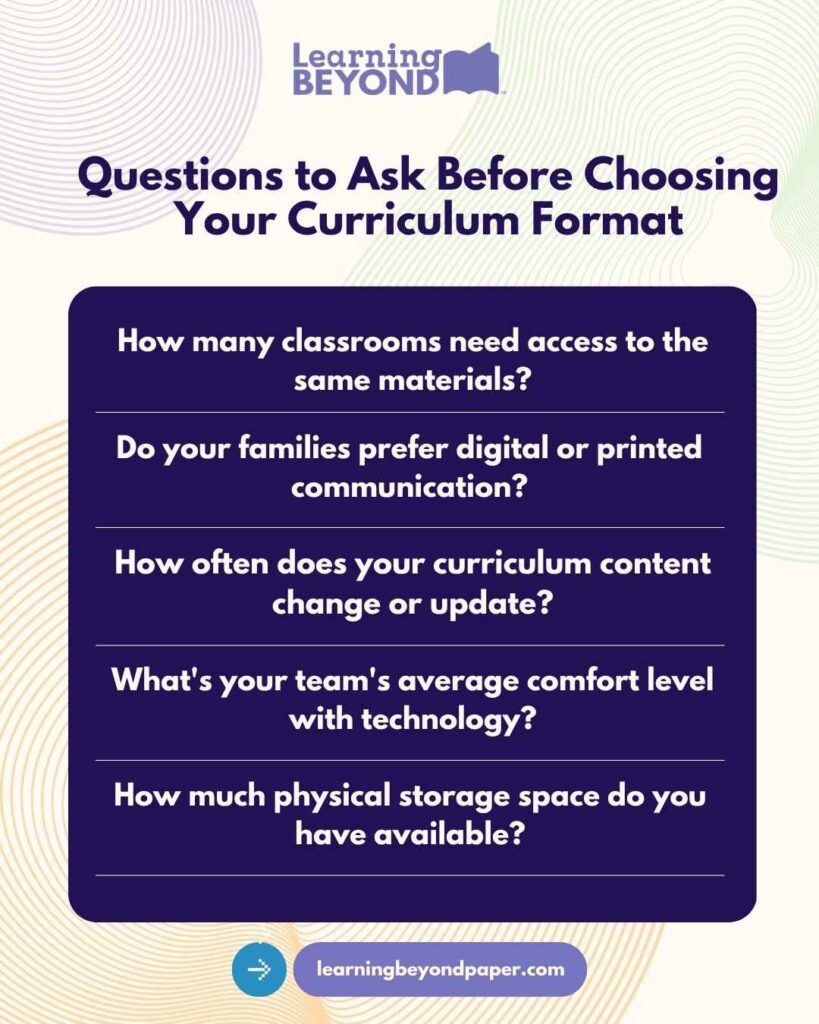
The cloud based preschool curriculum vs paper based decision comes down to your setting, your team, and your families.
Both formats can support strong early learning when implemented with purpose, adult interaction, and a clear understanding of what young children need.
Start with the format your team can sustain reliably, and adjust as your program grows.
At Learning Beyond Paper, the curriculum is built for educators who want the efficiency of a fully digital platform without losing the hands-on learning that preschoolers need.
With 52 weeks of ready-to-use lesson plans and over 4,000 developmentally appropriate activities, it is designed to reduce planning time and keep the focus where it belongs: the children in front of you.
Whether you are a preschool director evaluating your options or a teacher looking for a more manageable daily system, explore Learning Beyond Paper and find an approach that fits your classroom and your learners.