
Are you trying to choose between a play-based preschool program and a digital platform, but unsure which one holds up when real children are in the room?
The debate around creative curriculum vs digital curriculum for preschool is more than theoretical.
State-funded preschool in the U.S. hit a record 1.8 million children in 2024-25, and educators face real pressure to choose programs that work.
This guide breaks down both approaches in plain terms: what each looks like day-to-day, how they affect teacher workload, and how to choose the right fit.
These two models are often framed as opposites. The real difference lies in how teachers access and use resources, not necessarily what children do each day.
Creative curriculum is a play-based, teacher-guided model built around hands-on materials and child-led exploration.
Digital curriculum refers to platforms that help teachers plan, document, and communicate. Most are built for teacher use, meaning the child’s day can stay fully physical and play-centered.
| Feature | Creative Curriculum | Digital Curriculum |
| Primary focus | Child-led play and exploration | Teacher planning and documentation |
| Format | Physical materials, open-ended activities | Platforms, apps, planning tools |
| Teacher role | Observer and facilitator | Planner and platform user |
| Child role | Active participant in discovery | Guided or structured tasks |
| Main tools | Blocks, books, art, sensory materials | Dashboards, lesson libraries, e-portfolios |
A creative curriculum day centers on free choice time. Children move between building zones, reading corners, dramatic play, and sensory stations, with teachers following their cues.
A 2024-25 study of 40 preschool teachers confirmed a statistically significant positive link between guided play and gains in reasoning, language, and emotional regulation.
For most teachers, it means logging into a platform to access lesson plans, record observations, and send family updates. The child’s day can remain entirely hands-on.
Centers using integrated edtech tools report a 10% reduction in administrative workload, freeing time for direct child interaction.
No, a classroom can run a full digital preschool curriculum while keeping children’s daily experience entirely physical and play-based. The technology sits on the teacher’s side.
Choosing between creative curriculum vs digital curriculum for preschool shapes everything from daily prep time to how assessment gets done. Here is where the two models actually diverge.
| Factor | Creative Curriculum | Digital Curriculum |
| Flexibility | High; adapts to children’s interests | Varies by platform |
| Child screen use | Minimal to none | Optional; depends on implementation |
| Materials | Physical and consumable | Devices, internet, charging setup |
| Teacher workload | Manual planning | Streamlined planning; tech setup upfront |
| Assessment | Narrative, observation-based | Digital tracking and e-portfolios |
| Cost | Lower upfront; ongoing material costs | Subscription or licensing fees |
| Best fit | Play-first, flexible settings | Planning-focused, tech-ready centers |
Creative curriculum adapts to what children bring to class each day. Digital platforms vary: some are highly customizable, others follow fixed sequences.
Knowing your team’s preference here matters before choosing a platform.
A University of Georgia study published in 2025 found that only 10% of early childhood teachers have enough paid time to complete their work.
Over half use personal breaks and lunch for lesson planning and documentation. Another 41% arrive early or stay late just to keep pace.
For centers managing this pressure, how to document learning outcomes in early childhood covers a practical, four-step process that works across both curriculum models without adding to teacher burden.
A hands-on preschool curriculum relies on physical materials: sensory trays, building tools, books, and art supplies. Digital curriculum requires working devices, stable internet, and a charging setup.
In settings where tech access is unreliable, this practical gap can determine the decision before anything else does.
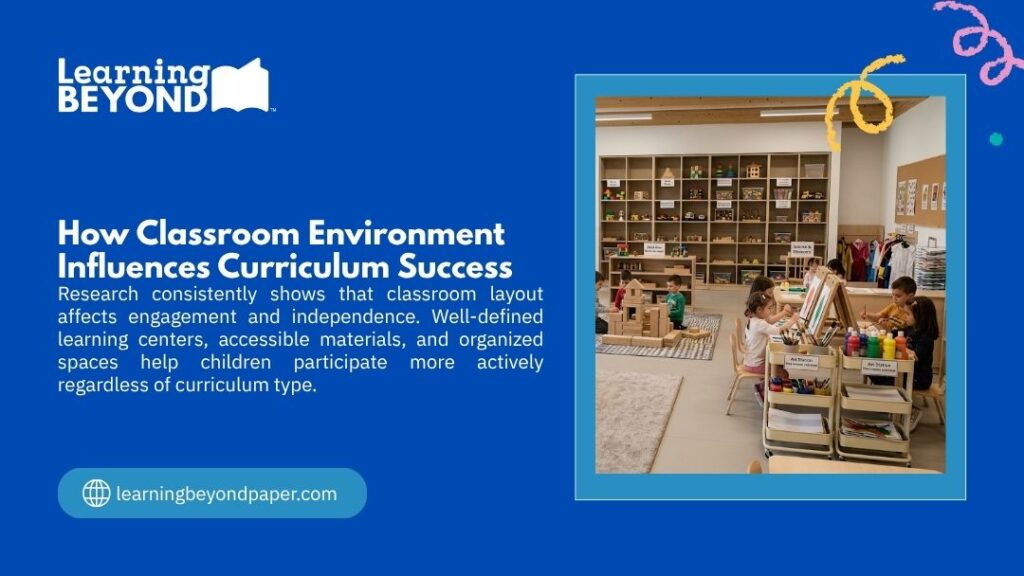
The evidence strongly supports play-based preschool learning.
Research shows 70% of preschool-age learning happens through play, children in play-based kindergartens demonstrate 30% higher reading comprehension scores by age 10, and 91% of teachers value play-based learning for academic success
The right model still depends on the setting.
| Setting | Curriculum Fit |
| Play-first, child-led classroom | Creative curriculum |
| Mixed-age group | Creative curriculum with open-ended activities |
| Limited or unreliable devices | Creative curriculum |
| High documentation and reporting demands | Digital curriculum |
| Teacher new to curriculum design | Digital curriculum provides helpful structure |
| Strong family communication expectations | Digital curriculum |
Creative curriculum is the natural match. It aligns with NAEYC’s guidance on developmentally appropriate practice and supports the kind of child-led discovery that research links most consistently to kindergarten readiness.
Open-ended activities naturally accommodate different developmental levels. A three-year-old and a four-year-old can engage with the same sensory table at entirely different levels of complexity, without the teacher needing to prepare separate materials for each.
If devices are limited, unreliable, or simply not a center priority, creative curriculum is the practical choice. It requires no tech infrastructure and works with materials most centers already have on hand.
These concerns surface whether a center is evaluating a creative framework or a digital platform.
| Concern | What Helps Resolve It |
| Is it worth the cost? | Compare per-child cost against teacher time saved and outcomes |
| Will training take too long? | Choose platforms with short onboarding and built-in support |
| Will it create more admin work? | Test documentation tools specifically before committing |
| Is it appropriate for young children? | Review the ratio of child-facing to teacher-facing features |
Budget is a real constraint in most early childhood settings. The real question is what the curriculum is solving for.
If teachers are consistently working unpaid hours to stay on top of planning and documentation, a well-designed digital preschool curriculum may reduce that burden enough to justify the investment.
A 2025 RAND survey found that only 9% of pre-K teachers use AI tools daily or weekly, showing that most early childhood educators are not yet comfortable with complex digital features.
Platforms that prioritize simplicity over feature volume tend to see faster, more consistent adoption across teams.
It can, when the platform is poorly matched to classroom realities.
A 2025 Australian study found that 73% of early childhood educators said high workloads were directly hindering their center’s ability to maintain quality. The curriculum needs to fit what the team can actually sustain, not what looks most impressive in a demo.
For centers thinking about making the shift, how to transition from paper curriculum to digital in childcare walks through the process in practical, low-disruption steps.
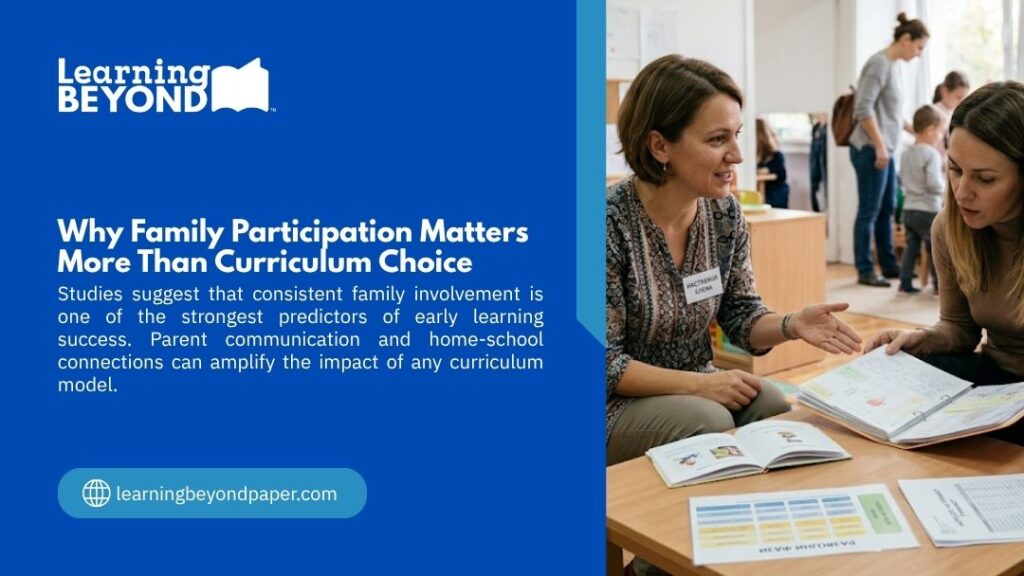
This concern is understandable. It is also often based on how the digital curriculum is perceived rather than how it actually works.
The WHO recommends no more than one hour of screen time per day for children aged 2 to 5. Most digital curriculum platforms are designed with teacher planning in mind.
Child-facing screen time, when it exists at all, typically falls within a teacher-guided, time-limited window.
| Technology Use | Impact |
| Teacher plans lessons using a platform | Positive; reduces prep time and improves consistency |
| Short, teacher-guided interactive activity | Acceptable when intentional and time-limited |
| Child uses a device independently for long periods | Problematic; linked to attention and developmental concerns |
| Digital portfolio for family communication | Positive; strengthens the home-school connection |
NAEYC’s position holds that technology is most appropriate when it supports active engagement, is mediated by an adult, and is developmentally matched. The concern is passive use, not the presence of technology.
A Georgia State University study found that 60% of technology use in early childhood classrooms falls into the instructional category, meaning teachers use tech as a supporting tool rather than a replacement for hands-on learning (GSU, 2025).
| Question | Points to Creative | Points to Digital |
| Is hands-on learning your core value? | Yes | No |
| Do you need planning or documentation tools? | Partly | Yes |
| Are devices available and reliable? | Not needed | Required |
| Does your team have strong curriculum skills? | Ideal | Not required |
| Is onboarding time limited? | Needs more support | Less, with the right platform |
If your classroom runs on child-led discovery and teacher observation, a creative curriculum fits naturally. It gives educators the freedom to follow what children are most curious about without being locked into a platform schedule.
If your center needs structured pacing, assessment tracking, and family communication in one place, a digital platform delivers this more consistently than a manual system.
For centers still comparing formats, cloud-based preschool curriculum vs paper-based covers the practical differences in more detail.
If most answers point toward structure and efficiency, the digital curriculum supports that direction. If most point toward flexibility and child-led discovery, creative curriculum is the stronger starting point.
Neither model is universally better. Creative curriculum consistently delivers strong developmental outcomes, particularly in play-first settings with experienced teachers.
Digital curriculum adds genuine value when planning efficiency, documentation quality, and family engagement are priorities.
The strongest programs often combine both: a creative, play-based classroom experience supported by digital tools on the teacher side.
With 67% of students reporting higher engagement in digitally supported learning environments, intentional technology integration has real potential. Technology should serve the child’s experience, not replace it.
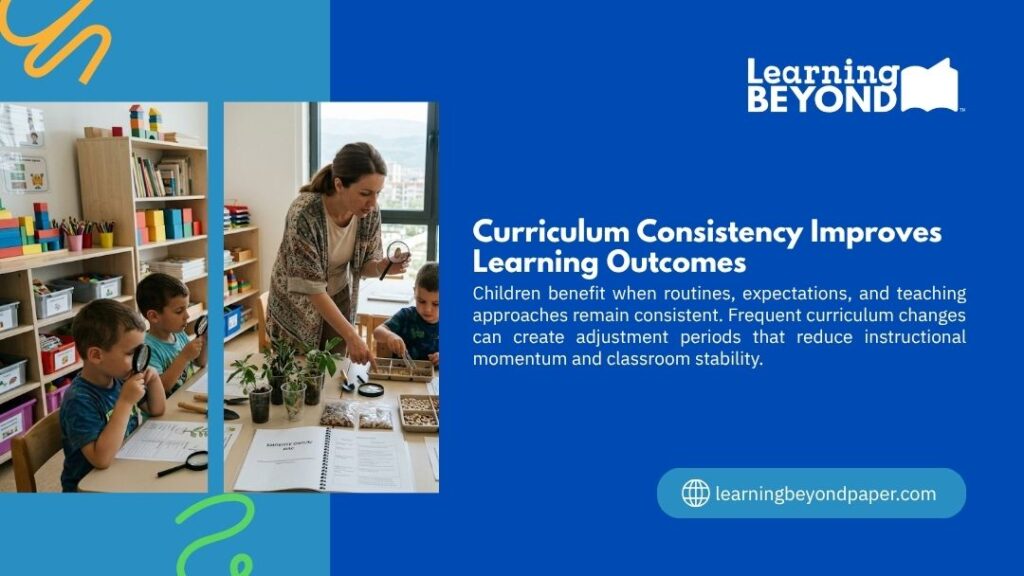
Creative curriculum is a play-based, teacher-guided model centered on hands-on materials and child-led discovery.
Digital curriculum refers to platforms that support teacher planning, documentation, and family communication. The two are not mutually exclusive and can work well together when implemented with clear purpose.
Yes, when used appropriately. Most digital curriculum tools are designed for teacher use, not direct child interaction. When children do engage with digital tools, keeping screen time under one hour per day with adult involvement throughout is the key.
Not necessarily. Many platforms focus entirely on teacher-side planning and documentation. A classroom using digital curriculum can remain fully hands-on from the child’s perspective every day.
Creative curriculum offers more day-to-day adaptability. Teachers can shift themes and pacing based on what children show interest in, without platform constraints. Digital platforms vary widely, with some offering strong customization and others following fixed sequences.
Creative curriculum is the stronger fit for settings with limited devices or unreliable internet. It requires no tech infrastructure and works immediately with physical materials most centers already have.
The right curriculum comes down to knowing your classroom, your team, and your real priorities. Creative curriculum excels where teachers have the experience and freedom to follow children’s curiosity.
Digital curriculum earns its place when it genuinely reduces workload and supports clearer documentation. Start with what your team can sustain consistently, and build from there.