
If you run a toddler room, you know the schedule on the wall and the day that actually happens can look very different.
One child arrives teary, another needs a diaper change mid-circle, and the preschool class has the playground right when your group is ready to burn off energy. A good schedule won’t prevent any of that. It gives children, teachers, and families a rhythm to come back to.
Below you’ll find a full-day sample toddler classroom daily schedule, half-day and extended-day variations, a fill-in template, and the pieces most sample schedules skip: transitions, licensing, and how each block connects to learning goals.
What a Good Toddler Classroom Daily Schedule Actually Does
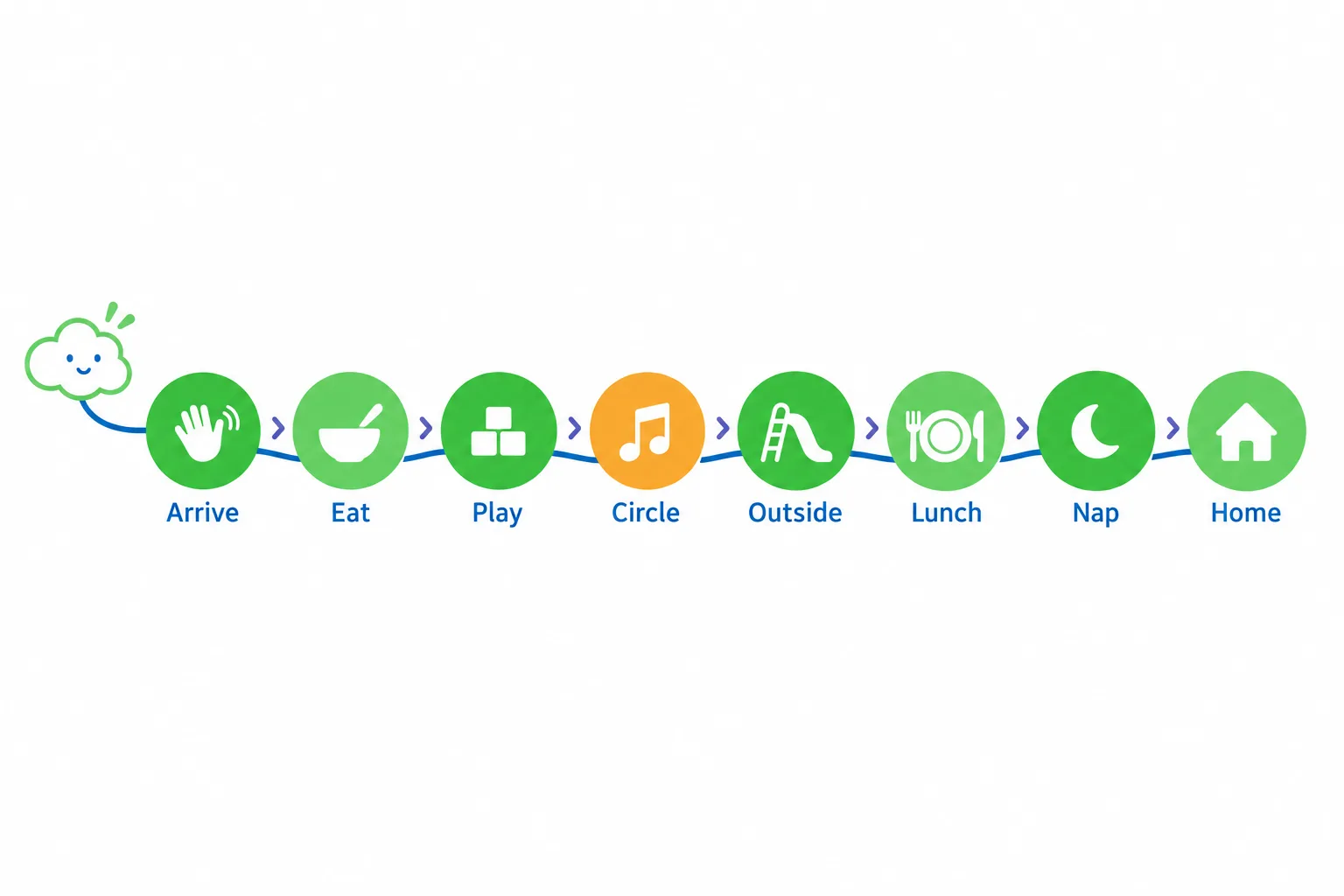
Quick answer: a toddler classroom daily schedule breaks the day into predictable segments for arrival, meals, free play, a short circle time, outdoor play, diapering and toileting, nap, and pickup. The order stays the same every day. The exact minutes flex with the children.
Toddlers can’t read a clock, but they learn fast that snack follows handwashing and a story means rest is coming. Knowing what comes next helps them feel secure and makes transitions smoother. For teachers, a steady sequence makes it easier to manage ratios, cover breaks, and plan.
Treat your schedule as a sequence of routines, not a strict timetable. That fits developmentally appropriate practice: same order every day, with an eye on children’s cues. If the group is deep into water play, a few extra minutes is fine. If everyone is melting down at 11:05, start lunch early.
As a director or owner, you also have to make one schedule work for teachers, families, and your licensing agency at once. Keep all three in mind as you adapt the sample below.
Sample Full-Day Toddler Classroom Schedule (Hour by Hour)
This sample assumes a center open from 7:00 a.m. to 6:00 p.m. Shift the times to match your hours.
| Time | Routine | What teachers do | Why it matters |
|---|---|---|---|
| 7:00–8:00 | Arrival and quiet free play | Greet each child and family by name, share quick notes, offer calm table toys and books | Eases separation and gives families a moment to pass along sleep or mood updates |
| 8:00–8:30 | Handwashing and breakfast | Sit with children, name foods, encourage self-feeding | Builds self-help skills and language |
| 8:30–9:15 | Free play and learning centers | Rotate through blocks, books, pretend play, and fine motor centers; join play and describe what children do | Child-led exploration supports problem-solving and social skills |
| 9:15–9:25 | Circle time | Sing a greeting song, read a short book, add simple movement | A shared group moment without asking toddlers to sit too long |
| 9:25–9:45 | Diapering and toileting, handwashing, morning snack | Move children in small groups, talk through each step | Keeps hygiene routines calm and unhurried |
| 9:45–10:45 | Outdoor or gross motor play | Supervise climbing, running, riding toys; have an indoor backup | Large-muscle movement and fresh air |
| 10:45–11:15 | Small-group or sensory activity | Lead a short art, sensory bin, or music activity with three or four children at a time | Focused interaction and hands-on learning |
| 11:15–11:30 | Diapering, handwashing, lunch setup | Invite older toddlers to help set the table | Builds independence and eases the shift into mealtime |
| 11:30–12:00 | Lunch | Eat family style if your program allows, chat with children | Language, social skills, and self-feeding practice |
| 12:00–12:15 | Wind-down story | Dim lights, read a calm book, play soft music | Signals rest is coming |
| 12:15–2:30 | Nap and rest | Monitor sleeping children, offer quiet books to early wakers | Rest supports health and afternoon regulation |
| 2:30–3:00 | Wake-up, diapering, afternoon snack | Let children wake at their own pace | Gentle transition back to activity |
| 3:00–3:45 | Art, sensory, or center time | Offer open-ended materials like playdough, paint, or puzzles | Fine motor and creative exploration |
| 3:45–4:30 | Second outdoor block | Free play, bubbles, chalk, nature walks | More movement before the end of the day |
| 4:30–4:45 | Closing circle | Sing a goodbye song, talk about one thing from the day | Closure and memory recall |
| 4:45–6:00 | Choice time and pickup | Offer calm activities, share highlights with families | Smooth handoff home |
Two details matter here. First, circle time is about 10 minutes. Toddlers are still building attention and self-control, so a long group session usually ends with children wandering off and teachers redirecting instead of teaching. Short and lively beats long and quiet.
Second, diapering, toileting, and handwashing don’t live in one slot. They happen all day, on each child’s own schedule, and before and after every meal. The table shows the predictable group moments; individual care always comes first.
Keep the order of routines the same every day, and let the minutes flex with the children.
Adjusting the Schedule for Younger vs. Older Toddlers
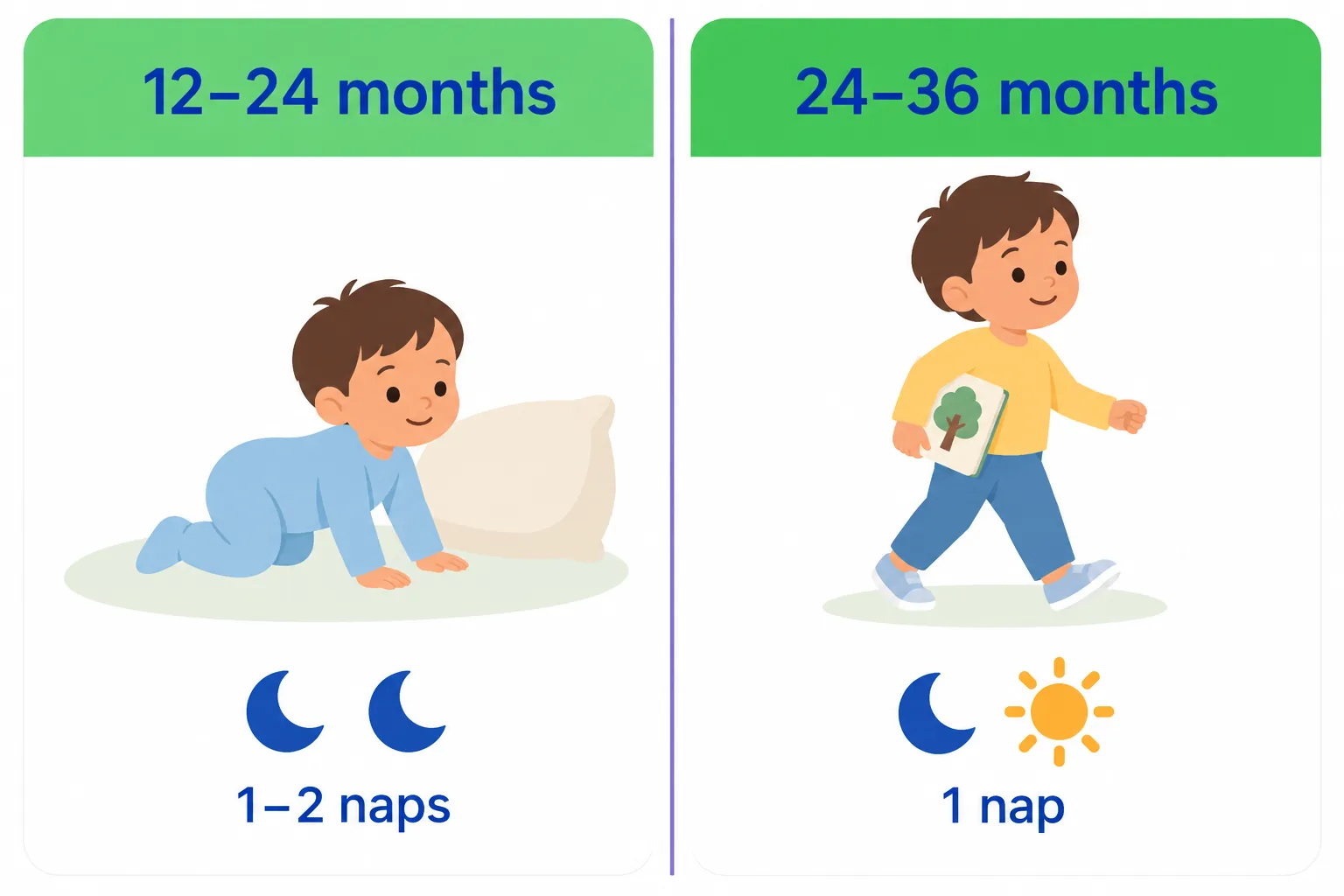
”Toddler” covers a wide developmental range, and your toddler classroom daily schedule should reflect that.
Younger Toddlers (about 12 to 24 months) Need More Individualized Routines.
Some still take a morning nap, many eat on their own timeline, and group moments should be very short.
Sleep needs are high at this age: the American Academy of Sleep Medicine’s pediatric sleep consensus statement recommends 11 to 14 hours per 24 hours, including naps, for children 1 to 2 years old. Plan for one teacher to handle care routines while another supervises play.
For ideas to fill this group’s play blocks, see our structured activities for young toddlers 12 to 18 months, which covers activities for 18-month-olds and younger.
Older Toddlers (about 24 to 36 months) Usually Settle Into a Single Afternoon Nap.
They can handle slightly longer group activities and enjoy helper jobs like passing out napkins or wiping tables. For a schedule built specifically around this age, see our sample daily daycare schedule and activities for 2-year-olds.
Mixed-Age Rooms Work Best With Parallel Tracks.
Let younger children nap or eat while older toddlers do a quiet small-group activity, then bring everyone back together.
Half-Day and Extended-Day Variations
Half-day morning (8:00 a.m. to 12:00 p.m.): keep arrival, free play, circle time, snack, and outdoor play. Protect the outdoor block; it’s often the first thing cut when time is short. End with lunch or a goodbye circle, depending on whether you serve a midday meal.
Extended day (early drop-off and late pickup): keep the edges of the day calm. Early mornings and late afternoons are when children are tired and staffing is lightest, so offer books, puzzles, playdough, and quiet music. Skip messy projects that need extra hands.
Staff shift changes: schedule handoffs during a predictable, low-demand time like nap or free play, never mid-transition. A short written log or quick verbal check-in tells the incoming teacher who napped, who ate, and who needs a change.
Building Your Schedule Around Licensing, Ratios, and Space
Before you finalize your toddler classroom daily schedule, review your state’s licensing rules. Requirements for outdoor time, rest periods, meal timing, and staff-to-child ratios vary by state, so confirm the details with your licensing agency instead of relying on a generic sample.
- Stagger shared spaces. If several classrooms share one playground or multipurpose room, build a center-wide grid so each group gets its time without crowding.
- Plan teacher breaks around nap. Nap is often the easiest time to rotate breaks, as long as your state’s supervision rules during rest are met.
- Coordinate meal service. If one kitchen serves several rooms, stagger meal times so food arrives at the right temperature.
Head Start administrators should also check daily routines against the Head Start Program Performance Standards and their own program policies.
Transitions: The Part of the Schedule Most Templates Skip
Most toddler classroom challenges happen between activities. Children wait, lose focus, and get upset. A few habits help:
- Give warnings. “Two more minutes, then we clean up” helps children prepare.
- Use songs and visual cues. A cleanup song or a picture card showing what’s next makes changes predictable.
- Move in small groups. Instead of lining up twelve toddlers for handwashing, send three at a time while the rest keep playing.
- Make transitions language-rich. Use teacher talk to name, describe, and count: “You’re putting the red block on the shelf. One, two, three blocks!” These moments add up.
Connecting the Schedule to Learning Goals
Every block is a chance to support development. The Head Start Early Learning Outcomes Framework (ELOF) organizes infant and toddler development into five central domains: Approaches to Learning; Social and Emotional Development; Language and Communication; Cognition; and Perceptual, Motor, and Physical Development.
Here’s how ordinary routines map to those domains:
- Meals support language and communication (naming foods, asking for more) and self-help skills.
- Outdoor play supports perceptual, motor, and physical development through climbing, running, and balancing.
- Sensory and center time supports cognition as children explore cause and effect.
- Arrival and free play support social and emotional development as children separate from families and play alongside peers.
- Circle time supports approaches to learning, like attention and curiosity.
If you’ve wondered what a child should learn in the toddler years and in preschool, much of the answer lives in these everyday routines. To place specific activities into each time block, follow our guide on how to create a lesson plan for toddlers in daycare.
Toddler Classroom Daily Schedule Template (Fill-in Version)
Copy this layout into a document, fill it in for your room, and save it as a PDF to post or share.
| Time block | Routine | Planned activity | Teacher responsible | Notes for individual children |
|---|---|---|---|---|
| ___ | Arrival | |||
| ___ | Breakfast | |||
| ___ | Free play and centers | |||
| ___ | Circle time | |||
| ___ | Snack | |||
| ___ | Outdoor play | |||
| ___ | Small group or sensory | |||
| ___ | Lunch | |||
| ___ | Nap and rest | |||
| ___ | Afternoon snack | |||
| ___ | Afternoon activity | |||
| ___ | Closing circle and pickup |
Tips for using it:
- Post a picture schedule at toddler eye level. Photos of your own children doing each routine work better than clip art at this age.
- Share a family version. A simplified copy helps families line up weekend routines and see what their child does all day.
- Use the notes column. Track individual nap needs, allergies, or comfort items so substitutes can step in smoothly.
Common Schedule Mistakes and Quick Fixes
- Too much large-group time. Shorten circle time and move most teaching into small groups and play.
- Rigid clock-watching. Keep the order consistent, but let the minutes flex with children’s cues.
- Skipping outdoor time in bad weather. Keep an indoor gross motor plan ready: an obstacle course, dancing, or a tunnel.
- No plan for non-nappers. Offer a quiet cot with books or soft toys so they rest without disturbing others.
Filling Each Time Block Without Hours of Planning
Your toddler classroom daily schedule is the frame. The harder part, week after week, is filling every block with developmentally appropriate toddler lesson plans and daycare activities that actually hold children’s attention. That’s where many teachers lose their evenings and weekends.
Learning Beyond Paper was built by educators with more than 300 years of combined experience to take that weight off teachers.
Our cloud-based young toddler curriculum provides daily, research-based activities aligned to all 50 state standards, CLASS indicators, and the ELOF’s infant and toddler domains, all in one place. Teachers open the app and find what they need for circle time, small groups, and outdoor play.
When a plan needs adjusting in the moment, ELBY, our virtual instructional coach, helps teachers adapt activities for the children in front of them.
Bilingual English and Spanish content and 49.5 hours of embedded professional development through LBP University are included, and one subscription covers Infant through Pre-K 4. It’s also far more affordable than paper curriculum kits that need replacing every few years.
FAQ
Related readingBack to School Activities for Preschool: Week 1 PlanRead the guide →Frequently asked questions
How long should circle time be for toddlers in a daycare classroom?
How much outdoor time do toddlers need each day at daycare?
How long should toddlers nap at daycare, and how much sleep do they need in total?
What should non-nappers do during rest time in a toddler classroom?
Should a toddler classroom daily schedule be the same every day?
See How It Works in Your Classroom
You’ve built the frame for your day. To see how ready-to-use activities can fill each block without extra hours of planning, watch the demo or start a free trial and try Learning Beyond Paper alongside the schedule you just created.