
Learning Beyond Paper and Teaching Strategies both support early childhood programs, but they solve different problems. Learning Beyond Paper focuses on digital curriculum access, school-wide pricing, teacher support, and infant-through-Pre-K lesson planning. Teaching Strategies offers a larger early childhood platform built around The Creative Curriculum, GOLD assessment, professional learning, reporting, and family engagement.
In this comparison, we will look at curriculum design, play-based learning, pricing, assessment, teacher support, Head Start alignment, technology tools, and best-fit program types so directors and early childhood leaders can make a clearer decision.
Searches for learning beyond paper vs teaching strategies usually come from people who are already past the what is a preschool curriculum? stage. They are comparing real options. They may run a child care center, manage a Head Start program, lead curriculum decisions for a multi-site provider, or support teachers who need lesson plans that work on a normal Tuesday morning, not only in a polished brochure.
Here’s the thing: this is not a simple question of which one is better. comparison. Learning Beyond Paper and Teaching Strategies both support early childhood education, young children, lesson plans, play-based learning curriculum, family engagement, and school readiness. But their product models are different.
Teaching Strategies is a long-established early childhood education company best known for The Creative Curriculum and GOLD. It offers a broad ecosystem that connects curriculum, assessment, professional development, reporting, and family engagement. Learning Beyond Paper is a newer, fully digital early learning curriculum built around cloud-based access, a flat school-wide subscription model for smaller programs, embedded teacher support, and standards-aligned lesson planning for infants through Pre-K.
That difference matters. A large organization that wants curriculum, assessment, reporting, and professional learning in one familiar system may look closely at Teaching Strategies. A center that wants a simpler digital curriculum, clearer budgeting for smaller programs, and less dependence on paper binders may find Learning Beyond Paper easier to adopt.
Both can support play-based learning in early childhood education. The real question is which one fits your program better.
For most early childhood programs, the choice is not really about which brand sounds bigger. It is about where the pressure sits day to day. If your teachers need a simpler digital curriculum, clear school-wide pricing, and lesson support they can use without digging through binders, Learning Beyond Paper is worth a close look. If your program needs a larger system that connects curriculum, assessment, reporting, professional learning, and family engagement, Teaching Strategies may be the better fit.
| If your program needs… | The stronger fit may be… | Why it matters |
| Clearer curriculum budgeting for a smaller program | Learning Beyond Paper | Learning Beyond Paper’s core curriculum is a flat school-wide subscription for smaller programs, which can help directors budget with less guesswork. For larger or enterprise customers, pricing may vary based on scale and specific requirements. This is part of its USP because it gives directors a clearer way to budget for curriculum without paying separately for each teacher or age group. |
| A full curriculum and assessment system | Teaching Strategies | Teaching Strategies connects The Creative Curriculum, GOLD assessment, professional development, reporting, and family engagement tools. |
| A digital-first curriculum model | Learning Beyond Paper | It is built around online access, which can reduce the day-to-day burden of binders, printed materials, and scattered planning files. |
| A deeply established assessment tool | Teaching Strategies | GOLD is one of the brand’s strongest advantages and is widely known in early childhood programs. |
| Teacher support inside daily planning | Learning Beyond Paper | ELBY and embedded professional development bring guidance closer to the lesson, where teachers often need it most. |
| A familiar early childhood brand | Teaching Strategies | The Creative Curriculum has strong recognition across many early childhood programs. |
Learning Beyond Paper is a cloud-based early childhood curriculum for infants, toddlers, preschoolers, and Pre-K classrooms. The company positions itself around a direct problem in child care: teachers need strong lesson plans, but they often have limited planning time, mixed levels of training, and growing documentation demands.
Instead of selling a traditional paper-heavy curriculum kit, Learning Beyond Paper gives programs online access to age-specific lesson plans, daily activities, professional learning, bilingual content, and standards alignment tools. Its subscription includes 52 weeks of lesson plans, more than 4,000 hands-on play-based activities, coverage for every classroom from infant through Pre-K, ELBY coaching, 49.5 hours of embedded professional development, English and Spanish content, and standards alignment tracking.
The strongest part of Learning Beyond Paper’s position is its simplicity. A director does not have to think in terms of separate binders, separate classroom kits, separate age-group purchases, and separate teacher support tools. The curriculum is built to be reached from an internet-connected device, which can help programs shift from a paper curriculum to a digital one without rebuilding their whole process from scratch.
For a center that wants to reduce prep time, a cloud-based early learning curriculum may feel practical. A toddler teacher can look at the day’s activity, review the purpose behind it, adapt it for the group, and connect it back to early learning goals. A director can look for consistency across classrooms. A new teacher can get support inside the platform rather than wait for a training day weeks away.
That is where Learning Beyond Paper works well. It speaks less like a textbook publisher and more like a support system for real classrooms. The message is not “buy our curriculum because it is impressive.” It is closer to: teachers deserve tools they can actually use.
Programs researching the platform may want to begin with the company’s cloud-based early learning curriculum, then look at its infant curriculum, young toddler curriculum, older toddler curriculum, preschool curriculum, and Pre-K curriculum to see how the age bands connect across the early years.
| Pros | Cons |
| Learning Beyond Paper offers transparent school-wide pricing, which can make budgeting easier for small and mid-sized programs. | It is a newer brand compared with Teaching Strategies, so some administrators may want more third-party validation before adoption. |
| The curriculum is fully digital, which can reduce paper use, storage issues, and manual updates. | Programs with limited classroom device access may need to plan carefully before switching to a cloud-first workflow. |
| It covers infants through Pre-K, helping centers create consistency across age groups. | Programs that want a deeply established assessment system may still prefer Teaching Strategies GOLD or another dedicated assessment tool. |
| ELBY and embedded professional development bring teacher support closer to daily lesson planning. | Teams that are already fully trained in The Creative Curriculum may need time to adjust to a different curriculum structure. |
| English and Spanish content can support bilingual classrooms, staff, and families. | Larger agencies may still require broader reporting, family engagement, and assessment tools outside the curriculum itself. |
Learning Beyond Paper’s pros are strongest when the buyer cares about access, simplicity, teacher support, and cost clarity. Its limitations mostly matter when a program needs a larger assessment and reporting ecosystem.
Teaching Strategies is a major name in early childhood education. For many directors and educators, the brand is closely tied to The Creative Curriculum, one of the better-known early childhood curriculum options in the United States. Teaching Strategies also offers GOLD, an observation-based formative assessment system, along with family engagement tools, professional development, reporting features, and implementation support.
That broader ecosystem is one of the company’s biggest strengths. Teaching Strategies is not only selling lesson plans. It offers a connected structure for curriculum, assessment, planning, reporting, and professional learning. For programs that need a mature system with many moving parts, that can be valuable.
The Creative Curriculum for Preschool is described by Teaching Strategies as research-based and play-based, with project-based studies and whole-child learning. GOLD, meanwhile, is used to document child development and learning through observation, evidence, and progress monitoring. Teaching Strategies says GOLD aligns with early learning guidelines in each state and the Head Start Early Learning Outcomes Framework.
So, when people compare learning beyond paper vs teaching strategies, they are often comparing a focused digital curriculum platform with a broader early childhood ecosystem. That is an important distinction. A program may not need the full Teaching Strategies ecosystem. Another program may depend on it.
Teaching Strategies may appeal to administrators who want a familiar name, deep assessment infrastructure, and an established curriculum model. It may also fit programs that prefer a mix of print and digital resources, or that already use GOLD and want curriculum decisions to stay close to that assessment process.
| Pros | Cons |
| Teaching Strategies has strong brand recognition in early childhood education. | Pricing can be less transparent because it depends on product selection, materials, training, and implementation needs. |
| The Creative Curriculum is widely known and used by many early childhood programs. | Smaller centers may find the ecosystem larger or more complex than they need. |
| GOLD gives Teaching Strategies a strong assessment advantage. | Programs that mainly need daily curriculum support may not need the full system. |
| The company offers curriculum, assessment, professional development, reporting, and family engagement tools. | Implementation may require more planning, onboarding, and staff training. |
| Print, digital, and ecosystem-based options may suit programs with mixed technology readiness. | Programs trying to move fully away from paper may find Learning Beyond Paper more directly aligned with that goal. |
Teaching Strategies’ pros are strongest when the buyer wants depth, continuity, assessment, and ecosystem-wide support. Its limitations become more visible when the buyer wants fast adoption, a simple digital workflow, or clear upfront curriculum pricing.
Before choosing between Learning Beyond Paper and Teaching Strategies, it helps to separate three things: curriculum delivery, assessment depth, and day-to-day teacher support. Both companies serve early childhood programs, but they are built around different strengths.
| Category | Learning Beyond Paper | Teaching Strategies | What This Means for Programs |
| Core product identity | Fully digital early childhood curriculum platform | Broader early childhood ecosystem with curriculum, assessment, professional development, reporting, and family engagement | Learning Beyond Paper is more focused on curriculum access and usability. Teaching Strategies is broader and may support more system-level needs. |
| Best-known curriculum | Learning Beyond Paper curriculum | The Creative Curriculum | Learning Beyond Paper is the direct curriculum product. Teaching Strategies is often compared to The Creative Curriculum. |
| Assessment connection | Supports standards alignment, documentation, and curriculum-to-outcome tracking | GOLD is a major observation-based formative assessment system | Teaching Strategies has a stronger assessment identity. Learning Beyond Paper is stronger as a curriculum delivery and planning platform. |
| Age coverage | Infant through Pre-K | Multiple early childhood solutions, including infant, toddler, twos, preschool, and Pre-K products | Both can support early childhood age groups, but buyers should compare the exact age package and classroom needs. |
| Format | Cloud-based access with no traditional binder-heavy setup | Print and digital resources, depending on the selected product and package | Learning Beyond Paper fits cloud-first programs. Teaching Strategies may suit programs that want print, digital, or hybrid implementation. |
| Pricing visibility | Flat school-wide subscription for smaller programs; larger or enterprise pricing may vary based on scale and requirements | Pricing usually depends on product mix, materials, assessment tools, training, and implementation needs | Learning Beyond Paper may be easier for smaller programs to budget because the core curriculum is positioned as a school-wide subscription. Larger organizations should confirm pricing based on scale, sites, and implementation needs. Teaching Strategies may require a custom quote. |
| Teacher support | ELBY virtual coach, embedded professional development, bilingual content, and lesson-level guidance | Professional development, coaching, product training, teacher resources, and ecosystem support | Learning Beyond Paper brings help closer to the daily lesson. Teaching Strategies offers broader training and implementation support. |
| Play-based approach | Daily hands-on play-based activities tied to lesson plans and early learning standards | Project-based studies and whole-child learning through The Creative Curriculum | Both support play-based learning, but Learning Beyond Paper is more daily-plan focused, while Teaching Strategies is more study-framework focused. |
| Best fit | Programs that want transparent pricing, simple digital access, and practical curriculum support across classrooms | Programs that want an established curriculum, assessment, reporting, and professional learning ecosystem | The right choice depends on whether the program needs a focused curriculum platform or a broader instructional system. |
A fair comparison should avoid calling Teaching Strategies “old-fashioned” just because Learning Beyond Paper is digital-first. Teaching Strategies has digital tools, too. The sharper distinction is this: Learning Beyond Paper emphasizes a focused digital curriculum subscription, while Teaching Strategies emphasizes a broader connected platform.
A useful comparison has to look at play, not just software. In early childhood education, play is not a break from learning. It is one of the main ways young children build language, self-regulation, social skills, problem-solving, and early academic understanding.
NAEYC puts it plainly: Playful learning pedagogies support development across domains and content areas and increase learning relative to more didactic methods. That matters because both Learning Beyond Paper and Teaching Strategies use play-based language, but they structure it differently.
Learning Beyond Paper emphasizes ready-to-use daily activities. Its curriculum includes thousands of hands-on experiences across age groups, designed to help children learn through play while teachers connect those experiences to early learning standards. This can be useful for programs where teachers need clear lesson plans, not vague activity ideas.
Teaching Strategies, through The Creative Curriculum, often centers learning around project-based studies, classroom investigations, and intentional teaching experiences. Its approach tends to feel broader and more established, especially for programs already trained in the Creative Curriculum model.
So, what is play-based learning in this comparison? It is not free play with no teacher role. A useful play-based curriculum gives children room to explore while teachers guide language, observation, problem-solving, movement, and social interaction. Children learn best through play when the adult knows when to step in, when to step back, and how to connect play to a learning goal.
That is why both options may work for play-based learning in kindergarten, preschool, toddler rooms, and Pre-K settings. The difference is in the workflow. Learning Beyond Paper may suit teachers who want a clear digital plan for each day. Teaching Strategies may suit teams that want a wider curriculum framework with studies, print resources, and assessment tools linked to instruction.
For readers still comparing the basics, Learning Beyond Paper’s take on what a preschool curriculum should include can support that decision, while its STEM activities for preschoolers offer a closer look at how early learning goals can show up through hands-on classroom work.
Assessment is where Teaching Strategies has a clear brand advantage. GOLD is one of the company’s central products, and many early childhood programs know Teaching Strategies through GOLD even before they compare curriculum options.
GOLD is built around observation-based formative assessment. Teachers gather evidence from daily classroom moments, then use that evidence to understand each child’s development and learning. Teaching Strategies describes GOLD as a whole-child assessment model for children from birth through third grade, with progressions that help teachers select and adapt activities to support development and learning.
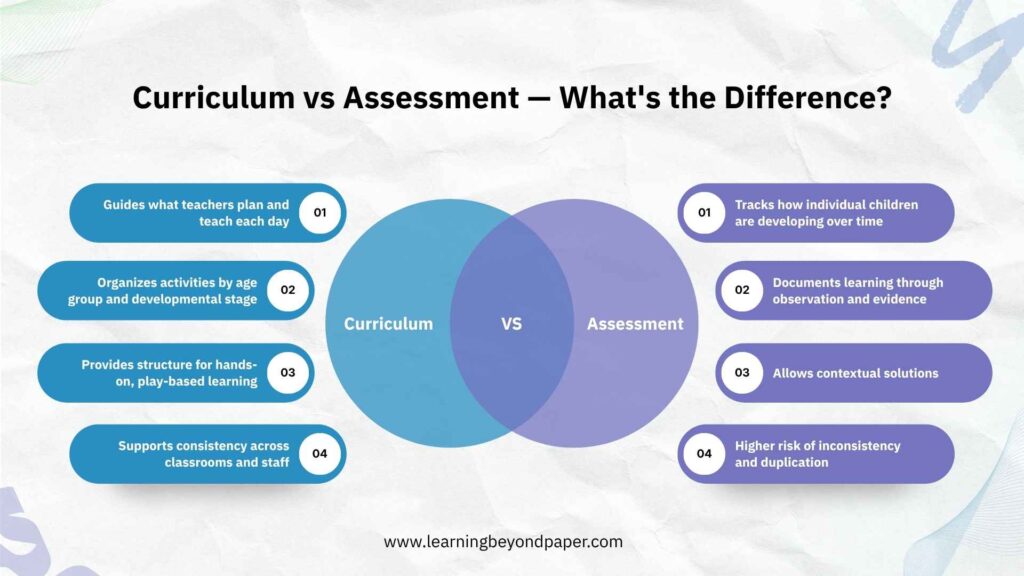
That is not the same as a curriculum. This distinction is worth making because some buyers blur the line between The Creative Curriculum and GOLD. The Creative Curriculum guides what teachers teach and how classroom experiences are planned. GOLD helps educators observe, document, and assess children’s progress over time.
Learning Beyond Paper takes a different position. It focuses on curriculum delivery, standards alignment, lesson planning, and documentation support. Its platform connects to state standards, Head Start ELOF, CLASS indicators, and other early learning frameworks. For programs that already use an assessment tool, this may be enough. For programs that want assessment to sit at the center of their system, Teaching Strategies may feel more complete.
The practical question is not which one has assessment language? Both do. The better question is this: Does your program need a full assessment system as part of the same vendor ecosystem, or does it mainly need curriculum planning and documentation support that works alongside existing assessment practices?
A program already committed to GOLD may still consider Learning Beyond Paper if it wants a cloud-based curriculum that supports classroom planning while maintaining its current assessment process. A program that wants curriculum and assessment from the same long-standing provider may lean toward Teaching Strategies.
Teaching Strategies has the stronger assessment identity; Learning Beyond Paper has the stronger simplicity and curriculum-access story. That does not weaken Learning Beyond Paper. It helps the buyer understand when each product makes sense.
Curriculum decisions often fail for one quiet reason: teachers do not get enough support after the purchase. A beautiful curriculum can sit unused if staff members feel lost, rushed, or unsure how to adapt it.
Learning Beyond Paper tries to solve that problem within the curriculum itself. Its platform includes embedded professional development and ELBY, a virtual instructional coach. ELBY is positioned as a real-time support tool that can help teachers plan, adjust activities, support different learners, and make stronger instructional decisions.
That support model is part of Learning Beyond Paper’s Unique Selling Proposition. The teacher does not have to leave the curriculum, search through a binder, or wait for a supervisor to answer a basic planning question. Support sits closer to the lesson.
Teaching Strategies also invests heavily in teacher support. Its professional development ecosystem includes product training, coaching, and a large library of flexible courses and classes. For a large district, Head Start agency, or multi-site organization, that depth may matter. A bigger ecosystem can support role-based training for teachers, coaches, administrators, and family engagement teams.
The difference is where the support lives. Learning Beyond Paper’s support feels more lesson-connected and immediate. Teaching Strategies’ support feels broader, more formal, and more system-wide.
Neither model is wrong. A small child care center may value fast, embedded help. A large program may need layered professional learning across multiple roles.
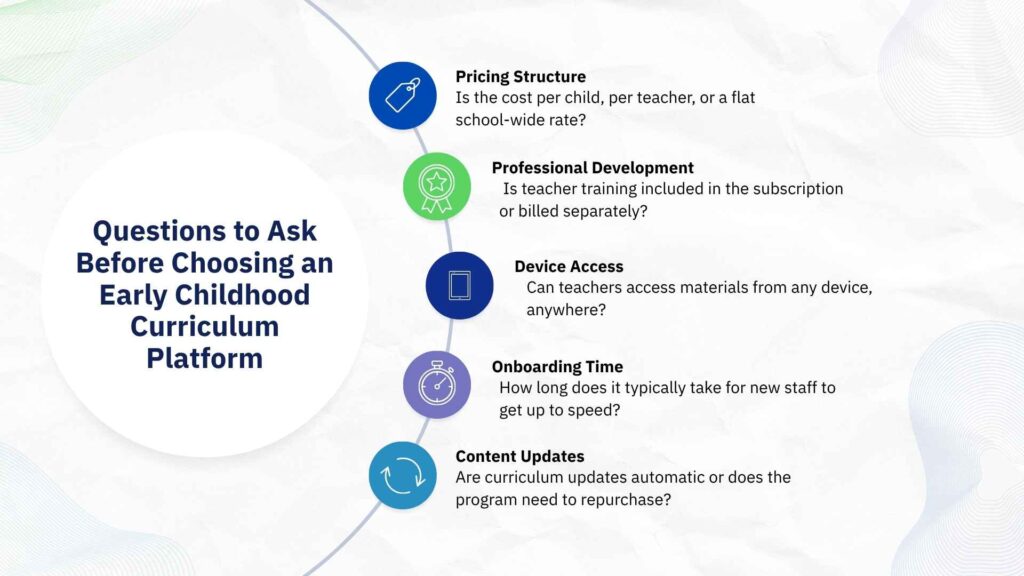
Technology in early childhood education should be judged carefully. Toddlers and preschoolers need relationships, routines, play, movement, and responsive adults. The best digital tools do not replace that work. They reduce the administrative pressure around it.
Learning Beyond Paper and Teaching Strategies both use technology to support teachers and administrators, but they use it differently. ELBY is positioned as a virtual instructional coach inside Learning Beyond Paper. SmartTeach is positioned as a connected Teaching Strategies platform that brings curriculum, assessment, family engagement, professional learning, reporting, and support into one place.
| AI / Technology Factor | Learning Beyond Paper: ELBY | Teaching Strategies: SmartTeach | What This Means for Programs |
| Main purpose | Virtual instructional coaching | Connected platform for curriculum, assessment, family engagement, professional learning, reporting, and support | ELBY is more teacher-support focused. SmartTeach is more platform and workflow-focused. |
| Primary user need | “How do I adjust or use this lesson?” | “How do curriculum, assessment, documentation, and family communication connect?” | ELBY may help with immediate instructional questions. SmartTeach may help organize broader program work. |
| Teacher support style | Lesson-level guidance and classroom support | Tools for teaching, documentation, classroom management, and family engagement | ELBY feels closer to coaching. SmartTeach feels closer to a connected work platform. |
| Assessment connection | Supports instructional decisions and curriculum use | Connects with Teaching Strategies tools such as GOLD | Teaching Strategies has a stronger assessment and data ecosystem. |
| Best fit | Programs with newer teachers, mixed experience levels, or a need for quick instructional support | Programs that need connected curriculum, assessment, reporting, and family engagement workflows | The better fit depends on whether the urgent issue is teacher confidence or system-wide coordination. |
The fair takeaway is this: Learning Beyond Paper uses ELBY to support teachers closer to the moment of instruction. Teaching Strategies uses SmartTeach to connect classroom work, assessment, and program workflows across a larger platform. Neither tool replaces human judgment, coaching, or relationships.
Let’s talk numbers, because this is where the comparison gets honest. Learning Beyond Paper’s core curriculum is a flat school-wide subscription for smaller programs, offering a clearer way for directors to budget across classrooms and age groups. For larger or enterprise customers, pricing may vary based on scale, number of sites, and specific requirements.
That distinction matters. A smaller child care center may value a school-wide subscription because it can reduce the guesswork that often comes with separate age-level purchases, classroom licenses, or curriculum kits. Larger providers, districts, agencies, and enterprise customers should confirm pricing directly because their needs may involve multiple locations, implementation support, training, integrations, or broader service requirements.
Teaching Strategies typically uses a more customized pricing approach. Its total cost can depend on selected products, curriculum materials, GOLD assessment, professional development, reporting, implementation support, and program size. For directors, the important question is not just “Which option is cheaper?” The better question is: Which pricing model gives our program the clearest path to budgeting based on our size and needs?
The pricing models reflect different buying situations. Learning Beyond Paper may appeal to smaller programs that want a simpler way to plan curriculum costs. Teaching Strategies may appeal to programs that need a broader ecosystem with curriculum, assessment, reporting, professional learning, and family engagement connected in one platform.
When evaluating Learning Beyond Paper vs Teaching Strategies from a budget perspective, directors should calculate more than the subscription or quote. Paper-based curriculum can involve storage, replacement cycles, printing, and staff time. Broader platforms can involve training, data management, implementation planning, and ongoing vendor support. The true cost extends beyond the initial pricing conversation.
For many small centers, budget clarity can become a deciding factor. A flat school-wide subscription model for the core curriculum may make annual planning easier. For larger or enterprise programs, however, Learning Beyond Paper pricing should be reviewed based on scale and specific requirements rather than assuming one standard rate applies to every organization.
In the Learning Beyond Paper vs Teaching Strategies cost analysis, one truth stands out. Teaching Strategies appears to use a more customized pricing model, which is common for larger education platforms with multiple products, services, and implementation variables.
A family child care provider, a private preschool, a public Pre-K program, and a Head Start agency may all search for the same keyword, but they do not all need the same solution.
| Program Type | Better Fit May Be | Why This Fit Makes Sense |
| Small child care center | Learning Beyond Paper | Smaller centers often need a curriculum that is easy to access, simple for teachers to use, and clearer to budget. Learning Beyond Paper’s flat school-wide subscription model for smaller programs and cloud-based structure can reduce planning friction. |
| Independent preschool | Learning Beyond Paper | A private preschool may want consistent lesson plans across classrooms without buying separate paper-heavy materials. The digital format, bilingual content, and embedded support can help teachers stay aligned. |
| Multi-site early learning provider | Either option | Learning Beyond Paper can help standardize curriculum access across locations. Teaching Strategies may be stronger if the organization also needs assessment, reporting, and professional development across several sites. |
| Head Start or Early Head Start program | Either option | Both address Head Start alignment. Learning Beyond Paper may fit programs focused on digital curriculum delivery and documentation support. Teaching Strategies may fit programs that want the GOLD assessment connected to the curriculum and reporting. |
| Program already using GOLD | Teaching Strategies, or Learning Beyond Paper, alongside GOLD | Teaching Strategies keeps curriculum and assessment inside one ecosystem. Learning Beyond Paper may still work if the program wants to keep GOLD for assessment while using a separate cloud-based curriculum for planning. |
| Program replacing paper binders | Learning Beyond Paper | Learning Beyond Paper is more directly positioned for centers moving from paper curriculum to digital planning. This makes it useful for programs trying to reduce printing, storage, and manual updates. |
| Low-tech classroom environment | Teaching Strategies | Programs that still rely on printed materials or have limited classroom device access may prefer a print/digital or hybrid model. |
| Cloud-first provider | Learning Beyond Paper | A center already comfortable with digital tools may benefit from online access, embedded support, and easier curriculum updates. |
| New teacher-heavy program | Learning Beyond Paper | Newer teachers may benefit from lesson-level guidance, built-in professional development, and direct daily support through ELBY. |
| Large district or agency | Teaching Strategies | Larger systems may need a deeper ecosystem for assessment, reporting, implementation support, and role-specific professional learning. |
| Bilingual early learning setting | Learning Beyond Paper | English and Spanish content can help programs support multilingual staff, children, and families more consistently. |
| The program focused mainly on assessment and child progress tracking | Teaching Strategies | GOLD gives Teaching Strategies a stronger assessment advantage, especially for programs that rely heavily on observation-based documentation and reporting. |
The more useful takeaway is not that one platform wins. Learning Beyond Paper and Teaching Strategies serve overlapping audiences, but they appeal to different buying priorities. Learning Beyond Paper competes on simplicity, digital access, budget clarity for smaller programs, and teacher support. Teaching Strategies competes on ecosystem depth, assessment strength, and long-standing curriculum authority.
Ease of use is not only a feature. It is a staff retention issue. Early childhood teachers already manage behavior, routines, family communication, transitions, documentation, safety, and child development needs. Carrying that many responsibilities wears anyone down, so our guide on ways to reduce teacher burnout shares how to lighten the load. A curriculum that adds confusion can quickly become a burden.
Learning Beyond Paper may be easier for teachers who want a direct daily path: open the platform, review the lesson, gather materials, teach the activity, document what happened, and move forward. The digital structure can reduce the time teachers spend hunting through old binders or piecing together plans from different sources.
Teaching Strategies may be easier for teachers who already know The Creative Curriculum or work in a program with strong coaching support. Teachers familiar with studies, objectives, intentional teaching cards, and GOLD documentation may prefer staying in an ecosystem they know.
This is where program context matters. A new center with many newer teachers may prefer Learning Beyond Paper’s simple access and built-in guidance. A mature program with experienced curriculum coaches may get more value from Teaching Strategies’ deeper ecosystem.
The best curriculum is the one teachers can use well when the classroom is loud, the schedule shifts, and three children need help at the same time.
No. Learning Beyond Paper is a cloud-based early childhood curriculum platform. Teaching Strategies is a broader early childhood education company known for The Creative Curriculum, GOLD assessment, professional development, reporting, and family engagement tools.
No. GOLD is an observation-based formative assessment system. It helps educators document and understand child development and learning. The Creative Curriculum is the curriculum product more directly tied to lesson planning and classroom experiences.
Both can support play-based learning. Learning Beyond Paper emphasizes daily hands-on, play-based activities tied to lesson plans and standards. Teaching Strategies uses project-based studies and whole-child learning through The Creative Curriculum. The better fit depends on whether teachers need a simpler daily digital plan or a broader curriculum framework.
Either may work for Head Start programs. Learning Beyond Paper may fit programs that want digital curriculum access, bilingual content, teacher support, and alignment documentation. Teaching Strategies may fit programs that want a connected curriculum and GOLD assessment ecosystem.
Learning Beyond Paper may feel easier for newer teachers because lesson support, digital access, and embedded professional development sit close to daily planning. Teaching Strategies may work well for new teachers, too, especially in programs with strong coaching and existing Creative Curriculum training.
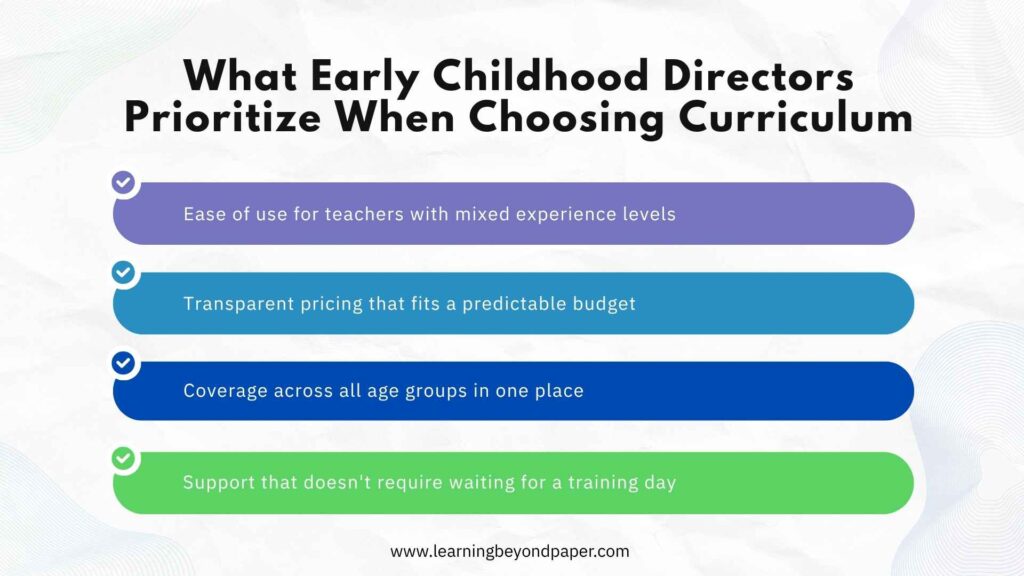
Learning Beyond Paper and Teaching Strategies both support early childhood programs, but they serve different needs. Teaching Strategies offers a broad, established ecosystem built around curriculum, GOLD assessment, reporting, and professional learning. Learning Beyond Paper is a stronger fit for programs that want a simpler, fully digital curriculum with clearer budgeting for smaller programs, embedded teacher support, bilingual content, and practical lesson guidance from infant through Pre-K.
The right choice comes down to your program’s biggest friction point. If you need deep assessment and system-wide reporting, Teaching Strategies may make sense. If your teachers need easier planning, less paper, faster access, and support they can use inside the daily curriculum, Learning Beyond Paper deserves a closer look.
Ready to compare curriculum options for your classrooms? Explore Learning Beyond Paper’s curriculum, review its alignments, and see how ELBY can support your teachers day-to-day.