
It’s 6:45 a.m., a lead teacher just called out, and a room of four-year-olds arrives in under an hour. If you run a center, you know this morning well. The fix isn’t a fancier plan. It’s a plan any caring adult can pick up and run safely within five minutes.
Below are substitute lesson plans for preschool, plus the binder, schedule, and activities that back them up.
Why Preschool Sub Plans Need Their Own Playbook
An elementary sub can follow a page of written directions. A preschool sub is managing toileting, snack, transitions, and a dozen small people who notice right away when their day feels different.
The best sub plan keeps the regular day intact: same order, same songs, same books. Keep directions short, visual, and light on reading.
What a Substitute Preschool Teacher Actually Does
A substitute preschool teacher keeps children safe, maintains supervision ratios, and follows the daily routine: arrival, circle time, centers, meals, outdoor play, rest, and dismissal.
Their job isn’t to introduce new content. It’s to use familiar materials so children feel secure, then leave clear notes for the lead teacher on behavior, toileting, meals, and anything notable.
What to Include in Your Preschool Sub Binder or Sub Tub
| Binder section | What goes in it | Why a sub needs it |
|---|---|---|
| Roster | Names with small photos, plus ratio reminders | Lets a sub learn names and count heads fast |
| Allergy and medical alerts | Alerts per child, plus where action plans and medications are stored | Prevents the highest-risk mistakes |
| Pickup list | Authorized adults and the dismissal routine | A sub never releases a child to an unlisted adult |
| Emergency procedures | Fire, shelter-in-place, and lockdown routes on one map; locations of the emergency bag, attendance sheet, and first aid kit | The sub can act without asking anyone |
| Contact card | Front office, director, and support staff extensions on one card | One grab-and-call card instead of flipping pages |
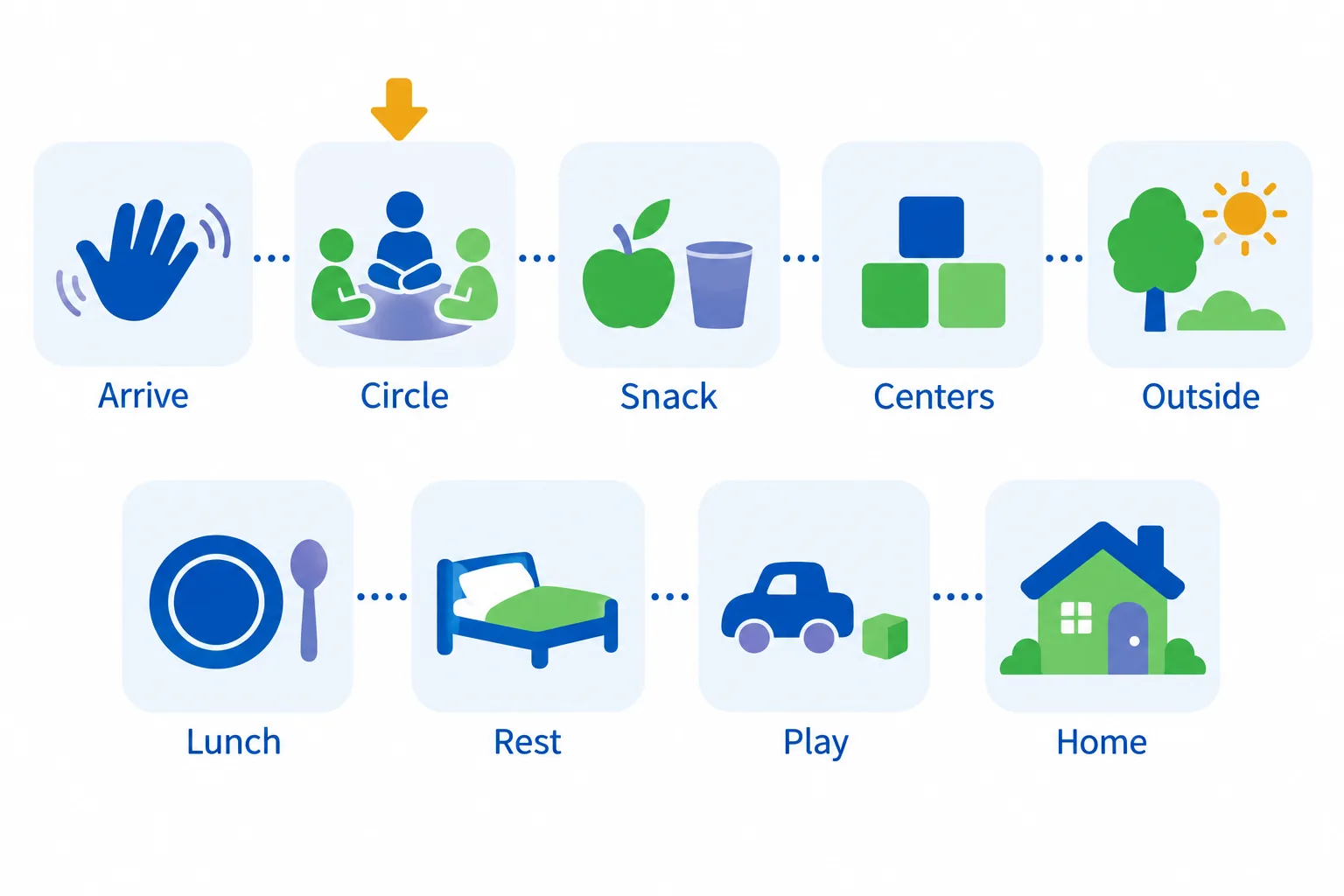
| Visual schedule | Picture cards with times beside each | Keeps the day the same for the children |
| Routine notes | Toileting, snack, rest (cot spots, comfort items, quiet music) | Covers the details children notice first |
| Activity plans | Books, songs, and centers using materials in the room | The sub never has to invent a lesson |
| End-of-day notes form | Behavior, toileting, meals, and anything notable | Gives the lead teacher a clear handoff |
Binder, folder, or labeled tub: keep it in one obvious spot and make sure the front office knows where it is.
Safety First: Roster, Photos, Allergies, and Pickup
- A class roster with small photos beside each name
- Allergy and medical alerts, plus where action plans and medications are stored
- The authorized pickup list and dismissal routine (a sub should never release a child to an adult who isn’t listed)
- Ratio reminders and support staff names with extension numbers
Emergency Procedures at a Glance
Put fire, shelter-in-place, and lockdown routes on a simple map. Note where the emergency bag, attendance sheet, and first aid kit live. Put front office and director extensions on one card a sub can grab without flipping pages.
A Picture-Based Daily Schedule
| Time | Routine | What the sub does | Visual cue |
|---|---|---|---|
| 7:30–8:30 | Arrival | Greets children, signs them in, checks allergy alerts on the roster | Photo roster |
| 8:30–9:00 | Circle time | Reads one or two familiar books, sings two or three songs | Circle-time card |
| 9:00–9:30 | Snack | Checks allergies, supervises handwashing, logs what children ate | Handwashing and snack cards |
| 9:30–10:30 | Centers | Rotates children through activities, asks one talk question per center | Center cards |
| 10:30–11:30 | Outdoor play (or indoor movement if raining) | Keeps ratios, counts children going out and coming in | Outdoor card |
| 11:30–12:15 | Lunch | Follows meal and allergy notes, logs toileting | Lunch card |
| 12:15–2:30 | Rest | Uses the cot map, comfort items, and class quiet music | Rest card |
| 2:30–3:30 | Free play | Offers blocks and dramatic play | Free-play card |
| 3:30–5:00 | Dismissal | Releases children only to adults on the pickup list, then fills in the notes form | Dismissal card |
Use the visual schedule cards your children already recognize, with times written beside each picture.
Eastern Connecticut State University’s early childhood center explains in its guide to using a visual schedule that children can check the pictures on their own to see what comes next, which helps them regulate their behavior and can especially help those who struggle with transitions.
Add two or three transition songs or signals the class already knows.
Ready-to-Run Substitute Lesson Plan Ideas for Preschool
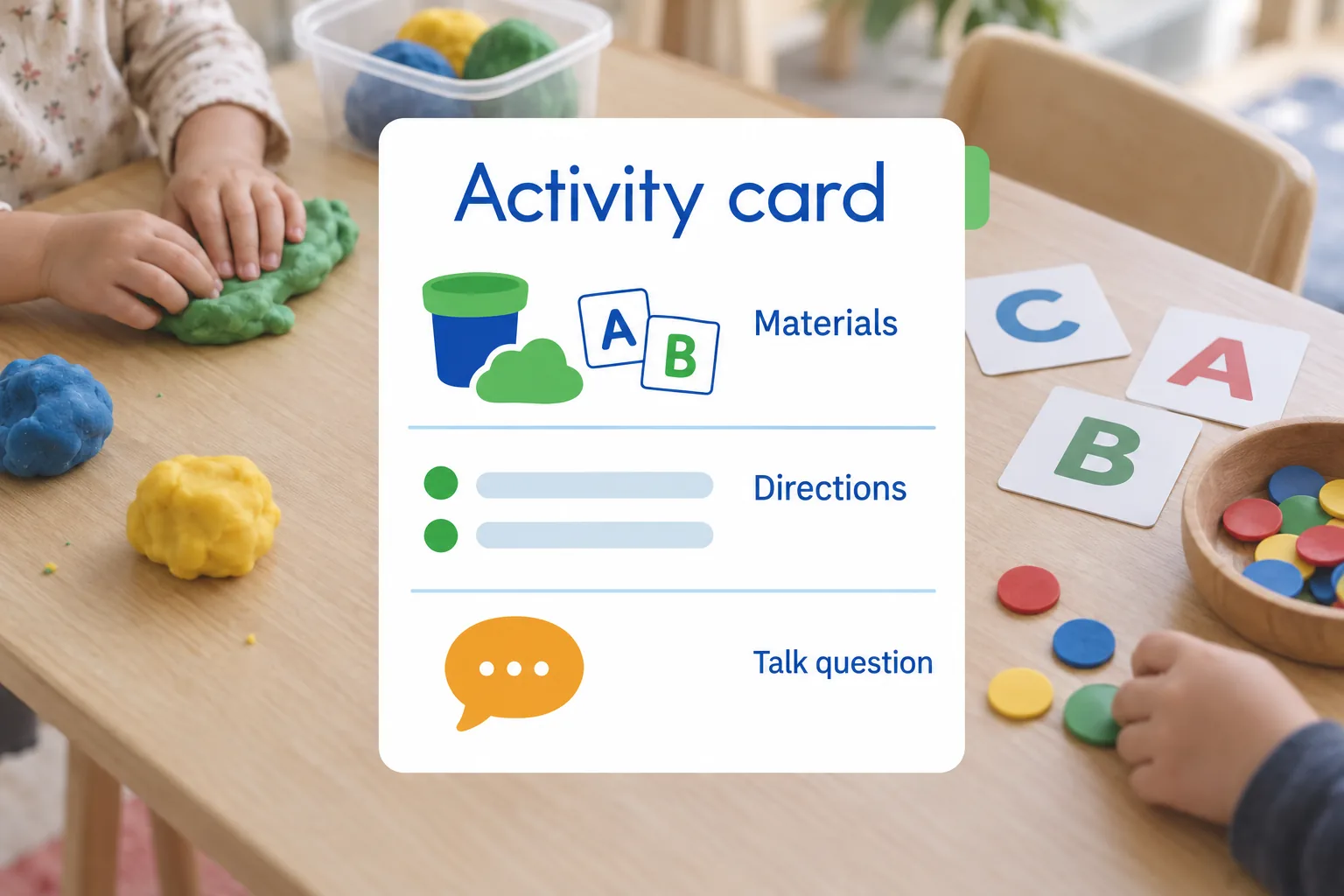
Good substitute lesson plans for preschool use materials already in the room and need almost no reading from the adult. For each activity, list the materials, two sentences of directions, and one teacher talk question to keep conversation language-rich.
Circle Time: Familiar Books and Songs
Read one or two picture books the class already loves, then sing two or three familiar songs. Follow the story with a turn-and-talk: “What was your favorite part? Tell your neighbor.” For more structure, see our guide on how to plan circle time for preschoolers.
Center Rotations a Sub Can Manage
- Literacy and fine motor: name tracing strips, letter matching cards, playdough letters
- Math: counting small manipulatives, sorting shapes, color matching
- Art: paper-bag puppets or cut-and-paste with pre-cut shapes
- STEM: block towers and ramps, with the question “What will happen if we make it taller?” Our STEM activities lesson plan for ages 3-5 has more low-prep options.
Indoor Movement, Free Play, and Rest
On rainy days, movement songs and freeze dance burn energy fast. Block building and dramatic play give children calm, self-directed choices. Add rest notes: where the cots go, who needs a comfort item, and which quiet music the class uses.
Adapting Sub Plans for Toddler and Two-Year-Old Rooms
Your toddler rooms need sub coverage too. For 18-month-olds and 2-year-olds, keep activity windows short and lean on sensory bins, board books, and simple songs. Include the diapering, feeding, and nap logs the sub must fill out. Our guide to creating a lesson plan for toddlers in daycare walks through age-appropriate structure.
Keeping Sub Days Aligned to Standards
Related readingBack to School Activities for Preschool: Week 1 PlanRead the guide →| Activity | Materials | Directions (two sentences) | Teacher talk question | ELOF domain |
|---|---|---|---|---|
| Familiar story circle | Class favorite books | Read the story, then pause on the last page. Have children turn to a neighbor and share. | “What was your favorite part? Tell your neighbor.” | Language and Literacy |
| Name tracing | Name strips, crayons | Give each child their name strip to trace. Help them say each letter aloud as they go. | “What sound does your name start with?” | Language and Literacy; Perceptual, Motor, and Physical Development |
| Sort and count | Small manipulatives, bowls | Have children sort by color or shape. Then count each group together. | “How many do you have? How do you know?” | Cognition |
| Paper-bag puppets | Paper bags, pre-cut shapes, glue sticks | Let children glue shapes onto a bag to make a face. Invite them to introduce their puppet to a friend. | “Who is your puppet? What does it like to do?” | Approaches to Learning; Social and Emotional Development |
| Block towers and ramps | Blocks, ramps, small balls | Build towers or ramps in small groups. Roll a ball down and watch what happens. | “What will happen if we make it taller?” | Cognition |
| Freeze dance | Music player | Play a song and let children dance. Stop the music so everyone freezes. | “Can you freeze like a tree? How does fast feel in your body?” | Perceptual, Motor, and Physical Development |
A sub day doesn’t have to be a lost learning day. The Head Start Early Learning Outcomes Framework organizes learning into five central domains: Approaches to Learning; Social and Emotional Development; Language and Literacy; Cognition; and Perceptual, Motor, and Physical Development. Simple activities map onto them neatly.
Name tracing supports literacy and fine motor skills, counting supports cognition, and taking turns at centers supports social and emotional growth. Because the ELOF spans children from birth to five, the same domain labels work for your toddler rooms. A quick label next to each activity helps your sub keep the day purposeful.
Printable Sub Plans vs. a Digital Plan Anyone Can Open
Printable and PDF sub packets work, but they go stale, disappear into drawers, and need rebuilding every season. With a cloud-based curriculum, your substitute lesson plans for preschool are one tap away: a director or sub can open today’s lesson, materials list, and teacher talk prompts on any device.
Learning Beyond Paper’s all-in-one curriculum includes 4,000+ research-based lessons and activities from Infant through Pre-K 4, English and Spanish content, and ELBY, a virtual instructional coach who can answer a sub’s questions about running an activity in the moment.
Teachers save about three hours of planning a week, and none of it depends on a binder that walked off.
Choosing a Curriculum That Makes Sub Days Easier
Look for daily plans ready in advance, simple directions, alignment to all 50 state standards and CLASS, and no extra hardware.
A curriculum platform works alongside your attendance and billing tools rather than replacing them; our breakdown of childcare software options for lesson planning and teacher support explains how the pieces fit.
If you’re moving away from paper-heavy kits, compare digital-first curriculum options for childcare programs.
Frequently asked questions
What are some good lesson plans for a substitute teacher?
What are some good lesson plan ideas for preschoolers?
What does a substitute preschool teacher do?
What should you include in pre-K and kindergarten sub plans?
See How a Ready-Made Daily Plan Looks
Want to see what your sub could open tomorrow morning? Watch the demo or start a free trial and try it in your own classroom. Everything lives in one place, so there’s less paperwork and more time with the children.